When the Trail Ends Too Soon:
 By Rajat Aikant Sharma
There are moments in the Himalayas that stay with you long after the trek ends. Mine came not at the summit, but on the long walk back.
A few years ago, after reaching the breathtaking meadows of Har Ki Dun, I wanted to do what generations of trekkers have dreamt of doing—pitch a tent, sit quietly beneath the stars, watch the Milky Way emerge above the snow peaks, and wake up to the first golden light touching the mountains. Instead, because of the overnight camping restriction imposed after the Uttarakhand High Court’s 2018 judgment, our group had to begin the exhausting return to Osla village the very same day.
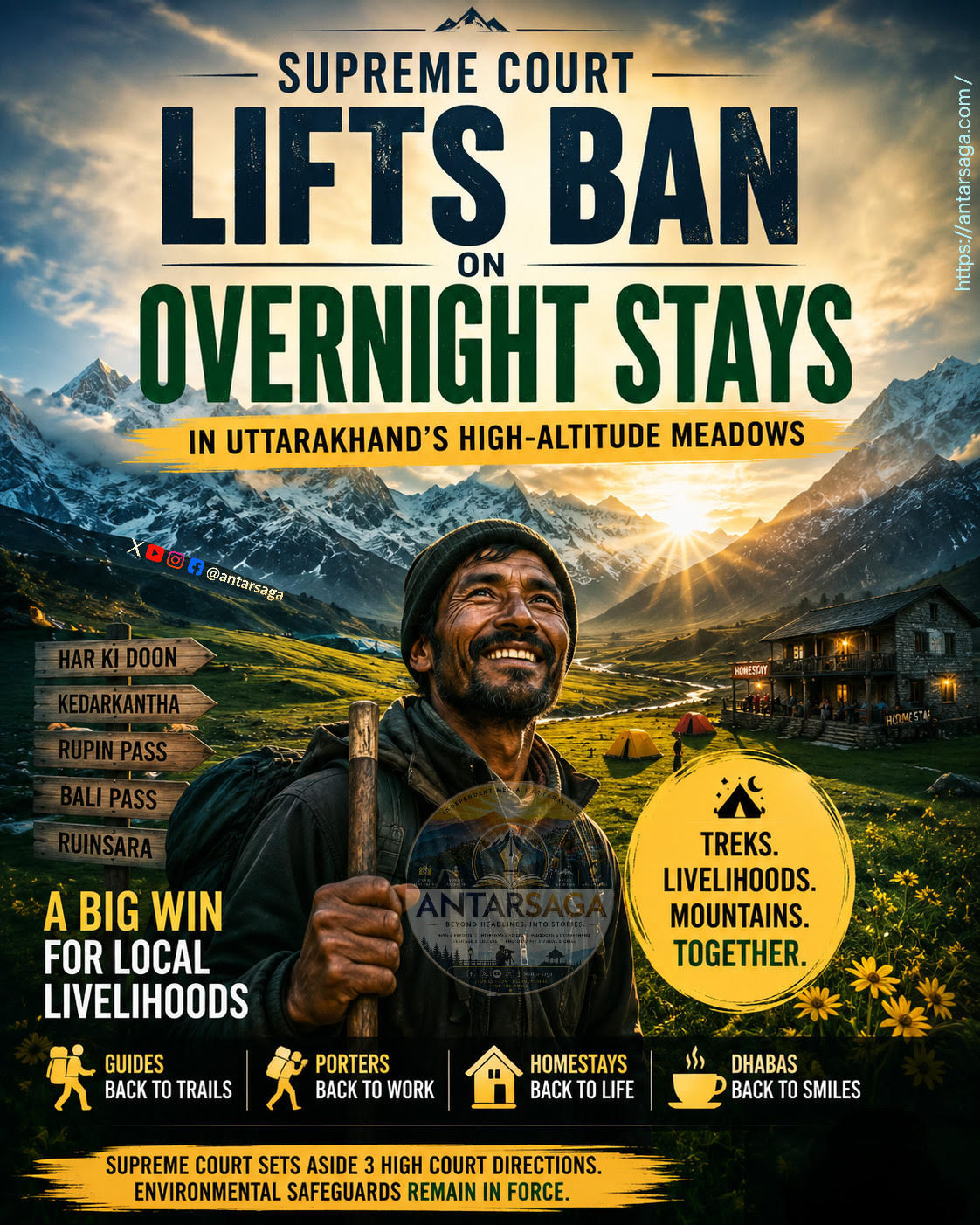
By the time we reached Osla after trekking nearly eight to nine kilometres back, we were physically drained. What could have been an unforgettable night in one of India’s most beautiful alpine landscapes became a hurried descent dictated not by weather or safety, but by regulation. That personal experience returned to me when the Supreme Court, on 20 July 2026, set aside the High Court’s blanket prohibition on overnight stays in Uttarakhand’s bugyals. For many, this is simply another legal judgment. For trekkers, mountain guides and Himalayan villages, it represents something far more meaningful—it restores balance.
Why the Ban Was Introduced
The original High Court order emerged from genuine concerns. Uttarakhand’s bugyals—those fragile high-altitude alpine meadows—had begun showing visible signs of stress. Plastic bottles, food wrappers, campfire scars, damaged vegetation and irresponsible tourism had become increasingly common on several trekking routes.
No mountain lover can deny these realities. The bugyals are among the Himalayas’ most delicate ecosystems. They regenerate slowly, support unique biodiversity and play an important role in water conservation. Once damaged, they can take decades to recover. The court’s intention was noble: protect these landscapes before they reached a point of irreversible degradation. Unfortunately, one of the chosen solutions—a blanket ban on overnight stays—also carried unintended consequences.
The Human Cost of Conservation
Policies often look logical on paper, but reality in the mountains is different.
For a trekker, reaching Har Ki Dun or Bedni Bugyal is not like driving to a tourist viewpoint. It involves long days of walking through forests, rivers and steep mountain trails. The destination itself is part of a carefully planned itinerary. Forcing trekkers to return the same day often meant walking several extra kilometres after already completing an exhausting ascent. That was not merely inconvenient; it could also be unsafe. Fatigue increases the likelihood of slips, injuries and poor decision-making. Trekkers who would otherwise spend a peaceful evening acclimatising had to rush downhill before darkness. Ironically, a rule intended to protect nature sometimes placed people under greater physical stress.
The Villages That Went Quiet
The impact was felt even more deeply by the people who live in these mountains.
Villages such as Wan, Didna, Mundoli, Kuling and Osla are not merely picturesque stops along trekking routes. They are living communities whose economies revolve around trekking. Guides, porters, mule owners, homestay operators, tea stalls, local taxi drivers, shopkeepers and seasonal workers all depend on the trekking season.
When overnight itineraries disappeared, so did much of the income that sustained these villages. Several tourism-related businesses struggled to survive, reminding us that conservation cannot ignore the people who have lived alongside these landscapes for generations.
The Supreme Court’s Balanced Approach
The Supreme Court did not dismantle environmental protection. It simply recognised that some provisions of the earlier order had become impractical.
The Court set aside Directions C, E and L of the High Court judgment, including the blanket prohibition on overnight stays, while leaving the remaining environmental safeguards intact. The judgment does not give anyone permission to exploit the mountains. It replaces an absolute prohibition with a more practical framework—one guided by science, local realities and responsible regulation rather than blanket restrictions.
Freedom without Responsibility is Dangerous
Supporting this judgment does not mean supporting uncontrolled tourism. If anything, reopening overnight trekking increases our responsibility.
The biggest threat to the Himalayas has never been tents. It has been behaviour—plastic waste, disposable packaging, illegal campfires, loud music, open defecation, unregulated campsites and visitors who treat the mountains like picnic grounds. If these practices continue, no court order will save the bugyals.
Responsible trekking must become the new standard. Every trekking company should follow “Leave No Trace” principles. Every trekker should carry back every piece of waste they bring. Campsites should be monitored, guides trained in environmental ethics and violations dealt with firmly. Regulation—not blanket bans—is the sustainable way forward.
Learning from the Mountains
The Himalayas have always taught patience. Nothing grows quickly here—not forests, not meadows, not trust. Tourism should learn the same lesson.
Instead of chasing larger numbers, Uttarakhand should pursue better tourism: smaller groups, certified operators, waste audits, eco-friendly camping practices, biodegradable toilets, visitor education, local employment and scientific carrying-capacity studies. Such measures protect both nature and livelihoods.
A Night beneath the Stars
There is something profoundly humbling about spending a night in the high Himalayas. The silence is unlike anything cities can offer. The stars appear impossibly close. The Milky Way stretches across the sky with astonishing clarity, reminding us how small we really are.
That experience often creates lifelong ambassadors for mountain conservation. People protect what they truly experience. Sometimes, one night beneath a Himalayan sky inspires more environmental awareness than years of lectures.
Walking Forward Together
The Supreme Court’s decision is not the end of the debate, nor should it be. Environmentalists will continue to raise valid concerns, and tourism stakeholders will continue advocating for livelihoods. Both deserve to be heard.
The challenge before Uttarakhand is not choosing one side over the other. It is ensuring that conservation and community walk the same trail.
The mountains have never belonged solely to trekkers, governments or local residents. They belong to the future.
As someone who once walked eight to nine exhausting kilometres back to Osla when all I wanted was to spend one quiet night beneath the stars of Har Ki Dun, I welcome this judgment—not because it makes trekking easier, but because it recognises that thoughtful regulation is often wiser than blanket prohibition.
The trails have reopened. Now it is up to every one of us to prove that we deserve them. The greatest souvenir from the Himalayas should never be a photograph alone. It should be the knowledge that we left the mountains exactly as we found them—for the next traveler, and for the generations yet to come.
(Rajat Aikant Sharma is a writer and photojournalist exploring culture, history, and human stories. Beyond print, he creates digital content, posters, and social campaigns that extend his editorial voice into the world of influencer engagement and brand storytelling.)