 By Atul Rawat
As we sat down for our family dinner, I noticed that the body language of my daughter and son seemed suspicious.
They were playing with their food rather than eating it in the wholesome manner they usually did. I immediately knew that something was brewing.
“What?” I cocked an eyebrow at them while biting into my chapati.
“Papa, when will the Iran war end?” my daughter demanded.
I stopped chewing.
Where had this come from on the dining table?
“Well, there are several issues involved and it is not that simple,” I cleared my throat, and desperately tried to remember the prognosis offered by the countless social-media experts I had been watching over the days and months.
“This Trump guy is a madcap. My entire fuel budget has gone topsy-turvy,” my daughter charged.
I winced.
I wondered whether her visa application might be rejected somewhere in the future because of her fuel budget.
“Yes, the West Asia crisis has affected global energy markets and fuel prices,” I tried to bring some sense into the nonsense.
“Papa, please increase my monthly transfer to Rs 10,000,” she said, cocking an eyebrow at me.
I realised I had walked into a trap.
Before I could formulate a geopolitical explanation for a domestic allowance, my wife joined the discussion from the kitchen.
“And why have sugar prices gone up? That has got nothing to do with Trump.”
She was holding the belan, and gesticulating with it to emphasise her argument.
“Well, there are several factors,” I began cautiously. “Sugar prices depend on production, stocks, exports, weather conditions and—”
“Keep your logic to yourself dear,” came a sarcastic retort. “The price of sugar has gone up. That’s all I need to know.”
I maintained my silence against this domestic onslaught and quietly chewed my chapati.
“The government, I am sure, has the best interests of citizens at heart. We have to trust—”, I tried to pacify the lady.
“Don’t be such a wimp,” my wife said, waving the belan.
I immediately abandoned that line of argument.
A pregnant silence descended upon us.
“And what about E20?” my son suddenly asked.
I looked at him. Where had this fellow suddenly come from?
“My scooter is sputtering, and the mileage has also dropped.”
“Beta, E20 is part of the country’s effort to reduce dependence on imported crude oil and promote domestically produced ethanol,” I said confidently.
I thought I had delivered a fairly impressive mini-lecture.
He was ready for it.
“If that is the case, then why hasn’t my petrol become cheaper because we are mixing ethanol into it?”
I blinked. There was logic in the question.
I took a large gulp of water.
The government has said E20 is safe for vehicles meeting the prescribed standards and that extensive testing has been undertaken. But the household question is somewhat different – what does all this mean for the individual motorist’s wallet?
Just as I thought we had exhausted economics, geopolitics and petroleum engineering for one meal, we looked towards the television across the hall.
My favourite news anchor was shouting – the nation, apparently, wanted to know about the new UPI charges.
My daughter immediately picked up the issue. “Papa, are they going to charge us for UPI now?”
I suddenly felt useful again.
“No, no. The proposed 0.4% Merchant Discount Rate is on specified merchant transactions above Rs 2,000. Ordinary consumers are not supposed to be charged for making UPI payments.”
I was pleased with myself. For once, I had an answer.
The first lady looked unconvinced. “So, the shopkeeper will pay?” she quizzed.
“Yes.”
“Will he not increase the price? Remember the days of credit card?”
I looked at my son.
My son looked at my daughter.
My daughter looked at her mother.
Everyone looked at me.
The government may have clarified that the charge is not to be passed on to consumers, but the family had discovered a fundamental principle of household economics – if the cost is going up, somebody somewhere, will eventually pay.
The dinner table had now become a full-fledged economic policy forum.
There was no escape.
The young lad still had ammunition.
“What about the NEET paper leak?”
I looked up. “It is a serious matter,” I said.
“Who is responsible?” His tone had now acquired a distinctly insolent edge.
“Beta, the Supreme Court is itself looking into it. I am sure they will get justice in due course.”
“And what about the students who were hit by the pellet guns?”
I hesitated.
“Let the investigation establish the facts.”
Gen Z was not impressed.
“You always say that.”
He had a point.
“Calm down, guys,” I said. “Let us finish dinner. We can discuss everything after the pudding.”
“There is no sugar in it,” my wife said with a wicked smile.
Hmmm… perhaps the real enemy was not Iran, Trump, inflation, ethanol, UPI or even geopolitics. The real enemy, I thought, was the household budget.
The serene atmosphere of the dining room had been disturbed by several issues that had somehow travelled from international diplomacy to our dining table.
I switched off the television. My favourite anchor disappeared and peace returned.
I then walked towards the balcony and looked at the sky towards Mussoorie.
Dark, ominous clouds threatened rain.
In many ways, they depicted the budgetary situation of my household.
I remembered that 2026 had started on a rather pleasant note.
I had enjoyed the New Year party with my family and friends at the Club.
There had been laughter. There had been optimism.
Then, one event after another had begun nibbling away at the household budget.
Hormuz, fuel prices, cooking gas prices, groceries, sugar and then the UPI.
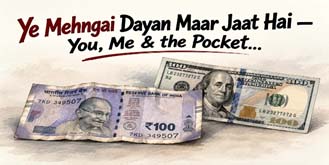
Really, Ye Mehngai Dayan Maar Jaat Hai, I muttered.
I stood there thinking about the strange life of the common person. Our GDP numbers have certainly not helped. No one follows the crude-oil futures or the intricacies of Merchant Discount Rates.
I simply want to know—will we ever see a day when the price of a commodity actually comes down?
The world is discussing wars, trade deals, technology, artificial intelligence, digital currencies and the new global order. Meanwhile, my family is sitting at the dinner table trying to calculate how much more our household budget can take.
I looked once again at the dark clouds.
“My cup of woes floweth over indeed,” I sighed.
From behind me came my wife’s voice.
“Enough of Shakespeare. Come inside. The electricity bill has arrived.”
I closed my eyes.
Just then, a notification sounded on my mobile phone.
My favourite anchor was asking the nation whether Trump would indeed impose a 100% tariff on India for buying Russian oil.
Damn!
(The author blogs at NotesfromDehradun@Atul Rawat.)