Garhwal Post Bureau
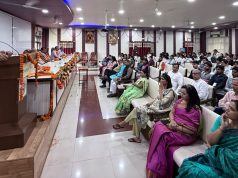
Dehradun, 1 Jun: A three-day Himalayan Action School, titled “Reimagining the Himalayan Future”, began today at Doon University under the joint aegis of ActionAid, a social organisation working on social and environmental issues, and will continue for the next two days. Government representatives from nine Himalayan states, policy experts, academics, social activists, and representatives from the media and voluntary organisations are participating.
The programme was inaugurated by Chief Guest Kusum Kandwal, Chairperson of the Women’s Commission, and Special Guest Kishore Upadhyay, MLA from Tehri, Dr Vimala Rai Paudyal, former Foreign Minister of Nepal, Sandeep Chachra, Country Doctor for ActionAid, and Khalid Chaudhary, Associate Director of ActionAid.
Speakers emphasised the need to rethink development in the Himalayas. Specifically, a separate model must be developed for the permanent residents of the Himalayan region, ensuring environmental balance and integrating them into the mainstream of development.
It also emerged during the discussion that the Himalayan Action School is crucial for conserving the Himalayan biodiversity, serving as a bridge between society and power in the future.
During the workshop, speakers emphasised that at a time when the Himalayan region is facing increasing ecological stress, exploitative development, and deepening inequalities, it is crucial to move beyond discussion and bring everyone together for collective reflection, solidarity, and action.
The workshop was informed that this school, organised by ActionAid in partnership with Doon University, will bring together researchers, activists, and community leaders from across the Himalayan region.
It was explained that the programme aims to develop concrete outcomes, policy decisions, action plans, and a sustainable Himalayan future framework.
Representatives from various states presented on environmental issues in their respective states. These presentations highlighted the rapid ecological changes in the Himalayas, which are making the Himalayas increasingly fragile. Governance, autonomy, and local leadership have also been impacted in addressing these problems. Increasing natural hazards in the Himalayas have disrupted livelihoods, labour, and community economies. This means that development, displacement, and environmental issues are not being addressed equitably.
Overall, the first day of the programme highlighted the urgent need to shape and strengthen this collective effort to reimagine the Himalayan future.
On this occasion, Women’s Commission Chairperson Kusum Kandwal stated that women bear the brunt of environmental crises. She added that society must work together to find solutions to natural hazards. She stated that she would convey any recommendations from this workshop to the government.
On the first day of the programme, former Cabinet Minister and Tehri MLA Kishore Upadhyay stated that he is working with local people in some villages in his assembly constituency to generate carbon credits. He stated that this will set an example in the coming days.
Dr Sunita Raturi, Joint Director, Health, stated that environmental threats primarily impact health, so collective action is essential to maintain environmental balance. Sandeep Chachra, Country Director of Action Aid, stated that climate change has the greatest impact on disadvantaged communities, forest-dependent people, and nomadic communities. It would be beneficial for governments to work on a joint plan in this regard.
Dr Vimala Rai Paudyal, former Foreign Minister of Nepal, stated that balanced development plans must be made, focusing on both development and the environment.
Tikendra Singh Parmar, Shimla, Geologist Prof SP Sati, Action Aid’s Associate Director Khalid Chaudhary, Women Leader Hira Jangpangi, Social Worker Aranya Ranjan, Environmental Activist and Forest Act Expert Tarun Joshi, Dr Livleen Kahlon of The Energy and Resources Institute, Environmental Activist Bachchi Singh Bisht, Ram Wangyarkpam, Manipur, Salma Khurshid, Lok Paryavaran Parishad, Jammu Kashmir, Environmental Scientist Soumya Dutta, Shravan Kumar Acharya, JNU Delhi, Dr Harsh Doval, Doon University, Social Worker Dr Atul Sati, Journalist Linda Chhakchhuak, etc., also expressed their views.