Mule and horse waste disposal project under scanner
By Arun Pratap Singh
Garhwal Post Bureau
Rudrapayag, 1 Jun: Questions are being raised over the handling of horse and mule waste on the Kedarnath pilgrimage route after a pilot project worth more than Rs 1.43 crores, approved for scientific disposal of the waste, has reportedly failed to become operational even months after its approval. The locals claim that earlier, when no funds had been allocated for waste disposal along the Kedarnath route, the system was working better. Now despite the fund allocation, the project is yet to take off.
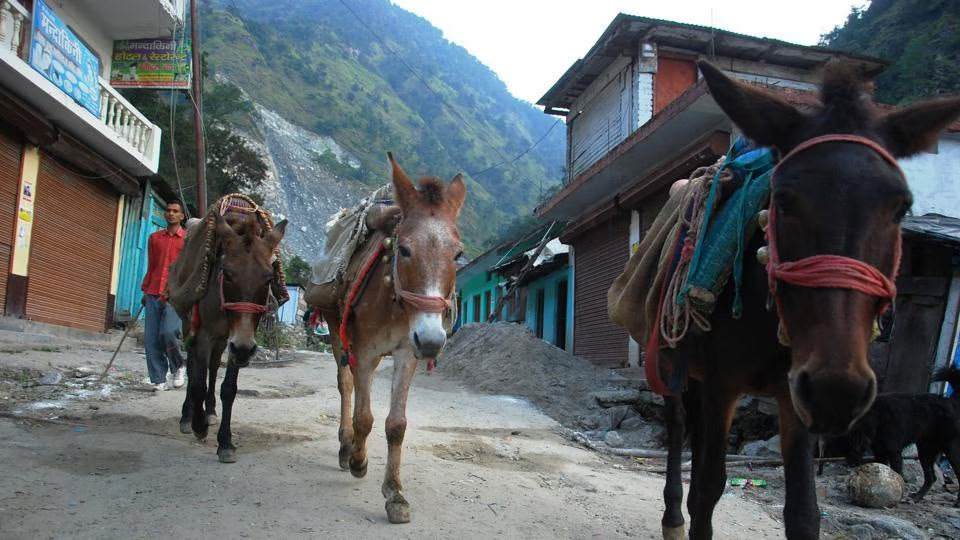
It may be recalled that the Tourism Department had announced that horse and mule dung generated along the Kedarnath Yatra route would be processed by mixing it with pine needles (pirul) to manufacture fire bricks. These fire bricks were proposed to be used as fuel in boilers for heating water, and to provide hot water facilities to pilgrims visiting Kedarnath. The project was projected as an environmentally sustainable solution to tackle the growing problem of animal waste along the pilgrimage route.
For this purpose, the State Cabinet had approved a pilot project and on 3 February, 2026, and consequently, a contract worth Rs 1.436 crores was awarded to the Himalayan Institute for Environment, Ecology and Development. The project received considerable publicity and was presented as an innovative initiative aimed at addressing environmental concerns associated with the annual pilgrimage.
However, despite the passage of several months since the approval of the project, the proposed boilers have reportedly not reached Kedarnath and the project is yet to become operational. As a result, horse and mule dung has reportedly continued to accumulate along the pilgrimage route, causing huge inconvenience to devotees and raising environmental concerns. During the rainy season, it is being feared that the horse and mule waste will be washed away into the Mandakini river and would raise further about pollution.
Sources have claimed that a portion of the sanctioned budget for the pilot project has already been released. Nevertheless, visible implementation on the ground remains absent, leading to questions regarding the progress and effectiveness of the initiative.
The issue has gained further attention in view of claims that a similar task was being undertaken free of cost until recently. According to the sources, during last year’s pilgrimage season, Patanjali Yogpeeth had been collecting mule and horse waste from the Kedarnath route at the request of the district administration. The organisation had also established a processing centre in Kedarnath and reportedly spent more than Rs 50 lakhs on infrastructure and related facilities. It is claimed that the work was carried out as a public service initiative without any financial assistance from the government.
Before the project could be expanded further, the District Animal Husbandry Officer of Rudraprayag, Ashish Rawat, had issued a notice on 10 April, 2026 to Patanjali Yogpeeth, alleging non-performance in relation to the project. It may be pertinent to point out here that in February, 2026, the waste disposal work had already been allotted to the Himalayan Institute for Environment, Ecology and Development, reportedly without prior intimation to Patanjali Yogpeeth. Yet, Patanjali Yogpeeth was served notice for non performance in April.
Following the notice, sources claim that Patanjali Yogpeeth has reportedly served legal notices on the Animal Husbandry Department and the district administration, seeking compensation for the expenditure incurred on the project. Sources suggest that the legal dispute has created discomfort within administrative circles.
The award of the pilot project has also triggered questions regarding the Himalayan Institute for Environment, Ecology and Development, with queries being raised about the institution’s background, its management, the circumstances under which the proposal was brought before the Cabinet and the reasons for the apparent delay in implementation.
Critics point out that a waste disposal activity which was allegedly being undertaken without government expenditure has now been replaced by a project costing over Rs 1.43 crores but the problem of waste accumulation on the pilgrimage route not only remains unresolved but has intensified.
Environmental concerns have also come to the forefront. It is estimated that approximately 4,000 horses and mules are operating on the Kedarnath route during the pilgrimage season. The National Green Tribunal (NGT) has on several occasions expressed concern over the issue and has reportedly written to the Uttarakhand Government and the Central Pollution Control Board regarding the impact of animal waste on the Mandakini river. Environmental experts have warned that the continued discharge of untreated waste could affect water quality and pose a threat to aquatic life in the river ecosystem.
With the pilgrimage season in full swing and thousands of devotees using the route daily, attention is now focused on whether the sanctioned pilot project will be implemented on the ground and whether an effective solution can be found to address the long-standing challenge of horse and mule waste management on the Kedarnath Yatra route.