Garhwal Post Bureau
Mussoorie, 1 Jun: Just as the tourist season reaches its peak, Mussoorie finds itself grappling with a drinking water crisis once again. Hoteliers, homestay operators, traders, and local residents are distressed due to disrupted water supply in several parts of the city. The situation has deteriorated to such an extent that questions are now being raised even regarding the multi-crore Yamuna Pumping Drinking Water Scheme.
On Monday, office-bearers of the Mussoorie Hotel Association, the Mussoorie Traders’ Welfare Association, and the Mussoorie Homestay Organisation submitted a memorandum to Chief Minister Pushkar Singh Dhami and Mussoorie MLA (and Cabinet Minister) Ganesh Joshi—routed through the SDM’s office—demanding an immediate resolution to the crisis.
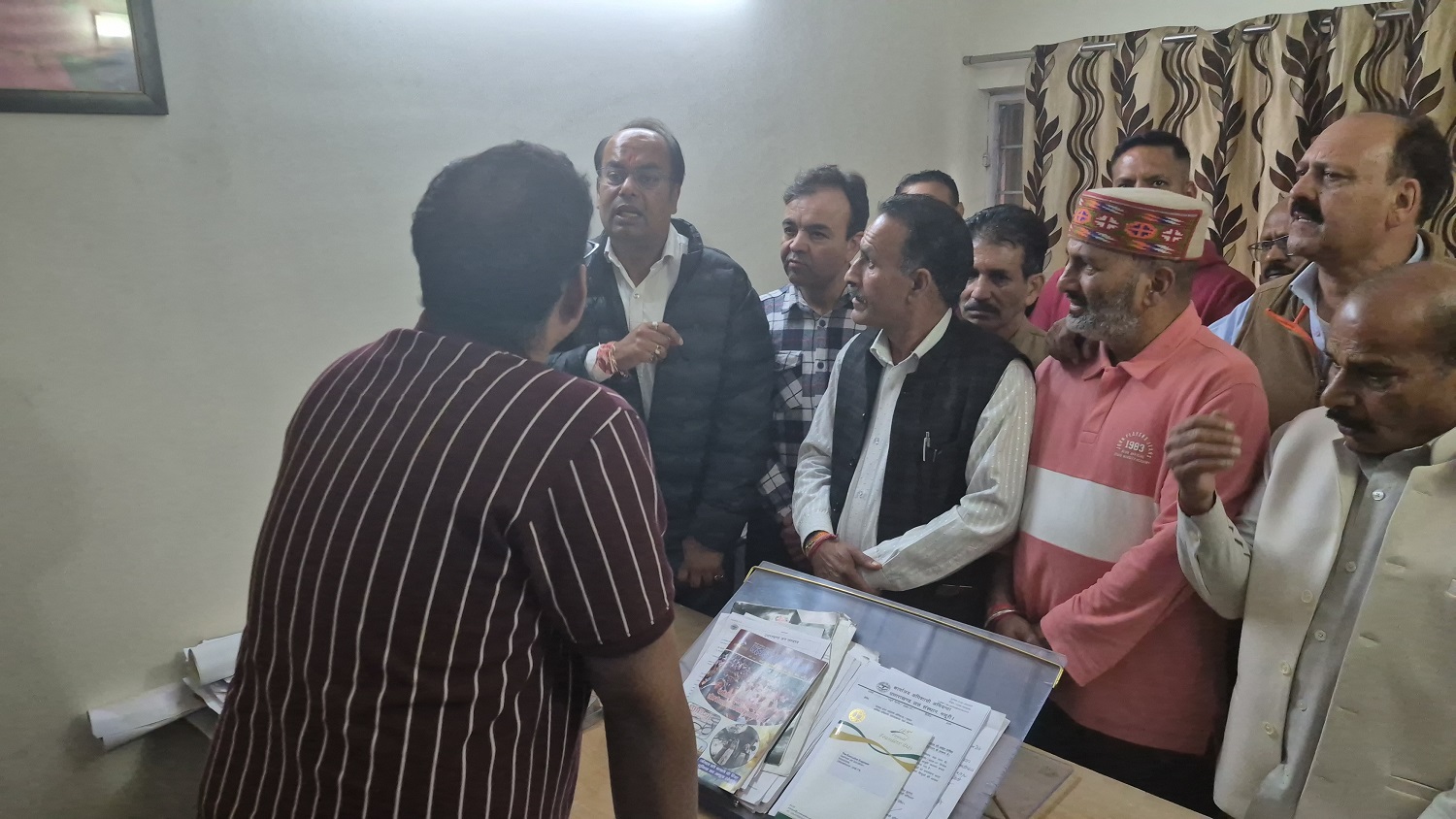
Separately, representatives from these organisations visited the Garhwal Jal Sansthan office and staged a vigorous protest, raising slogans against the officials.
Hoteliers state that while Mussoorie is currently witnessing a massive influx of tourists, the water supply is even lower than what is provided during normal days. In many areas, there is insufficient water pressure in the taps, causing immense hardship to hotels, restaurants, and local households. Ajay Bhargava, Secretary of the Hotel Association, noted that the Yamuna Pumping Drinking Water Scheme—estimated at approximately Rs 144 crore—was launched specifically to provide a permanent solution to Mussoorie’s drinking water woes. At the time, it was claimed that Mussoorie would face no water shortages until the year 2054; however, the current reality stands in stark contrast to those claims. He alleged that the general public and the tourism industry are bearing the brunt of a lack of coordination between the Jal Nigam and the Jal Sansthan. While the Jal Sansthan shifts the blame onto the Jal Nigam—and vice versa—the distressed public remains left waiting for a solution.
Ajay Bhargava stated that, if tourists visit Mussoorie only to find that even basic water supply is unavailable in their hotels, it has a direct negative impact on the city’s image. He noted that, currently, instead of enjoying better amenities, tourists are grappling with issues such as water shortages, traffic jams, and traffic fines—problems that are adversely affecting the tourism industry.
Rajat Agarwal, President of the Mussoorie Traders’ Welfare Association, remarked that the severity of the city’s drinking water crisis can be gauged by the fact that many temples lack sufficient water even to perform the ritual offering of water to Lord Shiva. He argued that if the city continues to thirst for water despite an ambitious project worth Rs 144 crore, it raises serious questions regarding the functioning of the departments. He alleged that a lack of coordination between the Jal Nigam (Water Corporation) and the Jal Sansthan (Water Institute) is preventing the benefits of the entire scheme from reaching the public.
Devi Dayal, President of the Mussoorie Homestay Association, explained that due to the water shortage, hotel and homestay operators are compelled to order a large number of private water tankers on a daily basis. According to him, 100 to 120 water tankers are entering the city every day; this places an additional burden on an already strained traffic management system, thereby exacerbating the problem of traffic congestion.
Issuing a stern warning, Rajat Agarwal stated that, if the water supply system is not restored to smooth operation within three days, traders and social organisations will launch an intense agitation. He announced that they would stage a lockout at the Garhwal Jal Sansthan office and organise a protest march on foot from Mussoorie to the Chief Minister’s residence to draw the government’s attention to this grave issue.
Meanwhile, Amit Kumar, Executive Engineer at the Garhwal Jal Sansthan, attributed the crisis to technical issues, stating that several drinking water pipelines had been damaged due to the heavy rainfall experienced in recent days. Furthermore, water supply was also disrupted due to a technical glitch in the water-lifting machinery during the second phase of the Yamuna Pumping Drinking Water Scheme. He stated that most of the technical issues have been resolved, and efforts are underway to restore normal water supply to all areas by late evening. He added that he would personally conduct on-site inspections regarding the complaints received concerning the distribution system. According to the Executive Engineer, the daily demand for water in Mussoorie is approximately 14 MLD (Million Litres Per Day), whereas currently, 14 to 15 MLD of water is being supplied. In his view, water availability is adequate; the problem primarily stems from issues related to the distribution system and technical hurdles.
Present on this occasion were Jagjit Kukreja, Satish Dhaudiyal, Nagendra Uniyal, Salim Ahmed, Surendra Panwar, Rajkumar, Rakesh Goyal, Deepak Sonkar, Pradeep Kumar, and others.