 By Rajshekhar Pant
The irritation of two utterly dull, insipid months in Lucknow—an occupational compulsion—was certainly there. But perhaps my attraction to the past was just as strong a reason why, one morning, almost a decade ago, I found myself setting off for Ayodhya, almost on a whim. In the 1940s, my grandfather had died there, on the day of Ram Navami. Somewhere in an unconscious corner of my past-haunted mind lingered my father’s voice—he had been alone with him at the end—repeating, again and again, a few words my grandfather had spoken in his final moments. Perhaps that, too, had something to do with this journey.
The sandy expanse of the Sarayu; a ride across its breadth in a craft that was neither quite a motorboat nor quite a barge; at my driver Ashok’s insistence, a visit to the now-abandoned workshop where stones for a proposed grand Ram temple had once been carved; then an hour and a half spent wandering through the maze-like barricades of what has, by now, taken on the air of a fortress around the Ram Janmabhoomi—and, at its entrance, the open sale (through small children, complete with catchy slogans) of video CDs of the Babri Masjid’s demolition on 6 December.
By about two or half-past, all of this had settled into a single, lingering discomfort: our culture, after all, has never taught us to keep wounds alive.
After that came Hanumangarhi, and a lunch of fried baati and chokha.
I now stand before a mansion-like structure known as Dashrath Mahal. Not far from it is Kanak Mahal, believed to have been gifted to Sita by King Dashrath – both open to visitors only around four or half-past. We still have nearly an hour to wait. Like any average Indian, Geeta is inclined to believe these structures must date back to the age of the Ramayana. Pointing out certain architectural features—arches, corbel brackets—I try to suggest that they are unlikely to be more than a century or two old. With my half-baked architectural knowledge, I attempt to explain the changes they must have undergone over time.
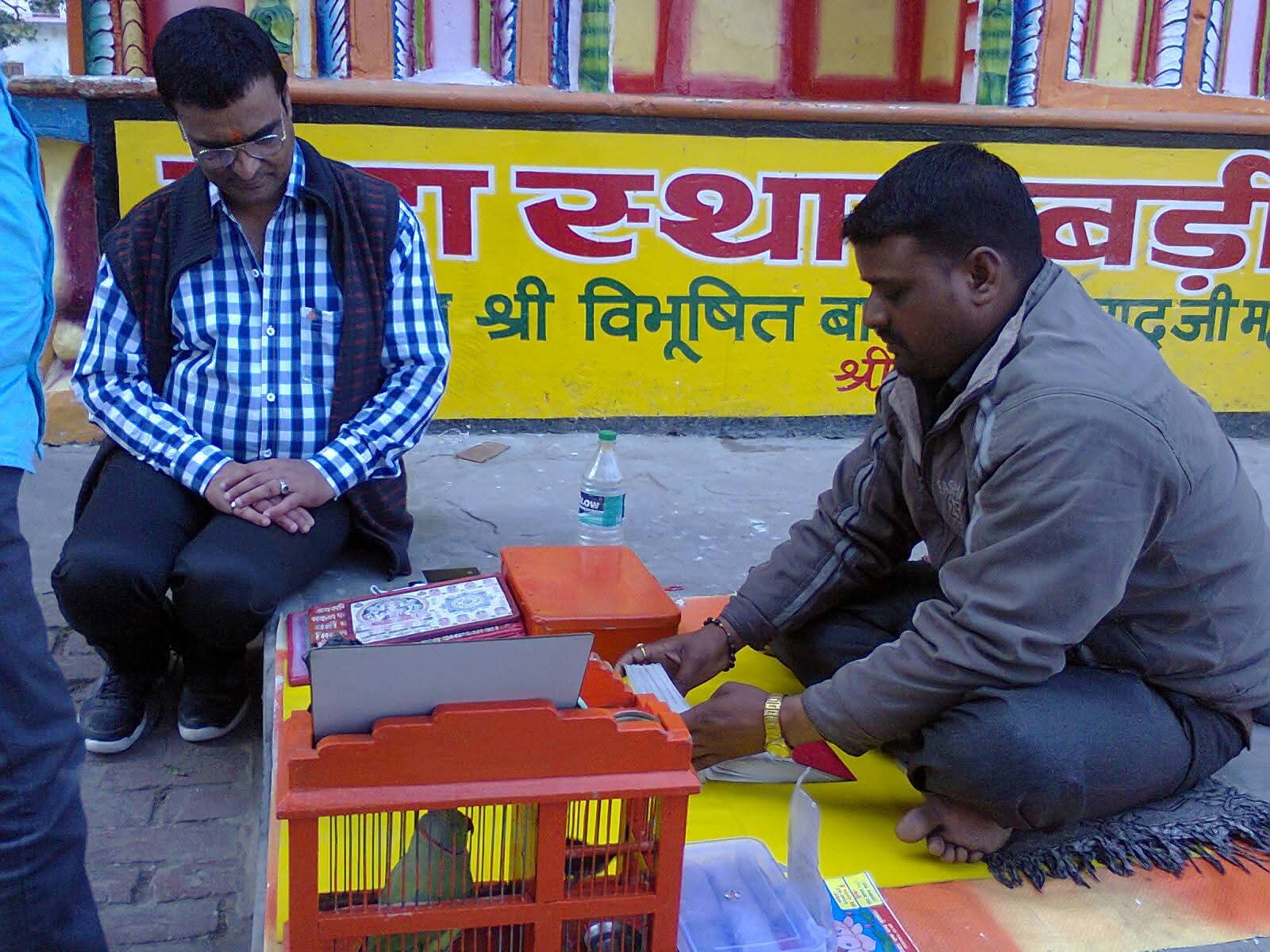
It is then that my attention drifts to a man seated just outside Dashrath Mahal. In a small square space near the entrance, he sits on a mat with a cage beside him. Before him lies a neat row of laminated cards. With the help of a trained bird confined within the cage, he offers auguries—glimpses into the future.
We have to wait anyway. Geeta, unimpressed by my bookish explanations, at least wants to see Kanak Mahal from the inside. To pass the time, I sit down beside the man who claims to read the future through birds.
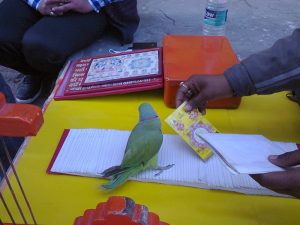
He is a serious-looking man, his face almost without expression. The price of a reading: ten rupees. He asks my name and opens the cage. A parrot—a black-ringed parakeet—steps out and begins to shuffle the envelopes, as though searching. Leaving the others aside, it pulls one out and extracts a laminated card.
“Maharaj,” the man says softly, addressing the bird, “have another careful look—is this the one?”
The parrot straightens the card with its beak, as if to confirm.
The card informs me that since my name begins with the letter ‘R’, my zodiac sign is Libra, and that certain planetary positions are presently causing me mental distress. I laugh and tell the man that all my siblings’ names also begin with ‘R’—a decision of our father’s—and that my own sign is actually Pisces, derived from another name.
He remains unmoved.
“No matter, Panditji,” he says. “We will draw your card again. You won’t have to pay extra.”
The ritual is repeated. This time the card correctly identifies my sign as Pisces, though the prediction remains broadly the same.
I ask Geeta to try. What surprises me is that her card addresses the subject in the feminine. For my twelve-year-old son, Tukur, another bird from a different section of the cage—perhaps a house wren, as far as my limited knowledge goes—draws a card that addresses him, as expected, as a boy.
After collecting thirty rupees in all, the man suggests that if I wish, I might wear a ring to counter the adverse movements of the planets. My curiosity sharpens.
“Let us first see whether it suits you,” he says. “There will be no extra charge.”
The parrot emerges again and selects another card. This one recommends a ring bearing the Shri Yantra. The man asks me to mark the card for identification. If “Maharaj” picks the same card again, I should accept the ring. He gathers the cards into a pile and hands them to me. I shuffle them as much as I like. The parrot draws once more—and places the very same card before me.
In China and Thailand, too, there exists a tradition of fortune-telling through birds—Java sparrows and canaries are often used. I recall a Chinese fortune-teller describing, in his memoirs, how he trained sparrows—and then freely interpreted the cards they picked to deceive his clients. But here, outside Dashrath Mahal, this man remains largely silent. He merely says that I may wear the ring if I wish; it is easily available in the market, and it will do me good. To Geeta, he recommends the worship of the Goddess.
Geeta seems to think I am getting somewhat carried away. In an effort to caution me, she remarks—in English—that such people also know how to hypnotise. I want to photograph the parrot and the small bird as they step out of the cage, but my phone is dead, and the power bank fails me at the crucial moment. Geeta, somewhat reluctantly, manages a couple of pictures with her modest phone.
The man’s silence, his impassive demeanour, and the repeated coincidence of the bird selecting the “right” cards—together, they leave an impression on me. My attempt to probe deeper yields little. The craft, he says, has been in his family for three or four generations. The birds are caught young and trained in astrology—that is all.
Even if the birds are only trained, it is no ordinary skill—and perhaps not entirely explainable either. Many questions remain, especially when one considers that training, too, must have its limits.
The ring costs three hundred and fifty rupees. At the very least, I find myself thinking, it is a small gesture of respect toward a fading craft. To dismiss such anonymous practitioners as mere peddlers of superstition—and to push them to the margins of a rigidly rational society—may not be entirely wise.
I buy the ring.
The man tells me again that I could have bought it in the market, and that if it breaks, it can be replaced by any fortune-teller who keeps such birds.
A wildlife protection law enacted in 1972 does not permit the keeping of parrots and birds in captivity for such purposes. There are also organisations that advocate for their “freedom” and find generous space in English newspapers. And yet, looking at that impassive face outside Dashrath Mahal, it seems to me that the relationship between humans and birds cannot be understood merely within the framework of law.
I took the ring off within an hour or so. I suppose I am a weak man. I left it in a corner of a shrine.
And now, whenever my eyes fall upon it, a face rises before me—flat, expressionless—speaking to a parrot that has just stepped out of its cage:
“Maharaj… have another careful look. Is this the one?”
(The author is an amateur filmmaker, a photographer, and a writer, who has written over a thousand write-ups, reports, etc., published in the leading newspapers and magazines of the country. He can be reached at pant.rajshekhar@gmail.com)