Garhwal Post Bureau
Pithoragarh, 21 Jun: The Press Information Bureau (PIB), Dehradun, under the Ministry of Information and Broadcasting, Government of India, organised a one-day regional media workshop titled “Lok Seva Hi Sankalp – 12 Saal Vishwas Ke, Vikas Ke, Jan Kalyan Ke” in Pithoragarh on Saturday with the objective of disseminating information about the Centre’s welfare schemes, development initiatives and achievements over the past 12 years to the wider public through the media.
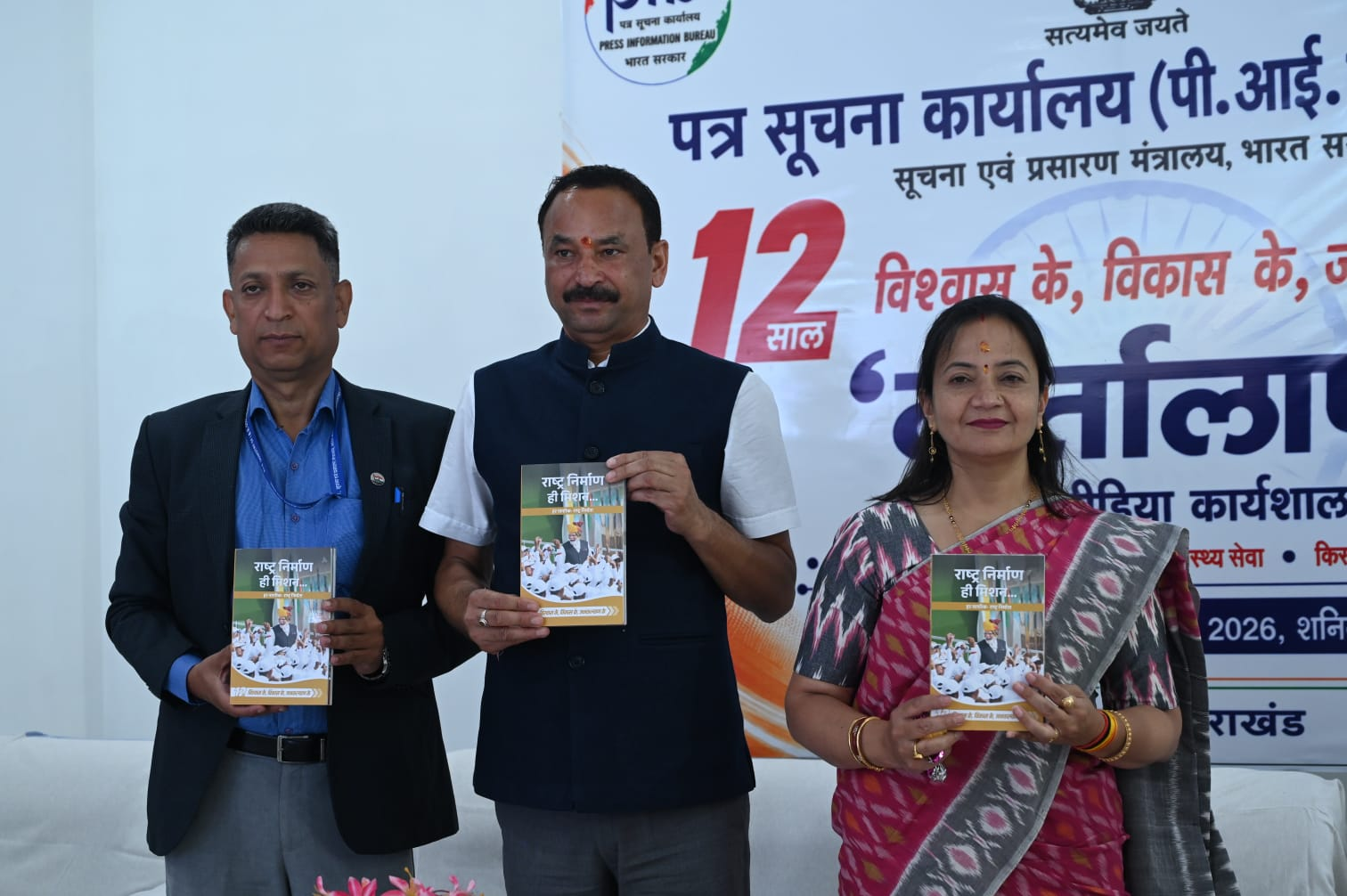
The workshop also witnessed unveiling of a booklet based on the theme of the programme. Mayor of Pithoragarh Municipal Corporation Kalpana Devalal participated in the event as the Chief Guest, while Ganesh Bhandari, Vice-Chairman of the State-Level Minor Irrigation Advisory Committee, District Magistrate Ashish Kumar Bhatgain and Chief Development Officer Deepak Saini were present as distinguished guests.
Welcoming the guests, media representatives and participants, Assistant Director, PIB Dehradun, Sanjeev Sundriyal outlined the objectives of the workshop and felicitated the dignitaries with mementoes. He said the purpose of the ‘Vishwas Ke, Vikas Ke, Jan Kalyan Ke – Vartalap’ programme is to ensure effective dissemination of information regarding the Centre’s public welfare schemes, achievements and development works through the media. He noted that during the past 12 years, development initiatives across various sectors, social welfare programmes, women’s empowerment measures, youth development efforts, healthcare services, agriculture and rural development schemes have brought positive changes to the lives of millions of citizens across the country.
Describing the media as a strong pillar of democracy, Sundriyal said journalists play a crucial role as a bridge between the government and society and are instrumental in ensuring that accurate and factual information about government schemes reaches the public. He thanked all officers and media representatives participating in the workshop and expressed confidence that the interactive programme would facilitate meaningful discussions on various government schemes and achievements while strengthening efforts towards their wider dissemination.
During the workshop, speakers highlighted a range of welfare schemes being implemented by the Central Government and discussed major developmental achievements recorded during the past 12 years. They provided detailed information about development initiatives being undertaken in Pithoragarh district, strengthening of infrastructure and efforts aimed at the holistic development of the border region. It was stated that continuous efforts are being made to ensure that the benefits of Central and State Government schemes reached people at the grassroots level.
The speakers also underlined special initiatives taken to promote tourism and religious tourism in the district, which have yielded encouraging results. Particular emphasis was placed on the growing number of pilgrims and tourists visiting Kailash Mansarovar, Adi Kailash and Om Parvat. They noted that extensive road construction and upgradation works had been undertaken in border areas to improve connectivity, benefiting local residents while also enhancing the region’s strategic importance. Expansion of air services and improved air connectivity were also cited as factors contributing to the growth of tourism, trade and transportation in the district.
The workshop highlighted the impact of the Lakhpati Didi scheme in empowering women associated with self-help groups by increasing their income and promoting self-reliance. Participants were also informed about efforts to strengthen healthcare services through the expansion of facilities at Pithoragarh Medical College and the Base Hospital.
Speakers also stressed upon the important role of the media in achieving the vision of Viksit Bharat 2047 and observed that the media serves as an effective conduit for communicating government schemes and achievements to the public. Media representatives present at the workshop also shared their views and suggestions on various issues.
Chief Medical Officer Dr SS Nabiyal, District Programme Officer Nirmal Singh Basera, District Education Officer (Primary) Himanshu Naugai, Agriculture and Land Conservation Officer Rajesh Khetwal, Senior Horticulture Inspector Kapil Bhatt and My Bharat Director Shailesh Bhatt provided detailed information about welfare schemes, programmes and achievements related to their respective departments.
Dr Nabiyal spoke about the Ayushman Bharat Scheme, Pradhan Mantri Jan Arogya Yojana, the National Health Mission and ongoing efforts to strengthen healthcare services. Basera elaborated on initiatives being implemented by the Women and Child Development Department, including Poshan Abhiyaan, Beti Bachao Beti Padhao, Mission Shakti and various women empowerment programmes. Naugai shared information about the National Education Policy, Samagra Shiksha Abhiyan and innovations being introduced in school education. Khetwal highlighted schemes such as the Pradhan Mantri Kisan Samman Nidhi, Soil Health Card programme, natural farming initiatives and other farmer-centric interventions. Kapil Bhatt spoke about horticulture development, promotion of apple, kiwi and other high-value crops, and measures aimed at enhancing farmers’ incomes.
Shailesh Bhatt informed participants about youth skill development initiatives, opportunities for youth participation in nation-building, volunteer activities and opportunities available through the My Bharat portal. All speakers emphasised the importance of the media in ensuring effective implementation of government schemes and in communicating their benefits to the public.
Extensive discussions were held on topics related to women’s empowerment, youth development, healthcare services, farmer welfare, public welfare schemes and the vision of Viksit Bharat 2047.
The event witnessed participation from expert officers, subject specialists and media representatives from different sectors. Presentations were also made on major government achievements, Digital India, Atmanirbhar Bharat, healthcare initiatives, social security schemes and other developmental interventions.
The workshop also featured an interactive session during which Sanjeev Sundriyal engaged directly with journalists and media representatives. He sought feedback on challenges faced by journalists in their professional work, particularly in border districts. Media representatives highlighted practical difficulties encountered during news gathering, issues related to information dissemination systems and matters concerning journalists’ welfare.
Sundriyal assured the participants that their suggestions and concerns would be conveyed to the appropriate authorities and that efforts would be made to address them wherever possible. He reiterated that the media is an important pillar of democracy and plays a vital role in establishing effective communication between the government and the public. He urged journalists to prioritise factual, constructive and public-interest-oriented reporting.
The programme also witnessed open discussions between journalists and government officials on a range of contemporary issues, making the workshop a meaningful platform for dialogue and exchange of ideas. Journalists associated with print, electronic and digital media from across the district participated in the event.