 By Ganesh Saili
A ‘Kipling Trail’ has been making headlines and that too for all the wrong reasons.
Why do I write? There are several reasons, of course, one of them being a desire to share information. These days one has to be cautious: someone posts it on Instagram, et. al., and dissemination multiplies many times over. Soon it is viral. There’s a pervasive problem when ‘too-clever-by-half’ people rip off your hard work, blithely copying and pasting without giving any credit to the original creator. Ouch! That unkind cut still hurts.
We know that imitation is the sincerest form of flattery. But that gives no solace.
This happened long years ago to a dear friend of mine, (whose name, in the interest of fair play and justice, I must leave out). Exasperated, he wrote a story about a Scotsman with a false nose.
‘That nose was a virus,’ he smiled. ‘Anyone referring to it would be infected.’
How right he was, when a few weeks later, a journalist plagiarised his work; he lifted, among other things, the false nose too. The trap was sprung! He was caught in flagrante delicto, like a monkey with its hands firmly glued to the cookie jar.
The same seems to be the case with the seven-mile-long footpath that stretches from Rajpur to Jharipani and on to Mussoorie. Distressing to find it has been renamed the Kipling’s Trail. This has little to do with the truth.
After countless searches through our documented history, I can’t find previous mention of a road by that name! None of the old maps, eight of them, nor any of the five guides to this hill station. For instance, F Bodycot’s guidebook of 1907 makes no mention of Rudyard Kipling. He was at that time a special correspondent of the Civil & Military Journal, and was staying at the Charleville for a few days, with his friends, the Hills.
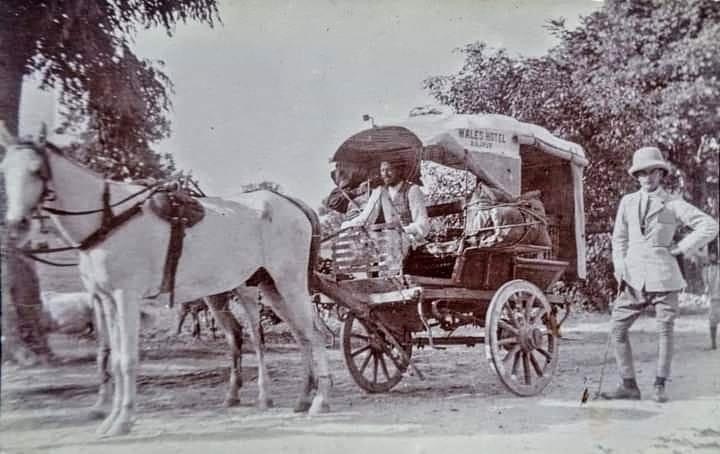
Pic courtesy: Pramod Kapoor
For me, the Kipling myth was born in Wayside Cottage, home to retired teacher Gerald Powell. His forebears were among the pioneers who built this town. One day, he pointed to the incline that goes past May Cottage, on to Florence Cottage, and ends up outside Wayside Hall, and said: ‘WJ Biggs, the old Principal of Wynberg Allen School, used to call it the Kipling Trail.’ That half-kilometre stretch of road begins at Jaypee Hotel’s gate, then it levels out below Ralston Manor and joins the main road. Ralston Manor saw our first European cremation in 1890. In atonement, Mrs Smallman built a church on the spot. This fact is duly mentioned in Chowkidar (autumn 1995) and the journal of BASCA, that is, the British Association of Cemeteries in South East Asia.
John Northam mentions it in his Guide to Masuri, published 1884: ‘A few years ago, the Mansuri Municipality constructed a road from Antlers to Sinclair, which cut off the unpleasant ‘pinch’ up to the Mansuri Hotel. The worst piece of road remained immediately under Wayside Cottage, which was incurably rough and rugged, but, thanks to the Municipality, this dangerous part has been abandoned, for a new road has been made from the left a little beyond Ralston.’
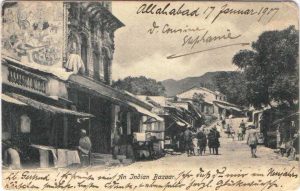
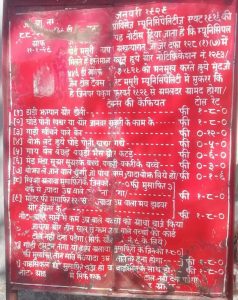
Meanwhile, in the Upper Rajpur area there are only ruins sprouting peepal trees, decaying bungalows, mute arches and the dilapidated sign-boards at the old toll barrier warning the visitor how hiring a coolie would set them back by a rupee and a hire of a pony meant an expenditure of eight annas.
Of course, new money meant the inevitable death of the old order. It had to perish. The new age licked its chops and rattled the doorknob. Soon forgotten were the old, hitherto thriving places like the Prince of Wales’ Hotel, the Agency Hotel, and other hotels where they stopped waiting for guests.
‘Big is beautiful!’ the builder nudges me. ‘Think really big! The bigger the better.’
Somewhere, a lone dog barks, reminding me of the nursery rhyme from my days in school:
Hark, hark, the dogs do bark,
The beggars are coming to town,
Some in rags, and some in jags,
And one in a velvet gown.
(Ganesh Saili, born and home-grown in the hills, belongs to those select few whose words are illustrated by their own pictures. Author of two dozen books, some translated into twenty languages, his work has found recognition world-wide.)