Garhwal Post Bureau
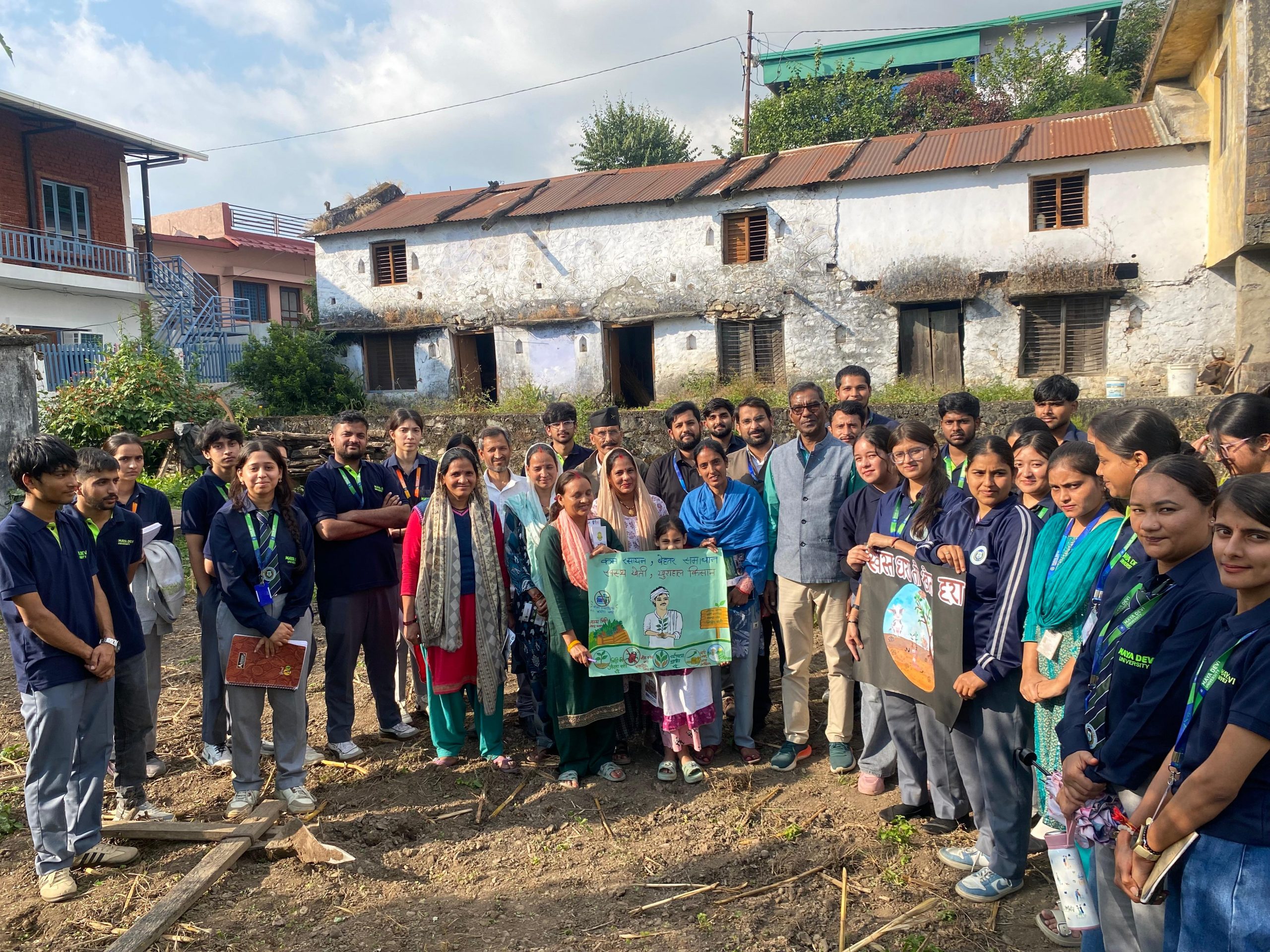
Dehradun, 28 Oct: Maya Devi University’s School of Agriculture and Technology organised an educational field visit and Farmer–Student Interaction Programme in Koti village, located in the Vikasnagar tehsil of Dehradun district. The programme aimed to provide students with practical agricultural knowledge, help them understand farmers’ challenges, and strengthen collaboration between the university and the farming community.
On the occasion, Prof. (Dr.) Tripti Juyal Semwal, Vice President of Maya Devi University, emphasised that agricultural education must extend beyond classrooms and connect students with farms and rural communities. She stated that such initiatives provide students with valuable opportunities to understand real-life farming conditions, the challenges faced by farmers and the needs of rural communities. She added that the university is committed to ensuring that students’ knowledge and research benefit local farmers while promoting innovation, self-reliance and sustainable agricultural development. Prof. (Dr.) Ashish Semwal, Vice Chancellor of Maya Devi University described the Programme as an important initiative towards experiential and practical learning. He observed that combining farmers’ traditional knowledge and field experience with scientific guidance from agricultural experts can help improve agricultural productivity and address local farming challenges. He further stated that the university would continue to undertake agricultural extension activities, field demonstrations and regular interactions with rural communities for the benefit of farmers and students. Faculty members and students of B.Sc. Agriculture and B.Sc. Food Technology participated in the visit.
Located approximately 25 kilometres from the university, Koti village has an agrarian economy with nearly 90 per cent of its population dependent on agriculture for their livelihood. During the field visit, students observed a variety of crops, including maize, pigeon pea, chickpea, potato, paddy, mustard, peas, turmeric, garlic, chilli, black gram, kidney beans, pumpkin, tomato, bitter gourd and ridge gourd. They also learned about fodder crops and locally important trees such as Timla, Bhimal, mulberry and Baheda. The students interacted with villagers and conducted household surveys to understand prevailing agricultural practices, crop production challenges and the socio-economic conditions of farming families. Following the field visit, an agricultural extension and Farmer Student Interaction Session was organised with the support of Gram Pradhan Kalpana Koli, Vinod Koli, retired military officer B.S. Rawat, local residents and Panchayat representatives.
At the beginning of the programme, Prof. Mahendra Singh Pal, Dean of the School of Agriculture and Technology welcomed the participants and encouraged farmers to share their crop production-related problems. Addressing their queries, he explained the importance of improved crop varieties, recommended seed rates, scientific farming practices and timely irrigation. Dr. Sahil Thakur highlighted the importance of soil health testing for assessing soil fertility and ensuring appropriate nutrient management. Dr. Vinay emphasised the use of quality seeds and the need to strengthen market linkages to improve farmers’ access to markets. Dr. Shubham Samkariya provided insights into improved dairy management practices to enhance milk production and strengthen rural livelihoods. Prof. Pal also demonstrated a practical method for estimating soil moisture in the field and explained its application in efficient irrigation management. Shivani and Ambika Kapil actively contributed to the interaction and agricultural extension activities.
During the discussion, farmers expressed the need for practical demonstrations covering the entire crop production cycle, better identification and management of pests and diseases, information on improved seed varieties, and technical assistance to promote natural and organic farming practices. The programme provided farmers with an opportunity to present their field-level challenges directly to agricultural experts and seek scientific solutions. Village representatives appreciated the university’s initiative and expressed the hope that similar programmes would be organised regularly in the future. As part of its long-term commitment to agricultural extension and rural development, the School of Agriculture and Technology also proposed adopting Koti Gram Sabha comprising seven villages Koti, Dhalani, Kinsal, Dharda, Maletha, Dwathra and Kandwal for sustained agricultural extension and rural development activities.