 Pics & text:
Satpal Singh Gandhi
When the Gods Descend to the Ghats of the Ganga Celebrated on the full moon night of the Hindu month of Kartik, about fifteen days after Diwali, Dev Deepawali literally means the Diwali of the Gods. According to Hindu belief, the gods descend from heaven to bathe in the holy Ganga and celebrate Lord Shiva’s victory over the demon Tripurasura. The festival is also known as Tripurari Purnima and symbolises the victory of good over evil, light over darkness and knowledge over ignorance.
Dev Deepawali is celebrated by lighting thousands of earthen lamps along the ghats of the Ganga in Varanasi. It falls on Kartik Purnima, a fortnight after Diwali, which is celebrated on the new moon night of Kartik. I was fortunate to have witnessed this magnificent festival in 2025, which fell on 5th November.
A Destination on My Post-Retirement Checklist:
After retiring from my job, having served for about 34 years, I prepared a calendar of festivals and events that I wanted to cover with my camera. Dev Deepawali was one of them.
I had visited Banaras during my college days when I appeared for the GDO examination of the Air Force. This was my second visit to the city. I came to know about Dev Deepawali through one of my former students, Shrivar, whom I had taught astronomy while he was preparing for admission to Doon School. Shrivar belonged to Banaras and had moved to Dehradun for his studies.
I decided to make a solo trip to Banaras to photograph the festival. I arrived a day before the celebrations and planned to explore the ghats to understand the location and prepare for the next day’s photography.
I was staying with Shrivar’s parents. From there, I took an auto-rickshaw that dropped me near Assi Ghat, where I planned to begin my walk.
Assi Ghat is one of the most important and culturally vibrant ghats of Varanasi. Situated at the southern end of the city’s riverfront, it is a place where religious devotion, music, yoga, ancient traditions and everyday life come together along the banks of the Ganga. Banaras has around 84 prominent ghats, and I decided to explore them on foot, starting from Assi Ghat.
Assi Ghat derives its name from the Assi River, a small stream traditionally associated with this area, where it meets the Ganga. The names of the Varuna and Assi rivers are commonly associated with the origin of the name Varanasi. The Assi River is also linked to traditional stories associated with Lord Shiva and Devi.
Exploring the Ghats Before the Festival
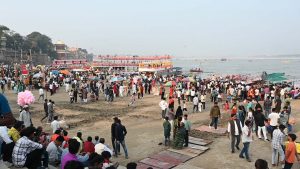
As I entered Assi Ghat, I was mesmerised by the vast expanse of the Ganga. The city and its ghats stretched along one bank, while the opposite bank was nowhere in sight. The entire old city of Banaras is situated along the western bank, while the eastern side is largely an open, sandy floodplain.
I had read about the working style of Steve McCurry, the renowned photographer famous for his photograph of Afghan Girl. He often researches a place before visiting and spends time understanding its surroundings and what makes it special. I decided to follow a similar approach by exploring the ghats before the festival.
I walked along the riverbank for about one or two kilometres, speaking to local people and asking about the arrangements for the following day. I learnt that the best way to enjoy Dev Deepawali was from a boat, as it offered a view of several illuminated ghats together. Boat bookings had to be made in advance, with shared boat fares ranging from approximately Rs. 2,500 to Rs. 15,000 per person, depending on the type of boat.
I decided to take a boat ride during my recce instead. On the actual day of the festival, I wanted to walk along the ghats and photograph the people and celebrations from close quarters.
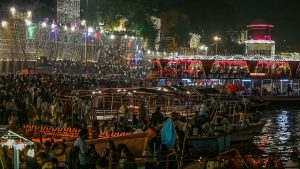
The boat ride gave me a wonderful view of the riverfront. Thousands of lights illuminated the ghats, their reflections shimmering on the gentle waters of the Ganga. The ancient palaces, temples and stone stairways looked like a golden amphitheatre against the night sky.
The boatman kept telling us about the different ghats as we sailed along the river. Two of the most striking were Manikarnika Ghat and Harishchandra Ghat, both known as important Hindu cremation grounds. They are deeply associated with beliefs about death, rebirth and liberation, or moksha. The sacred fires at these ghats are traditionally believed to have been burning continuously for centuries. From the boat, I could see several cremations taking place, with the fires glowing in the darkness.
Since I had decided to explore the ghats on foot the next day, I asked the boatman to drop me at Manikarnika Ghat. From there, I planned to walk back towards Assi Ghat, completing my recce for the following day’s photography.
On my way back to my accommodation, I walked through the narrow streets of Varanasi. I met several friendly people, many of them college students who had come from nearby towns and villages to study at Banaras Hindu University.
One thing I particularly enjoyed about Banaras was its street food. As a teetotaller, I was delighted to find tea shops at almost every corner of the street. The tea was excellent, and the city had plenty to offer food lovers. Chaat shops, jalebi stalls, rabri, rasgulla and other sweet shops were everywhere. And, of course, there was the famous Banarasi Paan.
I stopped at the well-known Kashi Chaat Bhandar to enjoy some local chaat, followed by jalebi and, finally, a Banarasi paan. After a satisfying evening, I returned for a good night’s sleep. The next day was going to be long, with several hours of walking and photography, carrying my camera equipment.
The City Comes Alive on Dev Deepawali:
I started the day early to explore the streets of Banaras and observe its people and daily activities. My plan was to walk around till late morning, rest for a few hours and return to the ghats in the evening.
I began with some local street food and lemon tea at a small shop that served different varieties of tea in large glasses. The streets were full of colour and activity. Sadhus, sanyasis, street vendors, rural visitors and devotees were all moving towards the ghats. For a photographer, there was no shortage of interesting faces and situations.
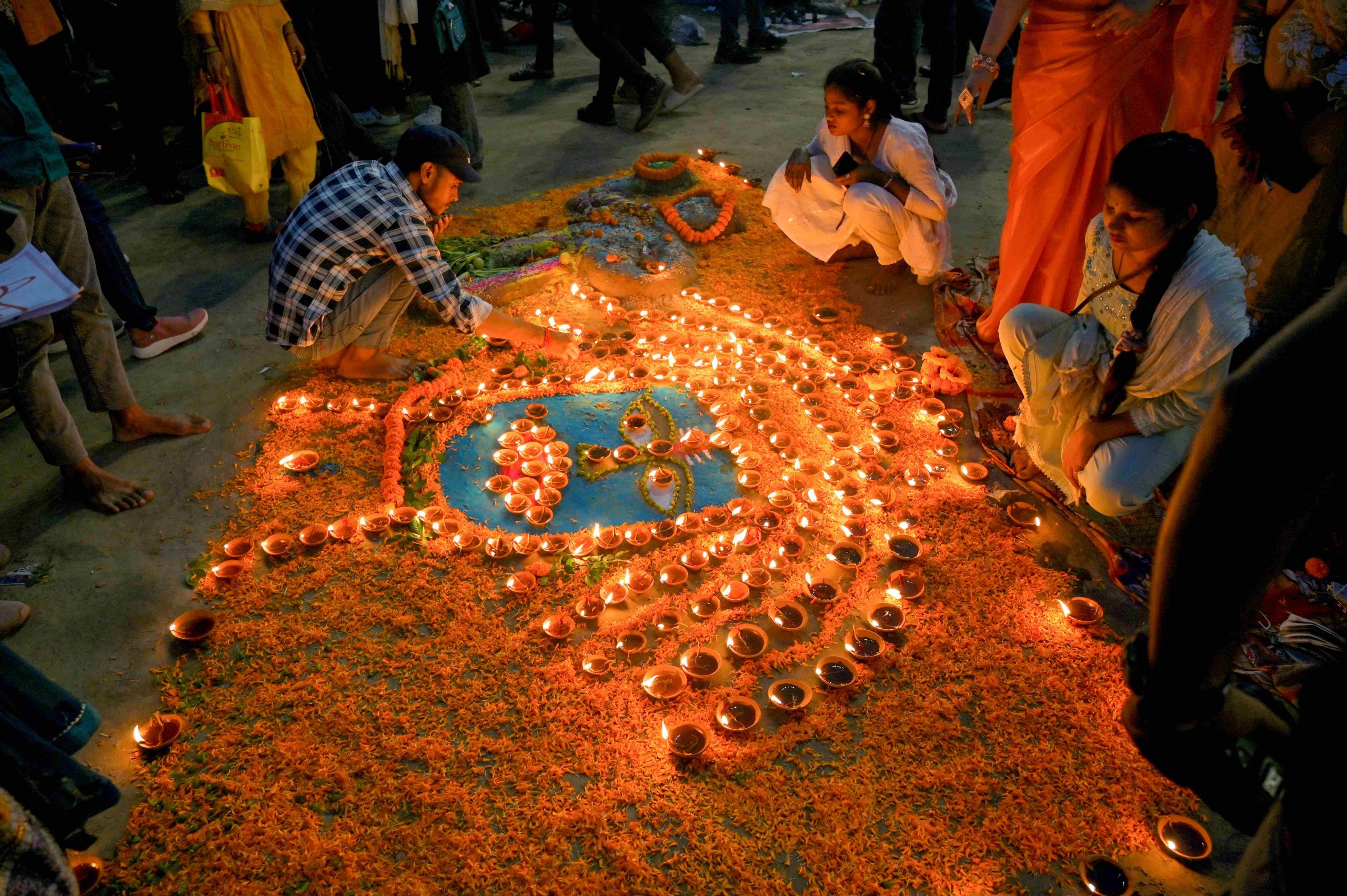
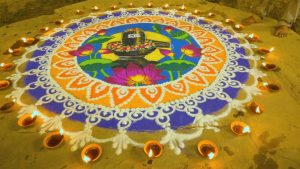
When I reached Assi Ghat, I found it completely transformed from what I had seen the previous evening. It was full of activity. Women were performing religious rituals, while school and college students were busy making rangolis.
One group of college girls had created a special rangoli to celebrate the Indian women’s cricket team’s historic first-ever ICC Women’s Cricket World Cup victory on 2 November 2025. The rangoli featured the blue jersey and the World Cup trophy.
I also noticed some women decorating a human-shaped figure laid on the ground with clay, fruits and vegetables as offerings. I could not understand the significance of this particular ritual, but it was interesting to observe the devotion and belief behind it.
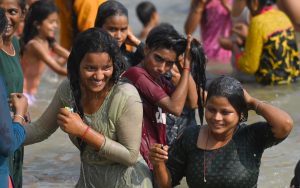
Most of the people performing rituals were middle-aged women, many of whom appeared to have travelled from rural areas. I also noticed elderly couples who had come from Rajasthan and different parts of southern and western India. Some local people were performing Surya Namaskar and offering water to the rising sun. Young visitors were busy taking selfies, while groups of foreign tourists watched the activities with amazement.
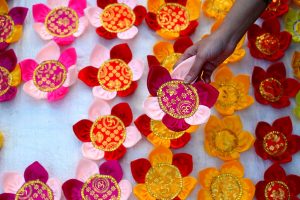
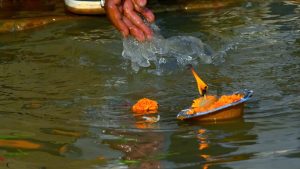
The ghat was filled with colour, religious rituals and people bathing in the holy Ganga. Local youngsters were busy decorating the steps, arranging thousands of earthen diyas and filling them with mustard oil and cotton wicks.
There were also beggars, sadhus and snake charmers seeking offerings from visitors. After their morning bath, many devotees were distributing handfuls of rice and dal to people sitting along the ghats.
I came across a family of snake charmers displaying different kinds of snakes, including cobras. I was particularly drawn to a young boy, perhaps not more than ten years old, who was holding an earthen pot with a lid. When I approached him to take a photograph, he opened the pot, and to my surprise, there was a cobra inside. He took out the snake and posed for my camera as if it were his pet.
I photographed him and other members of his family holding the snakes. I understood that he was happy to let me photograph him in return for some money. I gave him a few coins and moved ahead, only to find several other children approaching me with similar expectations.
I continued walking, looking for interesting faces and candid moments. This was one of the main reasons I had come to Banaras. The city offered an endless variety of expressions, traditional clothing, colours and everyday activities.
The Photographer and the People:
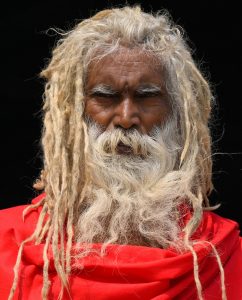
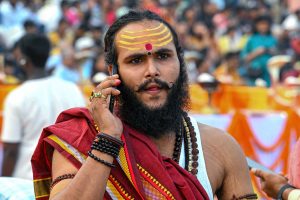
I often wonder why photographers are so attracted to rural faces and elderly people. Perhaps one reason is that we spend most of our lives surrounded by urban faces in cities and towns. At places like Banaras, we come across people with different backgrounds, expressions, traditional clothing and ways of life.
Another interesting aspect is that people are generally less hurried during such festivals. They have time to interact, observe and enjoy their surroundings.
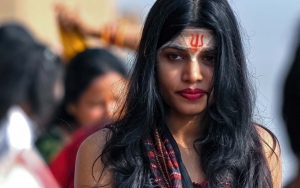
When you walk through a crowded festival with professional cameras and long telephoto lenses, you naturally become an object of curiosity. People notice your equipment and your photography. Some even approach you, wanting to be photographed.
I enjoy interacting with people while taking their photographs. Often, a simple conversation makes the experience more enjoyable. Seeing my appearance and turban, people frequently ask, “Are you from Punjab?” or “Where are you from?” They are usually surprised when I tell them that I am an Uttarakhandi.
A Word on Photography Ethics:
Photographing people at public places and festivals comes with a responsibility. While some people are happy to be photographed, others may feel uncomfortable or shy away from the camera.
A photographer should respect these feelings and avoid taking photographs of people who are clearly uncomfortable. With experience, one learns to understand people’s reactions and body language. A responsible photographer should always respect the subject’s comfort and privacy.
After spending some time at the ghats, I returned to the narrow streets near Harishchandra Ghat. I climbed the steps leading to the bazaar, where the lanes were crowded with people moving in both directions. There was something interesting happening at every turn, and I kept taking photographs whenever something caught my eye.
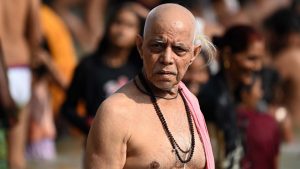
I was also craving a cup of tea. I stopped at a small shop for tea and kachori. The shopkeeper invited me inside, but I preferred sitting outside so that I could watch the people passing by and continue photographing them.
I had earlier read a few books by Desmond Morris, including Manwatching, Bodywatching and Tribe. These books had helped me develop an interest in observing people and understanding their body language. Sitting at the tea shop and watching the crowd was another opportunity to do just that.
As the day progressed, preparations for Dev Deepawali gathered pace. I took a short break and then returned to Assi Ghat, where arrangements for the evening Ganga Aarti were underway. Visitors were arriving in large numbers, and the ghats were becoming increasingly crowded.
Moonrise Over the Ganga:
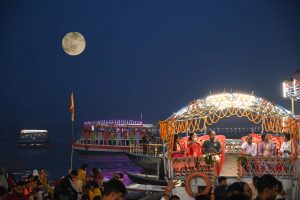
As the sun disappeared below the horizon, something magical happened. Across the Ganga, the full moon slowly began to rise. There was nothing between the river and the moon, just an uninterrupted view of the horizon.
It was around 5:30 in the evening, during the blue hour, that magical period when daylight fades and the moon takes over.
I was spellbound. For a few moments, I simply stood watching the moonrise, almost forgetting that I had come there with my cameras. It felt like a dream. Soon, I came back to my senses and my fingers returned to the shutter button.
I moved around to find different compositions, photographing the moonrise with the illuminated boats in the foreground. I was carrying two cameras with different lenses: one fitted with a 24–70 mm zoom lens and the other with a telephoto lens for closer shots.
The Spectacle of Ganga Aarti
As evening approached, the crowd at the ghats continued to grow. I managed to reach the front row at the Ganga Aarti venue. It was not easy to get there, but a few local youngsters noticed my interest and the cameras I was carrying and helped me move forward.
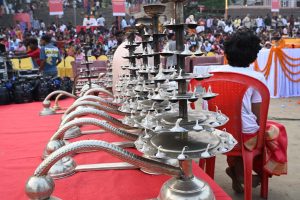
The Ganga Aarti was a magnificent spectacle. The priests performed the rituals with large, multi-tiered lamps, creating a beautiful display of fire and movement. The towering flames, rhythmic movements, rising smoke and illuminated surroundings made the entire scene almost surreal.
I spent some time photographing the ceremony before moving towards other ghats to experience the celebrations from different locations. It was a visual treat and perfect food for a photographer’s soul.
In the distance, fireworks continued to light up the night sky with bursts of colour. Their reflections shimmered on the waters of the Ganga, while a long line of lights along the opposite bank added to the beauty of the scene.
Despite the enormous gathering, the police and local administration managed the crowds very well. I did not notice any major disturbance or nuisance. What surprised me even more was the cleanliness of the ghats. Even during the day, I had noticed sanitation workers constantly cleaning the steps and keeping the surroundings tidy.
A Journey to Remember:
For me, it was a wonderful experience. I had finally ticked off one destination and one festival from the travel checklist I had prepared after retirement — witnessing Dev Deepawali in Banaras.
What began as a solo trip to Banaras was later extended to Sarnath and Ayodhya, making the journey even more memorable.
Retirement has given me the time and freedom to explore places I had always wanted to visit. My travel checklist is still long, and there are many more destinations waiting to be explored.
After all, there is no age to travel, discover and follow your passion.