By Dr Tania Saili Bakshi
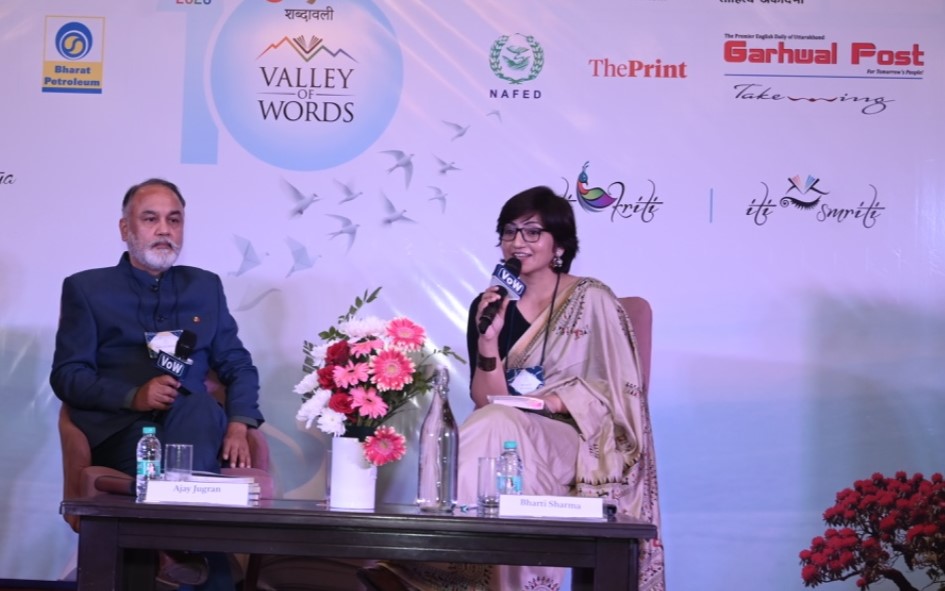
Dehradun, 27 Nov: A houseful session at the VoW Litfest in Dehradun brought readers into a lively conversation with son of the soil, lawyer, poet and author Ajay Jugraan about his Hindi short-story collection, Haar Upahaar Aur Anya Kahaniyan. Conducted by poet, author and academician Bharti Sharma, the free-flowing interview explored the experiences, literary influences and beliefs that shape his fiction.
Sharma’s engaging, well-researched questions revealed a close reading of the book. Moving between individual stories, the collection’s title, its cover photograph and Jugraan’s approach to language, she gave the discussion both depth and an easy conversational rhythm. An enthusiastic audience, whose questions extended the conversation, added to the session’s warmth.
Haar Upahaar Aur Anya Kahaniyan is a collection of 51 stories, approximately 23 of which Jugraan translated from his English collection, The Bridge on the River Song. Sharma’s question about translation opened a particularly personal reflection on his relationship with the two languages.
For Jugraan, a story begins with ordinary people—their small joys, disappointments, beliefs and struggles. Its purpose is less to deliver a grand lesson than to understand how people live with their contradictions.
Asked by Sharma about life’s most beautiful and most difficult truths, he located beauty in the human capacity for imagination, hope, effort and compassion. The difficulty, he suggested, lies in the distance between knowledge and acceptance: people believe in a divine power they do not fully know, yet struggle to accept the mortality they know to be certain.
English, he explained, was a language acquired through education and professional life, associated with discipline and the mind. Hindi is his doodhboli—the language received with his mother’s milk, belonging instinctively to the heart. Translating into Hindi therefore became an opportunity to feel the stories afresh and refine them.
His literary influences include Shivani, Ruskin Bond, Premchand, Tolstoy, Gorky, Chekhov and Kafka. Reading their stories, he said, is a form of conversation with their authors—and sometimes an experience of becoming their characters.
Sharma also drew him into a discussion on digital media and the future of books. Jugraan, who shares poetry and haiku on Instagram and YouTube, acknowledged that he had not systematically studied the subject. His observations were those of a writer watching reading habits change.
The conversation’s range owed much to Sharma’s familiarity with the collection. Referring to the mysterious atmosphere of Banaras Ki Thandai alongside stories concerned with action and endeavour, she asked how faith, mystery and realism coexist in his writing.
Jugraan first responded with a joke about bhang helping the journey towards the supernatural in Banaras Ki Thandai. His fuller answer centred on what he called “divine incompleteness”. Sharma’s questions also connected the domestic world of his fiction with its historical and regional concerns, including Garhwal’s Rani Karnavati. Jugraan sees history as a source of learning for individuals, societies and nations.
Discussing titles such as Doctor Chidhaku and Bhrashtachar Ka Nanga Calendar, he described social absurdity and corruption as familiar realities that naturally enter his stories. Jugraan’s humour reflects his own cheerful disposition and his wish to offer readers some relief from the difficulties they recognise.
The discussion of the collection’s title brought its public themes back to a deeply personal source. In Hindi, haar can mean both defeat and a garland; upahaar means a gift. A defeat can become a gift when its lessons help someone move towards success.
The audience’s questions and enthusiasm carried these ideas beyond the interview itself. In a packed session, Sharma’s thoughtful preparation and conversational ease helped create an engaging encounter between a Dehradun writer, his work and the readers who had gathered to hear him.