 By: Ganesh Saili
In my early days in college, I first bumped into Harsh Pati Nautiyal. Looking back through Time’s tunnel, he stares back at me like a genie who has lost his way. The very mention of his name still evokes a smile. We used to call him ‘Hash Pati’ – for he was the only person as far I know who spoke ‘Hinglish’ with an accent so special that only he could understand what he was saying. None amongst us could dare decipher what he had said. One fine day he vanished, taking his precious accent with him. He was last seen with a hippie, so presumably he went overseas. Wherever he be, this much I know: ‘Hash Pati’ Nautiyal will make it! His accent will see him through.
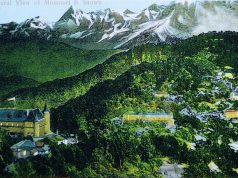
Almost two hundred years ago, the Angrez found our foothills perfect for setting up the first English medium school in the Himalaya called the Mussoorie Seminary. In 1834, it was meant for white parents, too poor to afford the added expense of sending their wards around the Cape of Good Hope to England. Lady Emily’s diary describes her meeting several little ones chaperoned by their helpers, who were travelling to this school.
Then came our second oldest school – Waverley Convent of Jesus and Mary – for girls, founded in 1845; followed by St. George’s College for boys in 1853; and Woodstock School. The last had started as a finishing school for girls, founded in 1854 and located in Cainville, became where the Indo-Tibetan Border Police Academy is currently located.
Although Rudyard Kipling had nothing to do with it, call it sheer coincidence, it so happened that in the year he came up the hill in 1888, two schools were founded: Wynberg-Allen School and Oak Grove. Mussoorie had indeed become one vast seminary. At the time of Independence, schools that took in new alumni thrived while those that failed to do so – Cainville and the Seventh Day Adventists’ included – stared at economic ruin.
In 2012, Ruskin Bond and I came together to do a book called ‘Letters of a Mussoorie Merchant,’ which tells the story of Maugher Monk, who came out to India as a teacher in the Mussoorie Seminary, joining on the 13th of April 1840. He later tried his hand at many different things. Tragically, nine years later, aged all of 34 years, he caught a chill and died enroute to Meerut. That is where he rests.
But his letters written to his father and sisters survive, and they paint a fascinating picture of British social life in the 19th century and the part that hill stations played in the lives of those who made a living out here. Rarely does one come across expressions like: ‘Every mickle makes a muckle’; or ‘Herring Pond’ (the Atlantic Ocean). He went to the Kumbh Mela; he went on a shikar with Frederick Wilson, who minted his coins to be called Rajah Wilson of Hursil, and there is never a dull moment. This unique collection of letters reads like a novel.
At day’s end, when we are done and dusted, languages tend to meet and mingle. Hindi purists can cringe at words that we have absorbed like achar, chabi, santra, aalpin and balti from Portugese; kainchi, chamach, topi, barud, and khanjar came to us from Turkish, and French gave us kaju, kartoos, and coupon. Of course, English gave us so many words that trying to list them would be an exercise in futility.
Further afield, while going to neighbouring countries where English is rarely spoken, comes the realization that these places were never colonized: for instance, Nepal and Thailand. Whilst I was wandering around Pattaya, a pretty girl walked up to me, and lest this tale get too long in the telling, or give you visions of hard-up authors softened by a massage, let me reassure you that this time it’s your turn to be surprised. Her eyes still haunt me as she sincerely asked me a question: ‘How long will it take me to learn to speak English like you Indians do?’
How I wish could have given her even a half-decent answer!
Ganesh Saili born and home-grown in the hills belongs to those select few whose words are illustrated by their pictures. Author of two dozen books; some translated into twenty languages, his work has found recognition worldwide.