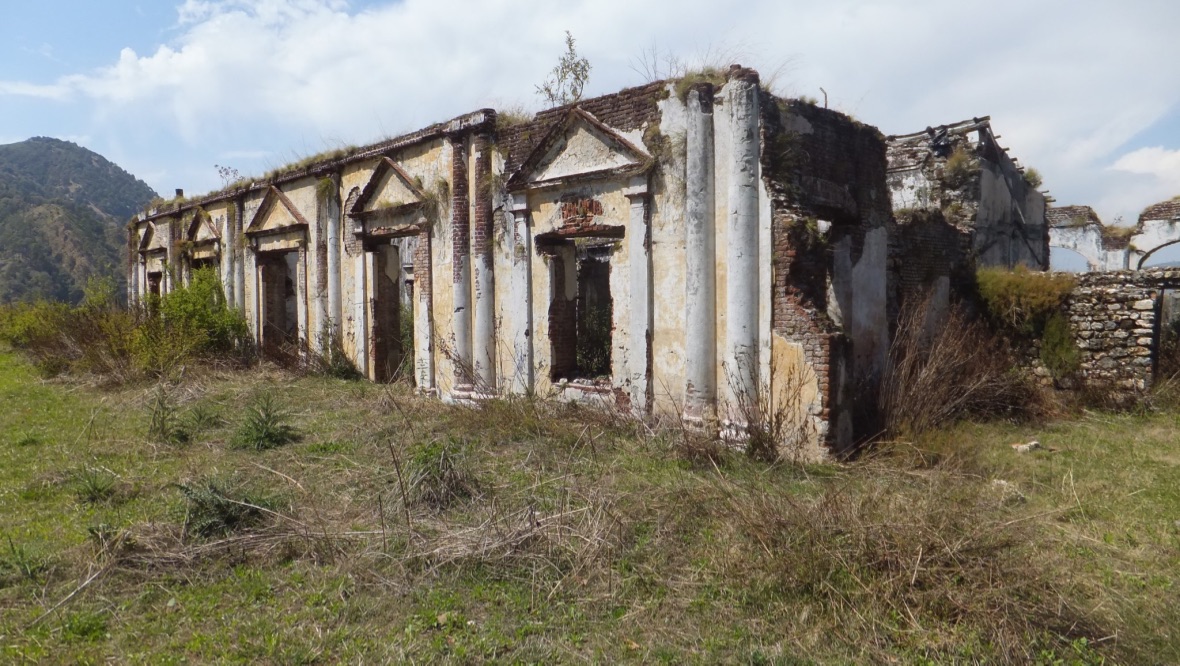
Ruins of the Bohle Brewery. Pic courtesy: Mark Windsor
By GANESH SAILI
For close to a hundred years, our breweries ensured that no one died of thirst at our clubs, hotels, or restaurants. Our affair with alcohol can be traced back to 1830 when Henry Bohle (who sleeps under the most elaborate grave in Camel’s Back Cemetery) came up this hill. He found out that the plains were ill-suited for making beer, so brewers headed to the cooler climes of Darjeeling, Murree, Mussoorie, Nainital, and Solan.
Trouble knocked for Bohle when he was accused of supplying beer to soldiers from the Convalescent Depot, using forged passes. Poker-faced Colonel Young, Superintendent of the Dun, was not impressed. He could not let this pass and called upon Bohle to account for distilling spirits without a license. Of course, the fact remains that no trace of a distillery was ever discovered in Bohle’s Brewery. Nonetheless, the fledgling venture floundered, and his estates were hammered down.
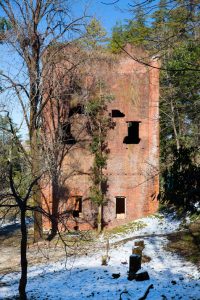
Mackinnon Brewery. Pic courtesy: Karam Puri
In his wake came the Scotsman, John Mackinnon, who tried his hand at many things. Buying the estate, he married Bohle’s sister and started a brewery slightly north of Lyndale or Bansi Estate, spread over six acres. This old brewery produced Pale Ale, Strong Ale (XXXX), and XXX Porter. Advertising it as: “These Ales and Stout are brewed with Malt Cured on the German system and the finest English hops only, and are guaranteed free from Arsenic.” Hops are the female flower of the hop plant, used as a flavoring and stability agent in beer, giving it a bitter, tangy flavor.
Reminds me of a legend from the past that has everyone smacking their lips over an exceptionally good brew. It was soon traced to Vat 42 – “everyone re-drank, re-tasted, and re-tested, until the diminishing level of beer revealed a worker who had slipped and fallen unnoticed into the vat and drowned.” His supreme sacrifice did not go in vain as it gave the local beer trade a real fillip and kept our station in high spirits.
In 1876, the Crown Brewery was set up by J. H. Whymper on Brookland Estate. Soon after, a recommendation came from Lieut.-Col. J. M. Campbell, R.A. Commandant of the Landour Depot, who stated: “I have the honor to inform you that the Beer supplied by you to the Depot under my command has invariably been of the most excellent quality, and that the non-commissioned officers and men prefer it to any other which has at any time been issued to them.”
Brookland’s Whymper Brewery ruins now built over
Obviously, it was not only the Redcoats who had parched throats. It included an inebriated army chaplain – Mr. Blunt – who seems to have exposed himself to soldiers and sailors while “talking all sorts of bawdy and ribaldry and singing scraps of the most blackguard and indecent songs.”
Often, in my mind’s eye, I can see him skidding – sevensheets to the wind – down the corridor of the Sergeant’s Mess near Landour’s Cheh Tanki, singing: “Beer! Beer! Glorious Beer! Fill me right up to here!”
By 1903, Mackinnon’s Brewery and Crown Brewery employed 131 men and produced an enormous half a million gallons of beer. The liquid gold rush, if you would not mind my calling it that, lasted seventy years. By 1920, with the advent of newer technologies, it was possible to brew beer almost anywhere.
A plain truth that has often been told is that the more things change, the more they remain the same. Our moment of grief came without any fanfare when prohibition was imposed in our hills in 1977. We were left, literally, high and quite dry. In desperation, we would try almost anything, which included the foul-tasting, alcohol-laced Ayurvedic tonic Mrit Sanjivanisura. It was justifiably reputed to bring back the dead to life, though we soon discovered that the taste alone could put you to sleep.
Showing enterprise, our local milkmen rose to the occasion. They filled our hot-water bottles with hooch from hidden stills in the village. The only trouble was that the contents reeked of rubber, and in the morning, our beds stank like a brewery.
Who said- You can tell a man who boozes by the company he chooses!?
Ganesh Saili, author-photographer, has written and illustrated twenty books. He belongs to those select few who illustrate their own writing. His work has found publication in periodicals, columns, and journals, in more than two dozen languages.