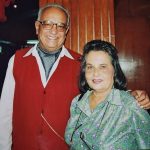
 By Hugh & Colleen Gantzer
Chapter 1: Marching Into Tomorrow
It was the 15th of August 1947.
At five o’clock that morning, the bells in the Clock Tower chimed the refrain of Big Ben.
THROUGH THIS DARK NIGHT
GOD BE MY GUIDE
AND BY THY POWER
NO FOOT SHALL SLIDE.
That was more than a chime: it was a prayer. We had to march in columns up to Mussoorie, a long distance away and higher than the Big Flat in St George’s College. It was not going to be an easy march because we had to wear hob-nail boots and trudge on a wet gravel road. But we welcomed it. We had been given the privilege of being the first citizens of Independent India to hoist the National Flag in our small mountain town: Mussoorie. We looked forward to sharing that honour with the senior girls of Waverley Convent.
Today, decades later, that memorable event is a series of flicker-swift images burnished with the gilt of history.
Crunch! Crunch! Our guards at our gate salute us. Mr Hearsey, our Parade Instructor, returns the salute. “Crunch! Crunch!” We start the long climb to Mussoorie. The clouds break, a ray of sunshine touches us. On our left Dehradun spreads below us stretching to the Shiwaliks. Patches of blue appear in the sky. We pass a train of 3 mules carrying tins of kerosene. Mr Hersey orders sing the Colonel Bogey March. It was written in 1914 by Lt JF Richards, a British Army Bandmaster under the pen name of Kenneth J Alford. “BULLOCKS IS ALL THE BAND CAN PLAY
BULLOCKS FROM DAWN TO END OF DAY
BULLOCKS FROM DAWN TO END OF DAY”
Perhaps, at that time, the British Army used bulls to pull heavy loads. Perhaps. It is a fact that the marching songs gave us new spirit and when we reached the beginning of Mussoorie’s main road, The Mall, we were greatly relieved. A breeze sprung up cooling us. The drizzle stopped, clouds began scudding away. The sun glistened on the grey gravel Mall. Familiar landmarks flickered past.
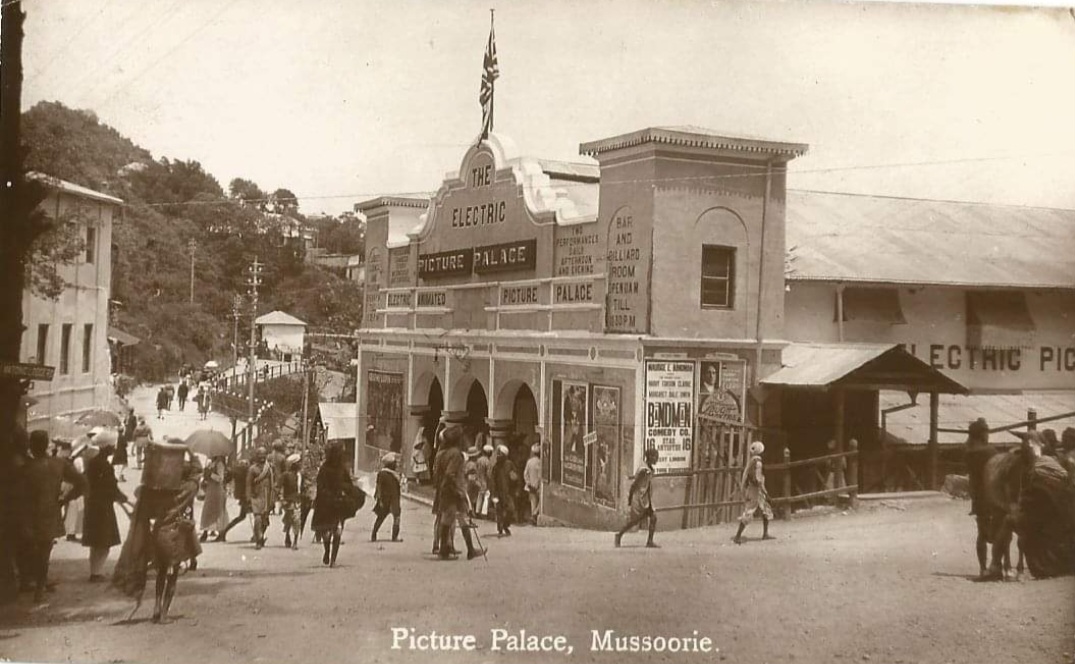
THE ELECTRIC PICTURE PALACE: Mussoorie was the first hill station to generate its own electricity. It supplied power to Mussoorie, Rajpur, Dehradun and Clement Town. Its Municipality became exceedingly rich. The Picture Palace was one of seven cinema houses in Mussoorie.
We marched on passing other landmarks.
THE PARIS RESTAURANT was buzzing with school kids feasting on chicken curry and rice at Rs 5 per plate, and around the corner RASTOGI STORES, magical, mystical and romantic filled with the accretion of adult memories: musk, saltpetre from the trans-Himalayan plains of Nubra and the Garhwali grain of cockscomb to fried fungoid caterpillars to enhance high altitude restoration.
Left Right, Left Right, Left Right.
We tread the path of mouth-watering confectioners from all over our sub-continent. THE SINDHI SWEET SHOP. Their confection originated in an area that is now in Pakistan. Then there was the BENGALI SWEET SHOP. The Indian province of Bengal was split into two. Half was given to Independent India, the other half to Pakistan. There is nothing sweet about that partition.
We moved on climbing up the Kulri slope and past halwais of Garhwal cooking behind golden, succulent pyramids of jalebis.
We were now moving into the elite area of Mussoorie. Here were displayed fur coats from Kashmir and a middle-aged Kashmiri sat outside a dry-cleaning establishment removing a thread from a garment and using it to darn a tear so skilfully that it was invisible to the naked eye.
Mussoorie’s pioneering dry-cleaners SUNBEAM advertised their services in poetry.
Kings and Princes, Knights and Earls, Men and Women, Boys and Girls
Hear the Universal Call let the Sunbeam clean it all.
The high point of BREEZY CORNER with shrieks of visitors as the wind from the Doon caused upskirt exposure. But their pragmatic English cutter, from the Drapers next door, Norge, while waiting for his next customer is wearing the tape measure around his neck.
Left, Right, Left, Right past the Imperial Bank of India and FITCH & CO, Provision merchants, slowly morphing into the RAILWAY OUT AGENCY, then down to the lowest point of the Mall overlooking the CONVENT OF JESUS & MARY HAMPTON COURT.
Its young students lining up under the great Horse Chestnut Tree.
We reached HACKMANS GRAND HOTEL with its sprung, wooden, dance floor. But we had no time to jive with Elvis or twist with the Comets, as we strode up a slope for a brief refreshment break at the COURT HOUSE. Then down to the Mall again, Left-Right, Left Right, Left Right past the STIFFLES RESTAURANT. The Stiffles were a family of Swiss bakers who had settled in India and become part of our land.
We were a little tired now but were relieved to see the wonderful MUSSOORIE OLD LIBRARY BUILDING rising at the far end of the Mall. Members of the Municipal Board and other local dignitaries were seated in the verandah of the Library Building. Many of our classmates greeted their sisters and cousins from Waverley and then we formed up around the FLAG MAST.
We were called to attention and heard JANA GANA MANA played for the first time as the FLAG OF INDEPENDENT INDIA was hoisted and flung open, starched in the breeze of INDEPENDENT INDIA.
At that moment the Ruler of Britain ceased to be the Emperor of India. Since he had never been the Emperor of any other country, the British Empire also collapsed. It was a fitting end, because it had begun only when the people of Britain realised that their future lay in the conquest of India.
This is the story of that adventure and of the pivotal role played by our small town, Mussoorie.
In the Fireside and Drawing Room chats that follow, we will tell you why Mussoorie played the essential role of the Love Child of the Himalayas. Without it the British Empire would have taken a different form. With it, it became THE GLOBE-ENCIRCLING EMPIRE ON WHICH THE SUN NEVER SET.
It all started when a handsome, swashbuckling scoundrel of an English Seadog sullied his cloak to win the heart of his Queen. His name was Sir Walter Raleigh.
(Hugh & Colleen Gantzer hold the National Lifetime Achievement Award for Tourism among other National and International awards. Their credits include over 52 halfhour documentaries on national TV under their joint names, 26 published books in 6 genres, and over 1,500 first-person articles, about every Indian state, UT and 34 other countries. Hugh was a Commander in the Indian Navy and the Judge Advocate, Southern Naval Command. Colleen is the only travel writer who was a member of the Travel Agents Association of India.) (The opinions and thoughts expressed here reflect only the authors’ views!).