Garhwal Post Bureau
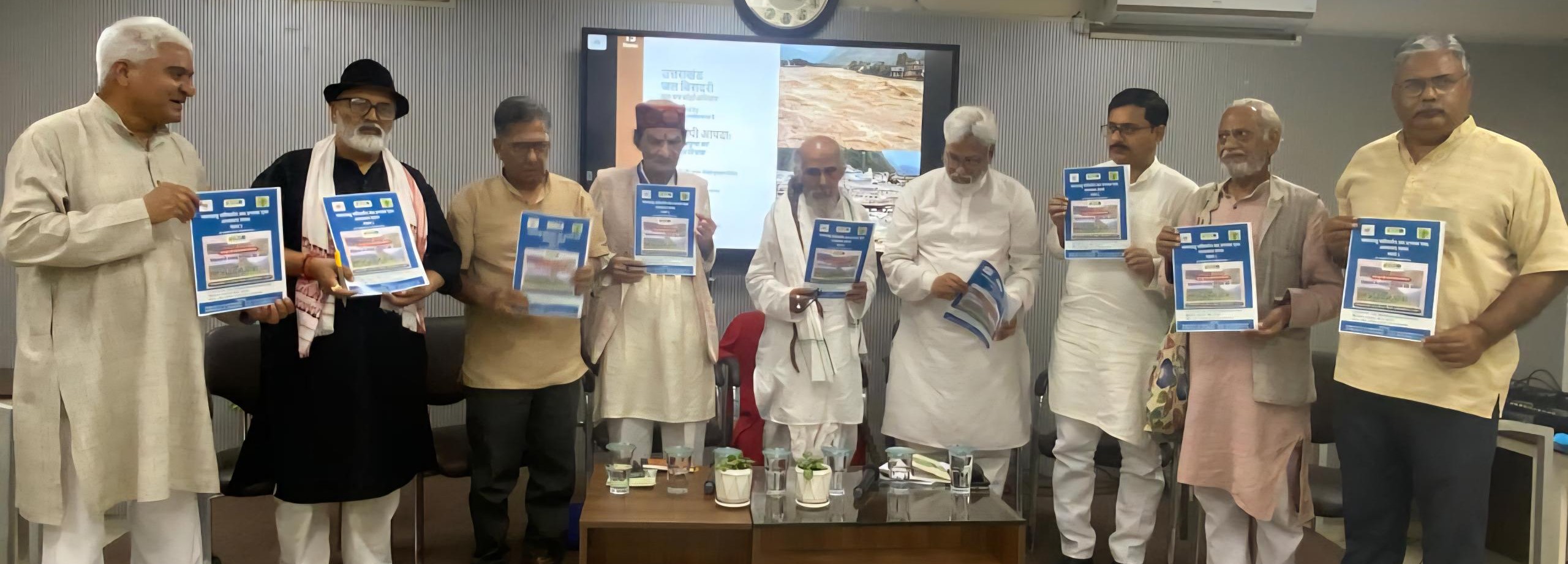
Dehradun, 15 Sep: A one-day meeting on “Himalayan Disaster – Development or Destruction of the Ganga and Yamuna” was organised by the ‘Uttarakhand Jal Biradari’ at the Doon Library and Research Centre, here. The speakers said that the present situation is a result of existing policies, emphasising that the road width in the Himalayan region should not exceed 5–6 metres.
Environmental activist Suresh Bhai, while opening the discussion, said that the current disaster is manmade. He stated that wide roads are not needed in the Himalayas. Since the construction of wide roads and dams began in Uttarakhand and Himachal, these regions have become disaster-prone.
Magsaysay Award winner Rajendra Singh (Waterman of India) said that people themselves are responsible for the wounds inflicted by disasters in the Himalayas. He gave a recent example, noting that the dams in Himachal had drowned villages in Punjab. The Bhakra Nangal and other dams had already filled up by June, but when rainfall occurred in Punjab, Haryana, and Delhi, the dams were opened, causing devastation in Punjab. Similar unplanned development across the Himalayas has pushed the region into crisis. He further said that rivers’ freedom and the greenery of the Himalayas are both under threat. Stressing the link between divinity and nature, he reminded that the ancestors connected “God” with the five elements of nature, which must be restored. Describing current development as just a “lollipop”, he added that governments alone cannot conserve natural resources—it requires people’s participation.
Padma Shri awardee Kalyan Singh Rawat said that the Himalayan “water towers” are under serious threat as glaciers are melting rapidly. Traditional community practices of conserving resources have been forgotten. Large-scale plantation drives are happening without purpose. He stressed that plantations should be need-based, as broadleaf trees in the upper Himalayas are being replaced by chir pine, which is worsening the disaster risk.
Environmentalist Prof Virendra Panwar (Panyuli) questioned the government’s statement that Delhi receives only 10% of the Yamuna’s original water—then what makes up the remaining 90%? He blamed unplanned development policies for disasters.
BJP leader Ravindra Jugran suggested forming a separate Himalayan Ministry to ensure that development in the region serves the public interest.
Swami Shivanand of Matri Sadan criticised the Uttarakhand government for its insensitivity towards development and Ganga conservation. He said two ascetics had sacrificed their lives for the Ganga, yet governments have ignored their demands.
Sanjay Singh of ‘Delhi Jal Biradari’ suggested that all organisations working for disaster relief and resource conservation should issue a white paper to define a future course of action.
Poet Atul Sharma recited his poem – “Now the rivers are in crisis, let the whole village gather” – and urged people to unite for development issues just as they had during the Uttarakhand statehood movement.
Sanjay Rana from Haryana highlighted that the Yamuna swallowed 10,000 bighas of land this year (about 5 sq. km), stressing that the flood plains were originally the Yamuna’s path 45 years ago.
Geologist Prof SP Sati expressed concern that the youth have become misguided, with governments to blame. He pointed to abnormal weather shifts—rainfall in deserts and uncontrolled rainfall in the Himalayas—as the drivers of disasters. Poorly constructed roads in Uttarakhand, he said, are also inviting calamities.
Historian Dr Yogesh Dhasmana said that policies must be framed on the Himalayas’ carrying capacity, regulating the flow of tourists and pilgrims.
Senior journalist Vijendra Singh Rawat suggested training Himalayan youth as “Himalayan Guards” or “Frontier Guards” so they can protect and manage the fragile environment.
Key suggestions offered at the meeting were: Debris from future road-widening works on Yamunotri and Gangotri highways should not be dumped into rivers but disposed of in designated dumping zones, with plantation carried out on top. Protect deodar and other tree species along the Gangotri highway by following recommendations of ecological studies. Introduce climate-resilient programmes to safeguard the livelihoods of small and marginal farmers living near the sources of the Ganga and Yamuna.
Conserve the biodiversity—plants, herbs, wildlife, and streams—around Gaumukh and Bandarpunch glaciers by involving local communities with state and central governments.
Restrict major construction activities within 150 km of the sources of the Ganga and Yamuna due to high risks of floods, earthquakes, and landslides. Instead, focus on small-scale works like durable roads, water source conservation, afforestation, and sanitation, creating local jobs for women and youth. Manage plastic and waste generated by unregulated tourism to ensure it does not enter the sacred Ganga waters and prevent sewage disposal into rivers.
Also, develop a separate Himalayan Model of Development—a Himalayan Policy—since plains-based models cannot be applied to mountains. Limit the annual number of pilgrims and train them beforehand to prevent littering and ecological damage. Ensure that pilgrims use public transport instead of private vehicles during yatras, reducing traffic load and black carbon emissions in the Himalayas.
The participants included Padma Shri awardee Kalyan Singh Rawat, environmental activist Sanjay Rana (Uttar Pradesh), columnist Prof Virendra Panyuli, poet Atul Sharma, Sarvodaya worker Ramesh Sharma, Subhash Nautiyal (Nagrik Manch), Sanjay Bhai (Rajasthan Jal Biradari), Sameer Raturi (Himalaya Bachao Movement), folk artist Nandlal Bharti, Dr Ashalal, Sarvodaya leader Kusum Rawat, environmentalist Shyamlal, folk artist Kundan Singh Chauhan, and social activist Shailendra David, among others.