Concluding Day
Garhwal Post Bureau
DEHRADUN, 15 Dec: The concluding day of the Crime Literature Festival of India, organised by the Doon Cultural and Literary Society (DCLS), on Sunday unfolded as a compelling culmination of conversations examining crime through the lenses of media, technology, justice, faith, literature, cinema and lived realities. Held at Hyatt Centric, Dehradun, the closing day witnessed thought-provoking sessions led by Former Commissioners of Delhi Police, Amod Kanth & Neeraj Kumar, former DGP-Uttarakhand Anil Raturi, Actress Tridha Choudhury, DSP (Retd), UP, KK Gautam, Writer, Actor & Bigg Boss Contestant Zeishan Quadri, former DGP-Uttarakhand Ashok Kumar, former DG Aloke Lal and Author Maanas Lal.
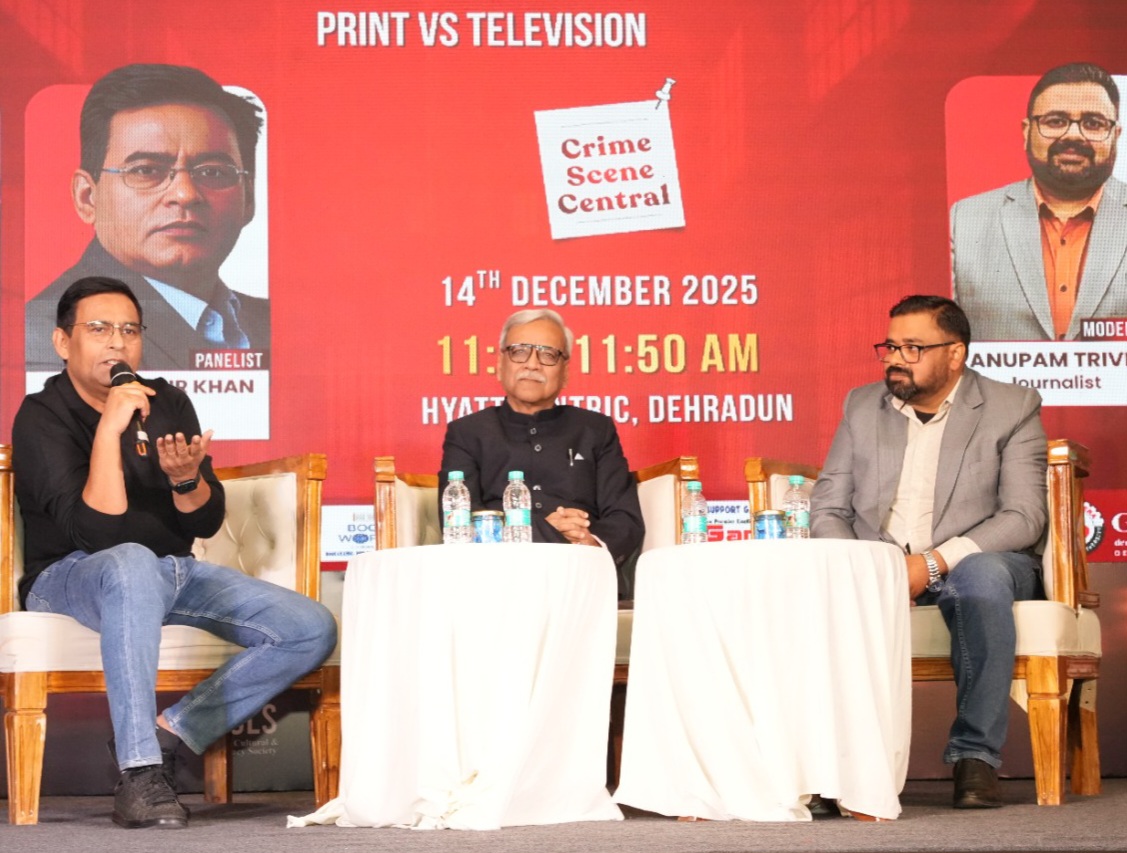
The day began with a session titled “Perspectives on Reporting Crime: Print vs Television”, at which Journalists Ashwini Bhatnagar and Shams Tahir Khan were in conversation with Anupam Trivedi. They discussed the contrasting responsibilities, pressures and ethical challenges of crime reporting across media formats. Ashwini Bhatnagar observed that journalism today is caught in a blur between content and news, with sensationalism often replacing factual reporting, leading to a sharp decline in media credibility. Shams Tahir Khan remarked that the media has shifted from journalism to entertainment, noting that media trials can both influence judicial processes and force authorities to act, while also shaping public thinking through selective narratives. Anupam Trivedi highlighted shifting consumption patterns from print to television and digital media, warning that the absence of editorial filters today has led to irresponsible reporting on sensitive issues such as caste and religion, deepening social divides.

This was followed by “Framed by AI: Deepfakes and the Risk of Digital Arrest”, featuring Additional SP, Intelligence & Security, Ankush Mishra, Journalist Mitali Chandola and Anti Cyber Specialist Dr Gagandeep Kaur in conversation with Pooja Marwah, which examined the growing dangers of AI-driven crime and digital manipulation. Mishra explained how deepfakes, ranging from morphed images to voice cloning, are created, stressing that everyone has a digital footprint and cyber hygiene is crucial. Chandola noted that crime has largely shifted online, warning that “digital arrest” exploits victims psychologically and that awareness remains the strongest defence. Dr Kaur highlighted the rising threat of cybercrime, particularly sextortion, in which victims are trapped and blackmailed through video calls.
In “Innocence at Risk: The Complex Landscape of Juvenile Justice”, IPS officer and social activist Amod Kanth spoke with former DGP Anil Raturi on the vulnerabilities of children within the justice system, stressing reform, rehabilitation and accountability. During the discussion, Kanth clarified that juvenile is not a loaded term and is now replaced by Child in Conflict with Law and Child in Need of Care and Protection, emphasising that the Juvenile Justice system focuses on care rather than punishment, with records cleared to protect a child’s future. He noted that juvenile crime accounts for less than one percent of total cases, while India has nearly 3–3.5 crore children in need of care, far exceeding the institutional capacity of about two lakh, with adoptions limited to 3,000–3,500 annually and foster care and sponsorship still weak. Highlighting the work of Prayas JAC Society, he said rehabilitation is achievable, as seen recently when 10 girls from a child care home cleared Delhi University examinations, but warned that poor aftercare post-18, weak implementation of Mission Vatsalya, underused child welfare committees, limited NGO support, and the closure of helpline 1098 remain serious systemic gaps. Anil Raturi added that while adolescence is a complex developmental phase, the 2015 amendment to the Juvenile Justice Act allows 16–18-year-olds involved in heinous crimes to be assessed for mental and physical maturity, noting that most such cases arise from deeply deprived socio-economic backgrounds.
The intelligence world came into focus with “The Delhi Directive: The Inside Story of Secret Operations by Intelligence Agencies”, in which Anirudhya Mitra and Anil Raturi were in conversation with Manoj Barthwal. Author Anirudhya Mitra said that characters are central to his storytelling, noting that a person’s core personality does not change with their profession. He shared that, while he chose fiction to allow for narrative flexibility, the book is grounded in extensive on-the-ground research. Former DGP Anil Raturi added that while intelligence work demands complete responsibility and commitment, life extends beyond one’s job profile, observing that intelligence professionals remain largely unsung due to secrecy, even as their mistakes attract swift attention.
In “Bawali Commander”, writer and filmmaker Amit Khan, in conversation with Sanjiv Mishra, reflected on the changing idea of heroism, saying today’s political leaders often blur the line between hero and villain. He stressed that stories should endure for decades, celebrating heroes whose values stand the test of time, adding that true heroes are those willing to sacrifice their lives for the nation.
This was followed by “Crime Kahaniyan: Serial Killers Se Savdhaan Tak”. Author Anirban Bhattacharyya and former Commissioner Neeraj Kumar spoke with Srishtree Sethi about storytelling, psychology and crime narratives for mass audiences. Bhattacharya stressed the need for restraint in crime storytelling, warning against sensationalism for TRPs and praising layered portrayals of police such as Delhi Crime and Paatal Lok, while noting that budgets significantly impact content depth.

Neeraj Kumar underlined that policing has both human and moral complexities, sharing personal experiences from life-threatening cases and urging support for local bookstores and Indian authors.
Social impact themes emerged strongly in “Unseen Wounds: The Real Impact of Bullying”, featuring Educationists Jyotsna Brar & Sangeeta Kain, and Author Maanas Lal, who were in conversation with Ridhima Oberoi, highlighting emotional trauma, digital harassment and long-term psychological effects. Jyotsna Brar stressed the need for corrective support over punishment, especially for younger children, while Sangeeta Kain called bullying a systemic failure marked by ignored complaints and lack of counselling. Maanas Lal shared his experience as a victim, urging institutions to support children with sensitivity rather than penalising them.
Cinema and crime intersected in “Beyond Wasseypur: The Evolving Voice of Zeishan Quadri”. Filmmaker Zeishan Quadri spoke with Nitin Upadhyaya about realism, regional narratives and crime storytelling in Indian cinema. Quadri said crime narratives often carry an element of dark humour, citing films like Khosla Ka Ghosla as examples of crime comedy. He noted that films often portray criminals as highly intelligent, whereas in reality they are more daring than sharp, often relying less on intellect. Looking ahead, Quadri revealed plans to write a non-fiction book in 2026 on an African-origin community in India that has won several medals yet continues to struggle for social acceptance despite living in the country for centuries. Reflecting on his Bigg Boss journey, he said he entered the show in 2025 without a game plan and was overwhelmed by the respect, warmth and love he received from fellow contestants and audiences alike.
The evening sessions opened with “Fiction as History: Bose vs Nehru”, featuring Journalist Anshul Chaturvedi in conversation with Aloke Lal. Aloke Lal spoke about a new literary space where history and fiction seamlessly merge, making historical facts more engaging when they are paired with imagination. He observed that such storytelling allows readers to experience history with the involvement of a novel, while still learning in an academic sense, adding that this approach has resulted in compelling works such as A Bird from Afar by Anshul Chaturvedi.
According to Anshul Chaturvedi, “Subhash Chandra Bose was marked by the courage to walk away, driven by a lack of insecurity rather than attachment.” He pointed out that Bose never believed holding on to positions or labels made one more secure, nor was he comfortable being confined to linguistic or regional identities. He also dismissed the notion surrounding conspiracy theories about Bose being alive as it lacks credibility.”
Prime-time discussions included “Behind the Badge: Stories Built for the Big Screen”. Actress Tridha Choudhury, well known for her shows like ‘Aashram’ & ‘Bandish Bandits’, along with KK Gautam, spoke with Satish Sharma about adapting real crime and policing stories for cinema and OTT platforms.
Actor Tridha Choudhury spoke about the psychological roots of crime, saying that in India crime often begins in the mind before taking a larger form, a reality reflected in the series Aashram. She said her character Babita highlighted how crimes that seem unimaginable do occur in real life, which resonated strongly with audiences. Tridha shared that the overwhelming love and recognition she received— especially being addressed as “Japnaam”—made the role particularly special for her. Expressing her fondness for Dehradun, she said the city’s clean air, pleasant weather and closeness to nature align with her focus on health and fitness, adding that the city feels like a peaceful and soothing escape.
Faith, fraud and belief systems were explored in depth in “Gold, God and Gurus: The Sinister Cult of Faith and Fraud”, featuring former DGP, Uttarakhand, Ashok Kumar and actor Tridha Choudhury in conversation with Gaurav Dwivedi. Speaking during the session, former DGP Uttarakhand Ashok Kumar said that law enforcement agencies across the country have uncovered and documented a wide range of criminal activities operating under the cover of faith in certain ashrams, including financial exploitation and abuse of followers. He clarified, however, that this does not imply that all ashrams or spiritual institutions are fraudulent, stressing the need to clearly distinguish between genuine faith and organised deception. Reflecting on the festival’s conclusion, Kumar noted the successful completion of the Crime Literature Festival, saying it had enabled meaningful conversations on crime, belief systems and public trust, while also educating the public on critical issues such as juvenile justice, cybercrime, drug abuse, land frauds and women’s safety, by bringing together diverse voices from policing, literature, cinema and journalism.
Parallel sessions at The Detective’s Den featured literary and thematic deep dives, including “What Draws Us to Write About Murder: A Conversation Across Languages” with Anjali Kaur Sunderaj and Gopal Shukla. Drawing from over 10 years of experience in crime reporting, Gopal shared that while his book is written in the language of fiction, its characters and cases are rooted in real life.
This was followed by “Love and Crime: A Deep Dive into Love, Lust, Jealousy and Murder” with Ruby Gupta and Ashwini Bhatnagar; and “The Challenges in Editing Crime Writing”, in which Penguin editor Srishtree Sethi spoke with Sanjiv Mishra, who said crime writing must be grounded in strong ethics, stressing that every line an author writes should be defensible and responsible. He added that while social media has altered writing standards, quality writing with integrity will always find its way to a credible publisher.
True crime realities were explored in “Narco Realities: True Crime Stories Behind the Headlines”, featuring Ram Singh Meena and Rajesh Mohan with Meenakshi. Speaking during the session, Meena explained that while drugs often originate from natural substances like opium and cannabis, enforcement typically catches only small-time sellers and addicts, while the main supply operators remain hidden. This was followed by “Matrimonial Crimes from the Eyes of a Private Detective”, where Dev Goswami spoke with Ruby Gupta, “The Oath of Shakuni: Mahabharata as a Crime Epic”, featuring Sapan Saxena, Harry Paintal and Suhail Mathur in conversation with Vinay Kanchan, offering a mythological lens to crime, revenge and moral conflict.
The festival concluded on a powerful and reflective note, with Festival Chairman and former DGP, Uttarakhand, Ashok Kumar, Festival Director and former DG, Uttarakhand, Aloke Lal, Festival Secretary Randhir K Arora, Chief Coordinator, DCLS, Praveen Chandhok, and Secretary, DCLS, Maanas Lal reaffirming their shared resolve to take the Crime Literature Festival of India to even greater heights. Together, they underscored the festival’s growing role as a nationally significant platform-one that sparks fearless conversations, bridges lived experience with storytelling, and deepens public understanding of crime, justice, and society. Their closing remarks set a clear vision for CLFI’s future: bolder dialogues, wider participation, and a lasting impact on the national discourse.