 By: Ganesh Saili
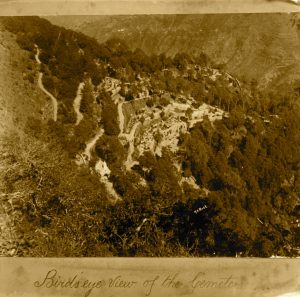
If you enter the lychgate of the Camel’s Back cemetery, you will risk being swallowed up by the dense scrub. Good fences don’t always make good neighbours. Wading through a riot of Congress grass, I arrive at a lonely grave. It stands out because of the scarlet leaves of the wild geranium. Some say it’s the rain; to others, it’s a bleeding heart. Interred here are the remains of probably one of the most callous outrages in the hill station – the murder of Mr James Reginald Clapp—if you were to accept that the man hanged for the crime was indeed truly guilty.
Clapp was an assistant in the chemists’ shop of Messrs. J.B. and E. Samuel, along Mall Road, and easily found companions among the soldiers. His only object, while in India, he would proudly tell everyone, was to save enough money to buy a house for his mother, who lived in Birmingham. This obsession made him stint himself in every way and with regularity, he remitted money home by depriving himself of his bare necessities.
On the night of August 31st, 1909, when the crime was committed, he was particularly friendly with Corporal Allen. Suspicion fell on the soldier because he had left Mussoorie that same night to arrive in Rajpur many hours later than expected, and, according to some, the victim had last been seen with him.
Collaborative evidence was flimsy. On the day of the occurrence, Mr. Clapp had received his salary and this sum in sovereigns and notes, which were never traced. Allen had made some payments in sovereigns at Rajpur. It was obvious that money was the object of the crime, but those notes were never found despite hundreds of labourers looking for any trace of the money down the defiles on the seven-mile route to Rajpur. Someone had given Allen some sandwiches packed in a biscuit tin for his journey down the hill, and folks believed that perhaps the tin had been used to hide the stolen money. The same search parties tried to find it but failed.
The murder was most brutal, with the attack being launched with a bottle on the victim’s head, and then the throat was cut from ear to ear with the victim’s razor, which was later found discarded on the shop floor.
Arrested in Rajpur, Allen was brought and taken immediately to the victim’s bedside. The authorities hoped that they might elicit a confession of guilt if they confronted him with the scene in broad daylight. Meanwhile, other troops from among Clapp’s friends waited outside seeking an opportunity to lynch Allen, but the police used a well-known local photographer, Mr. Thomas A. Rust, dressed up as an Allen lookalike, while the constabulary slipped the accused through the back door into the lockup.
Found guilty Allen was eventually hanged at Naini Jail, near Allahabad. But does that prove his guilt? Were those who always thought so not convicting him on purely circumstantial evidence? Or that Allen, though not stating so, certainly hinted that he was not in the vicinity that night. Instead, he was in the company of a lady whose name he refused to sully. Then there was the Chaplain—one of the station’s most honoured – who ministered to Allen in his last days on Death Row. He was convinced that the man was innocent. Left to him, he was prepared to absolve Allen, so certain was he that his charge was not that of a murderer.
Mr. Clapp, being a chemist’s assistant, was a close friend of Mr. and Mrs. Hamer, the original owners of Hamer & Co. It was left to Mrs Hamer to break the awful news to Mr. Clapp’s mother. That dear lady declared she could never die happily unless she could hold Mrs. Hamer’s hand and talk to her. Soon after, when Mrs. Hamer travelled to England, she complied with that sad request.
A hundred and more monsoons later, I scrape the moss and lichen, and push back the fiery geranium leaves off the tombstone, and the awful words rise to the surface: ‘Murdered by the hand that he befriended.’
Ganesh Saili, author-photographer, has written and illustrated twenty books, some translated into over two dozen languages. He belongs to those select few who illustrate their writing. His work has found publication in periodicals, columns, and journals.