
The Road to Development
 By Aloke Lal
There come moments in life when one’s faith in the nation is suddenly restored. Mine came on a Monday morning. Without fireworks. Sans fanfare. Silently. My patriotic soul suddenly burst into singing “Mere desh ki dharti…” with an image of Bharat Kumar in the backdrop!
This happened when I was driving along a newly laid road in my city. Smooth as silk, black as a moonless night, and so perfectly level that my car seemed to be floating rather than moving. Not a pothole in sight. It was magnificent. For years, I had believed that potholes were an essential feature of Indian roads, rather like punctuation marks in English prose. They helped motorists pause, reflect, and occasionally pray. But here was a road without punctuation. A complete, uninterrupted sentence of asphalt. I felt a surge of patriotism. We had arrived! We could now look Germany, Switzerland and Japan straight in the eye. Our engineers had finally conquered the pothole. I even considered driving along it again, without any destination, merely for the pleasure of driving. The road was clearly marked with unbroken lines in pristine white on either side, and a broken line to indicate the middle of the road. I felt like stopping to take a few pictures; or, perhaps, a reel to be uploaded on Instagram. Let the world see where mera Bharat mahaan has reached in road engineering…to the envy of those who are still dealing with wannabe roads!
I passed a day followed by a night in which my excitement kept me awake. I was restless to relive the out-of-the-world experience, on Tuesday morning, I returned. The road was gone. Not entirely, of course. A deep trench had appeared along its length. A yellow excavator was enthusiastically tearing into the beautiful black surface.
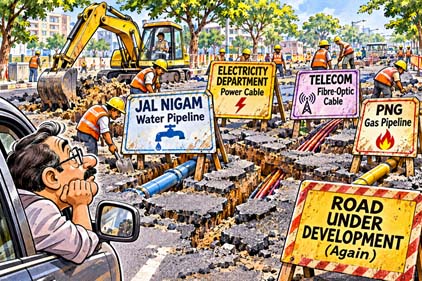
A board announced: JAL NIGAM — WORK IN PROGRESS.
I asked the supervisor what was happening.
“Water pipeline, sir.”
“But this road was completed only yesterday!”
“Yes, sir. Very good road.”
“Then why are you digging it?”
“Pipeline has to be laid, sir.”
“Couldn’t you have laid it before the road was built?”
He looked genuinely puzzled.
“How could we dig the road before it was built, sir?”
The logic was formidable.
For ten days, traffic crawled through dust and diversions. Motorcyclists performed acrobatics. Pedestrians developed mountaineering skills. Shops on either side of the road acquired a permanent coating of cement dust. Eventually, the trench was filled and the road patched up. The patch rose like a small hill in places and sank into a depression elsewhere. But at least the road was usable.
Three days later, the Electricity Department arrived.
Their excavator was larger, matching their greater ambition.
They dug across the road, perpendicular to the Jal Nigam trench.
“What now?” I asked.
“Underground electricity cable, sir.”
“But the Jal Nigam has just finished digging!”
“That is their department, sir. This is ours.”
“Couldn’t both departments have coordinated?”
He smiled sympathetically, as one does at a child who has asked why the moon cannot be brought down with a ladder.
“Sir, we have separate budgets.”
I realised that I had been thinking of the road as a road. The government regarded it as a bouquet of departmental opportunities.
Once again, the road was repaired. This time the patch crossed the earlier patch, producing an interesting geometric pattern. I began to appreciate the artistic possibilities. The original road had been a boring stretch of uniform black. Now it resembled an abstract painting. I wondered whether the municipal authorities might seek recognition from the Lalit Kala Akademi.
But the creative process was far from complete. On Thursday, the telecommunications people arrived. Fibre-optic cable. Naturally. A nation aspiring to become a digital superpower could hardly tolerate a road without fibre-optic connectivity.
“Couldn’t you have laid your cable along with the electricity cable?” I asked.
“Sir, electricity and telecommunications are entirely different things.”
“But they both go underground.”
“That is only a coincidence, sir.”
Another trench appeared. This one ran diagonally. By now the road resembled a giant snake-and-ladder game, with the destination buried somewhere underneath. Those road-users who had an exposure to the game in their childhood must have imagined themselves to be better equipped to deal with the civic challenges that confronted them.
The telecom workers departed, leaving behind a ridge of asphalt that gave passing vehicles the sensation of crossing a railway track.
Then came the gas pipeline agency. PNG — Piped Natural Gas.
“Very important project, sir. Clean fuel. Environment-friendly.” I looked at the dust clouds rising from the excavator, the traffic jams and the diesel generators powering the equipment.
“Excellent,” I said. “The environment must be delighted.”
“We are working for a greener future, sir.” The excavator operator had completely missed the sardonic intent of my statement.
So, the road was excavated once more.
By now I had developed a personal relationship with the excavator operator.
“How many more departments?” I asked. “Sewerage, sir. Storm-water drainage. Maybe smart-city cables.”
“Anything else?”
He lowered his voice. “Sir, sometimes they forget something.”
“What happens then?”
“We come back.”
I began to understand the philosophy of public works.
In developed countries, roads are constructed to facilitate movement.
In our country, roads are constructed to facilitate excavation.
The road is not the finished product. It is the raw material.
Each department must have its turn. Jal Nigam digs longitudinally. Electricity digs transversely. Telecommunications digs diagonally. Gas pipelines introduce curves. Every department contributes. Nobody coordinates. And the citizen participates by paying taxes, suffering inconvenience and replacing his car’s shock absorbers.
One afternoon, I encountered a municipal officer.
“Why can’t all these departments plan their work together?”
He brightened. “Excellent suggestion! We are considering a coordination committee.”
“And then?”
“They will prepare a comprehensive road excavation calendar.”
“When will it be ready?”
“After the next road is constructed.”
Eventually, the government sanctioned funds for complete resurfacing.
Contractors arrived. Trenches disappeared. Bumps vanished. The road became smooth again.
A minister inaugurated it with garlands, photographers and speeches.
He described it as a shining example of coordinated development.
I applauded enthusiastically.
The following morning, I drove along it.
Once again, my car floated over the asphalt. And then I saw it. A yellow excavator.
Beside it stood a newly erected board: JAL NIGAM — URGENT PIPELINE REPLACEMENT WORK.
“But you laid a new pipeline only a few months ago!” I protested.
“Yes, sir.”
“Then why are you replacing it?”
“Sir, that was the old scheme. This is the new scheme sanctioned in the new financial year.”
Tailpiece
The other day, I overheard two government engineers discussing a newly completed road.
“Beautiful work,” said one. “Perfectly smooth. Not a single pothole.”
The other looked concerned.
“Have you informed the departments?”
“Yes.”
“All of them?”
“All.”
“Good. We cannot allow such a fine road to go to waste.”
After all, in our country, a road is not truly complete until every department has had the opportunity to have a lasting say in it.
(Aloke Lal is a former DGP, author of six bestselling books, painter and TEDx speaker. He is the festival director of the Crime Literature Festival of India.)