All Around the World with the Most Travelled Indian
 By NITIN GAIROLA
One of the biggest scientific questions in the world is ‘What does it mean to be Human?’ It certainly is the biggest question in paleoanthropology. But first what is paleoanthropology? As most may know it is made up of 2 words i.e. ‘paleo’ which means ancient (as in paleontology) and ‘anthropology’ which is the scientific study of cultures and social behaviors of humans. So the scientific study of social behaviors of ‘very ancient’ humans is called paleoanthropology. Now unlike anthropology where you can study present living cultures, here with paleo we are talking about long gone ancestors of ours. And by ancestors I don’t mean the immediate ones but those that roamed Africa and later the entire planet as far back as 5-6 million years ago (50-60 lakh years ago). Yes indeed, we have come a long way.
This study of the past can only be done through a handful of methods such as via actual fossil discoveries (i.e. mostly inorganic, preserved skeleton frames found in the ground), via stone tools used (give insights into the technology at that time), via rock paintings (give insights into recorded art) and via DNA & protein samples (the most controversial methods). Naturally, the written language is out of scope since the latest written record of history, as opposed to the unrecorded pre-history, is just 5,200 years old or around 3,200 BC in Sumerian Mesopotamia which is present day Iraq. Quite ironic that man learned to be lettered and ‘civilized’ in a place that has undergone so much civil unrest in recent years. Our own Indus Valley has a yet deciphered script too, so that’s a mystery right there to be solved. Basically written language is the dividing line between the subjects of history and pre-history. Paleoanthropology is well past pre-history too and is really what can be called ‘deep-history’. Please know I didn’t coin that term, though I wish I did.

In my case since I am obviously not a scientist but a traveller with exploratory tendencies, I can only go looking for fossils, tools and rock paintings (those which are already discovered & documented) and try to leverage the searching & researching already done by smart people. The best I can do as a somewhat educated tourist and science nerd is to put it all together and make some sense of it. I also know that in putting together any given view I will probably be wrong and that is just how science is. It doesn’t claim you know everything; just that it is a slow process of discovery and there are always many, many unknowns.
So where do we all present day humans (i.e. the Homo Sapien species), come from? You see, here it is important to gain a perspective of the unimaginable cosmological timescale, so I will try my best and give a shot at providing a coherent snapshot of the deep past. For that I will have to go all the way back to the birth of the ‘observable’ universe. The universe started via the Big Bang (not the sitcom) hyper-expansion some 13.7 billion or 13,700 million years ago. That’s 13,700,000,000 years ago if you put all the zeros on it to really understand how long ago it was. After the Big Bang and the early star and galaxy formations (in the billions) we had the turn of our own home star to be formed much later around 5,000 million years ago. The home star is of course the Sun and its creation was driven by immense gravitational pressures due to its mass which resulted in nuclear fusion reactions and the emission of heat energy that we gratefully receive today. Also the debris and gases from our nascent Solar System started clumping and coalescing at various distances from the Sun. This clumping of loose rocks was driven by gravitational forces too and one of the spinning rocks to turn spherical was our Earth around 4,500 million years ago. All the 8 or 9 planets, if we want to add poor little Pluto, started dancing (actually rotating & revolving) around the young Sun. This was due to the ‘bending of the fabric of space-time’ (will explain it some other place & time) caused by our star. Ours is the 3rd planet from the home star and one of the 4 rocky interior planets along with Mercury, Venus and Mars. The others are gas giants – Jupiter, Saturn, Uranus and Neptune.
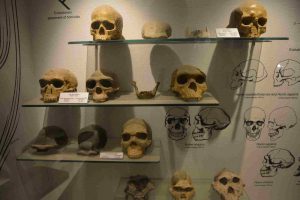
And while single cell and later multicellular life was there on Earth from around 3,500 and 2,300 million years ago respectively, it is only around 540 million years that there was an explosion of diversity of life in the sea during a geological time period aptly called ‘The Cambrian Explosion’. Later few of these sea creatures came out of the sea and evolved over millions of years to become the early amphibians, and then we had reptiles such as the ever-popular dinosaurs (252 to 65 million years ago). The extinction of the dinosaurs 65 million years ago, triggered due to an asteroid strike on Earth in the Yucatan Peninsula, gave rise to the mammals. Of these there was the lineage of monkeys some of whom branched out into the great apes (Orangutans, Gorillas, Bonobos and Chimpanzees) and finally the Chimpanzees branched out to give rise to the early forms of hominids such as Ardipithecus (4-6 million years ago) and Australopithecus (2.5 to 4 million years ago). And after that it has been the age of man with the various species under the genus of ‘Homo’ such as Homo Habilis, Home Erectus (from 2 to 0.1 million years ago), Home Heidelbergensis, Neanderthals, Denisovans and many more.
But it just so happened that our species, the Home Sapiens, that entered the scene as recently as 0.3 million years back, ended up being the only surviving hominine species out of the 14 that roamed the planet. In reality the count could and would be more than 14 but these are yet to be discovered. We Homo Sapiens became globe trotters, and went to all 7 continents, as opposed to others either being limited to Africa (where all species started) or at most Asia, Europe & Oceania. We modern humans have, of course, taken it a step further and have even been to the deepest point underwater (about 11 km down) and to the space and Moon (384,000 km away). It is truly incredible what we have accomplished in just 0.3 million or 300,000 years and now we may have the first human on Mars too. I am sure Elon Musk will make it happen in his lifetime.
So how did this human story play out in India or South Asia as scientists refer to what geographically is the Indian sub-continent (which includes our neighbours too). Well we know today India is a very diverse country but it so happened that way back then it also likely had a lot of different hominid species roaming its ancient lands. Basically Homo Erectus came to India well over a million years ago and many went down to what is now Indonesia as there was no water in between at that time. The global water levels were much lower back then and there was a land bridge. But many of these Erectus individuals would have definitely stayed on in South Asia too. Later there were Denisovans as well (from Central Asia) and we also carry in small part the Neanderthals DNA (who lived primarily in Europe & Middle East). Basically I found out to my sheer amazement that South Asia was a global hub for many different hominid species and that’s why it is such a complex and special place, anthropologically and geographically speaking. South Asia is a sort of crossroad of human evolution, if you will. How lucky can we get to live in this part of the planet?
The evidence of fossil, tools and paintings is all within our amazing country’s borders. But here is where it gets very interesting. The hominid fossils in India are all but a ‘sample of one’ with so far only the ‘Narmada Man’ skull found in a place called Hathnora in Madhya Pradesh, around 250 km south-east of Bhopal unearthed by Dr. Arun Sonakia in 1982. If you want to see it now then you have to visit the Anthropological Survey of India in Kolkata. Scientists have dated the skull to 350,000 years ago and it is yet not sure if it’s a Homo Erectus or Homo Sapiens or something in between. This is since the specimen has a large brain case (like Homo Sapiens) but a more elongated skull (like Home Erectus). The scientific community has nothing more to go on as far as hominid fossils go in India.
When it comes to tools however, there are few dig sites which include the ancient Acheulean stone tool technology (1.7 to 0.2 million years old) and these are essentially handaxes and large cutting tools of Home Erectus from the Early Paleolithic or Old Stone age period. We have also found stone tools from the Middle Paleolithic in what is known as the Levallois industry (from 300,000 to 45,000 years back). These include sharper flake tools, linked with the use of fire and generally associated with Neanderthals. It is very uncommon to have both these ancient stone tool technologies overlapping in one place as we have here in some sites, and this further adds to the complexity, mystery and the inconclusiveness as to who all roamed in India during the deep prehistoric times. One of the biggest tool sites (from the Early and Middle Paleolithic) unearthed is in Tamil Nadu called Attirampakkam, which is just 60 km from Chennai. There is also Adamgarh in Madhya Pradesh, Hunsgi in Karnataka and the Kurnool or Belam Caves in Andhra (from the Upper Paleolithic age). A lot of digs are also going on in the Middle Son Valley around the tri-border of UP, Bihar and MP besides excavations in Rajasthan, Kutch and the Gulf of Kambath areas of Gujarat. These are exciting times indeed for paleoanthropology in India.
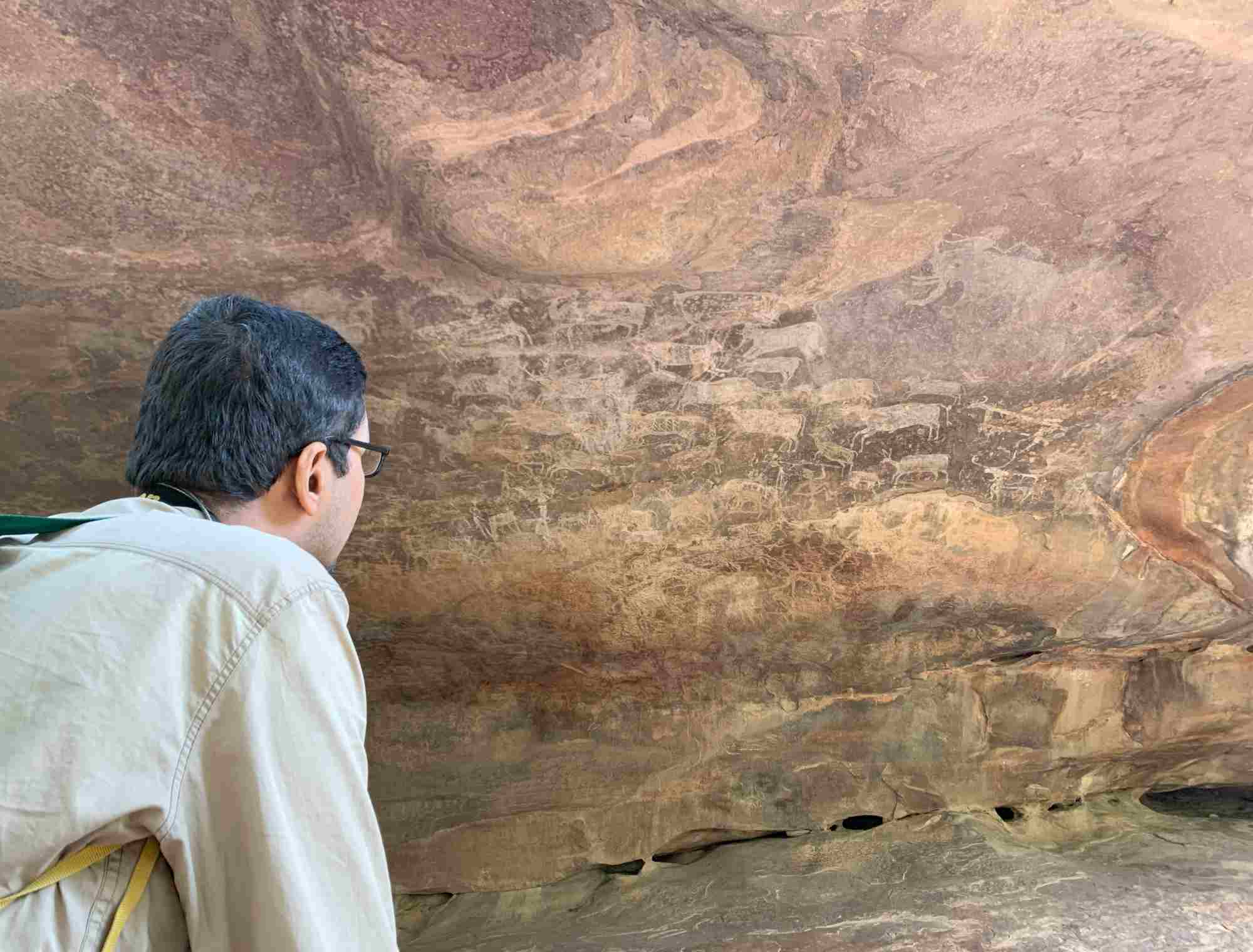
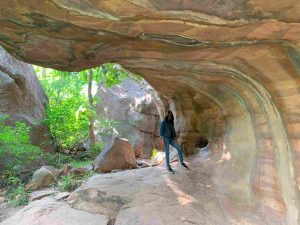
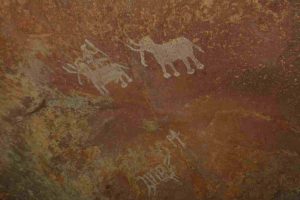
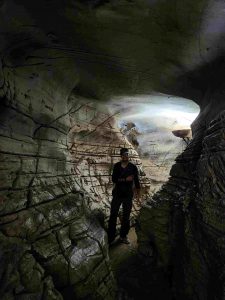
And after the one fossil and many tools, we finally have the paintings to look into (thank god for art). Now this is far more interesting for most as compared to studying tools and in India you can see paintings as old as those made 40,000 years ago. Most of these are in a very special place in the heart of the country. These paintings were made by Homo Sapiens, since Homo Erectus went extinct by 100,000 years ago, but it is believed that other humans have also been occupying the natural caves in the area for more than 1.5 million years. That is the time period for the first humans, Homo Erectus, in India after they moved out of Africa around 1.8 million years ago. This all comes to life in a mind bending place called the Bhimbetka Rock Shelters, very close to Bhopal in Madhya Pradesh.
Please know that this is different from rock art at Ajanta, Badami or Kanheri caves since that is far more recent (after the BC-AD changeover) and here we are speaking of our very ancient ancestor’s artistic outpourings captured through ochre, charcoal and minerals. A fun fact is that compared to Ajnanta we have far older rock art in Lakhudiyar caves, very close to Almora in our Uttarakhand itself. The oldest dates back to 5,000 years or around 3,000 BC, but naturally that is far more recent than what is found at Bhimbetka and nearby sites in MP such as Adamgarh, Chaturbhuj Nala and other places in the Satpura Hills. Another super stunning location in MP from the Lower Paleolithic is ‘Dar Ki Chattan’, which has over 500 cupules on the walls of its rock shelters.
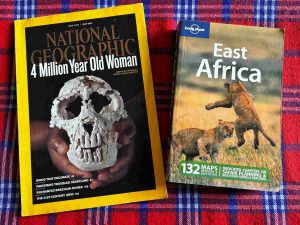
Basically there is so much to see and so little time. That is why I am so fascinated by Yuval Harari’s magnum opus, ‘Sapiens’ and our travels are planned after reading National Geographic articles rather than Lonely Planet ones. Travel is not just about the wanderings and wanderlust but it is about the wonderment in witnessing the greatest show on Earth, in super slow motion. The journey of man to every part of the world is the greatest story ever told.
(Nitin Gairola is from Dehradun and has travelled the natural world more than almost any Indian ever. He has set world travel records certified by India Book of Records, has written for Lonely Planet, and holds National Geographic conservation certifications. He is also a senior corporate executive in an MNC and in his early days, used to be a published poet as well. More than anything else, he loves his Himalayan home. Reach him at: www.facebook.com/ nitingairola/ and www.facebook.com/ MostTravelledIndian/)