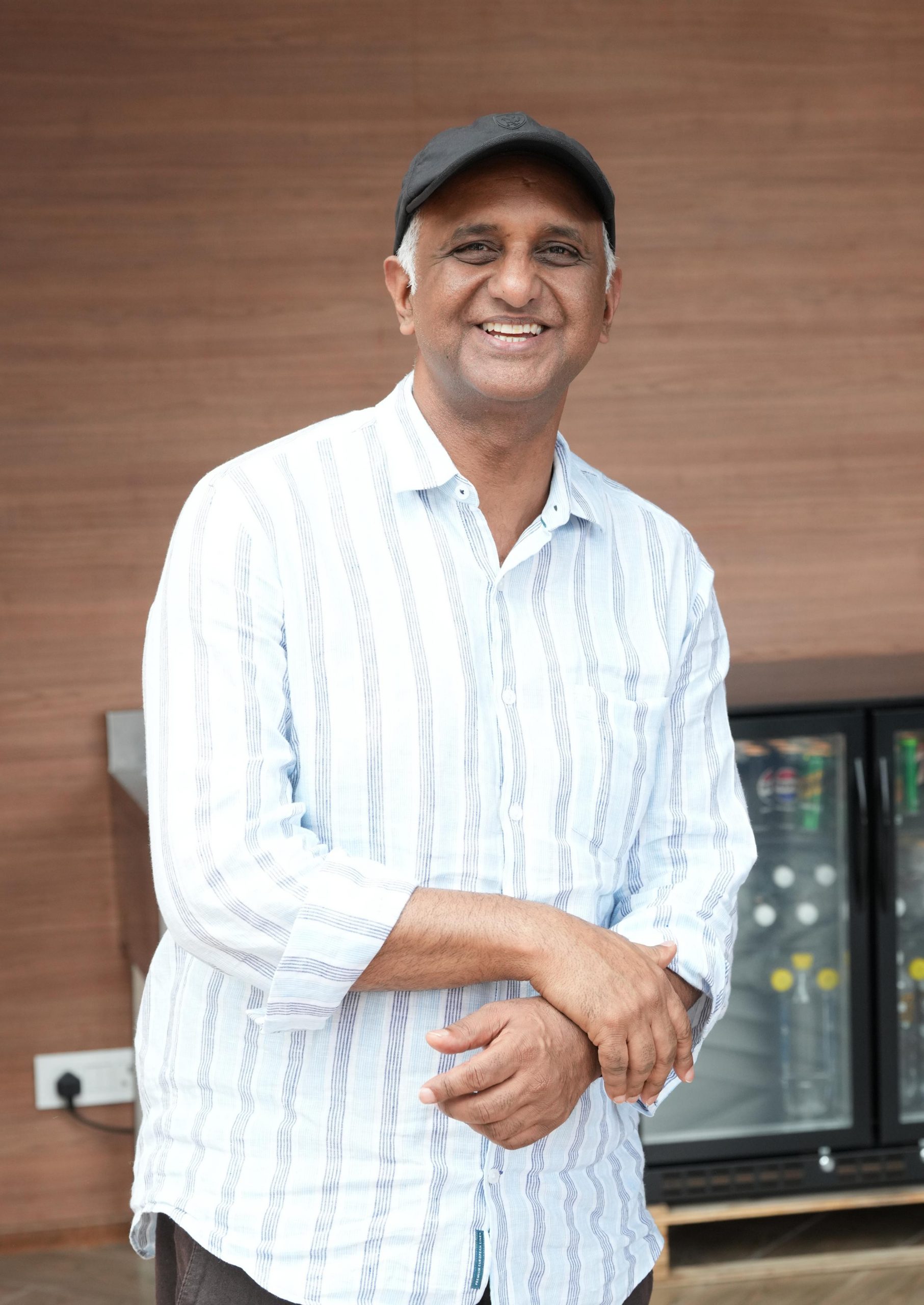
Actor Pramod Pathak on His Journey from Theatre to the Screen
By Sunita Vijay
Some actors command attention through sheer screen presence; others leave a lasting impression through the authenticity they bring to a character. Pramod Pathak belongs to the latter category. Marked by restraint, conviction and an innate understanding of human behaviour, his performances have steadily carved him a niche in Indian cinema.
From Gangs of Wasseypur, Raazi, Raees, Talvar, CityLights and Maharani to the hugely popular series Mirzapur, Pathak has shown a remarkable ability to inhabit diverse characters, making even brief appearances memorable. His success, however, was far from overnight. Years of theatre, backstage work and perseverance shaped the actor who eventually found wider recognition on the big screen and digital platforms.
A significant milestone in that journey was The Merchants of Bollywood, the globally acclaimed stage musical written and directed by Toby Gough to celebrate the grandeur of Indian cinema. As a key member of its principal cast, Pathak performed in nearly 600 shows across five continents, an experience that brought him into contact with people from diverse regions and cultures.
JOURNEY & BEGINNINGS
Life sometimes takes us down paths we never imagined. For Pramod Pathak, the journey from the football fields of Birla Vidya Mandir, Nainital, to the world of theatre and cinema was one such unexpected turn. Born into a business family, he dreamt of a career in sports until a leg injury during his graduation days brought that ambition to an abrupt halt. An unsuccessful stint in the family business left him searching for a direction of his own. He came to Mumbai with acting nowhere on his radar, and yet he landed in films.
ACTOR BY DEFAULT
What first drew you towards acting, and when did you realise this was the profession you wanted to pursue?
The family business never fascinated me. Coming to Mumbai was a random decision. I took up a job simply to sustain myself, as I did not want financial support from my family. With considerable free time in the evenings, I began watching films and theatre. Then, one day, I watched a play at Prithvi Theatre, and something about the experience completely changed my perspective. I met the director and told him I wished to explore theatre as a hobby. He was kind enough to let me sit in on rehearsals, and I started visiting regularly.
As a newcomer, you begin as a dwarpal or in a standing role and slowly move into more substantial parts. What began as an interest turned into a passion and eventually a career. Before I realised it, theatre had taken centre stage and everything else a backseat.
How did your journey from theatre to Bollywood unfold?
Initially, I took up screen acting as a means of earning money, as theatre was not financially rewarding. Gradually, I began to enjoy this medium as well. I was not institutionally trained, so I never hesitated to take whatever came my way – stand-in roles, day-player parts, one-line roles – to learn and understand the medium. I did a few films just to cover my expenses; my first break as an actor in an important scene came with Phas Gaye Re Obama.
Acting, theatre and cinema are like an ocean: the deeper you dive, the more you discover. I am still learning. For those who cannot afford professional training, the key is to keep learning through experience, seize every opportunity and continue to evolve. Gradually, you create your own niche.
You have worked in theatre, television and films. How has each medium shaped you as an actor?
Acting remains the same across all three mediums, but the technicalities differ. Screen acting is far more visual, whereas theatre relies on body language, voice and the expression of emotions. Theatre laid a very strong foundation for me. There, you practise your craft repeatedly and prepare thoroughly. On screen, you rarely get to rehearse. Sometimes you don’t even receive the script in advance; you simply go and perform. The discipline that theatre instilled in me has been immensely helpful there.
You have made a mark playing characters with negative shades. What attracts you to these roles?
Perhaps it has something to do with the way I look! But playing characters with grey shades is equally important for an actor. Whenever I approach a negative character, I believe the actor has to be the hero of that role. I try to understand the character from within and give it my own conviction.
Which of the characters you have portrayed are closest to your heart, and why?
Mishra in Maharani was particularly challenging, and I saw certain similarities between his personality and mine. Other challenging roles were the Gujjar in Gangs of Wasseypur, the minister in Raees and my role in CityLights. Once you take up something, you should never do it half-heartedly. Give it your best and enjoy the process; otherwise, there is no point in taking the plunge. I have never believed in cribbing about the work I choose.
What do you look for when choosing a film?
The first thing I look at is the story and whether it makes sense. Then come the character, the director, the production house and, of course, the remuneration. If the story is good, I am happy to take up even a small but significant role.
How do you prepare for a role?
Not having formal training has its advantages and disadvantages. I don’t follow any fixed process. The one constant is that I read a lot. I insist on getting the written script in advance, and if I have a month, I read the story at least ten times. I enjoy this repetition because every reading reveals something new about the character and the story.
CRAFT & INDUSTRY
Do you believe acting is primarily a natural talent, or can it be learnt and perfected through training and experience?
For me, acting is an acquired talent. I have learnt along the way—through travel, meeting people, observing life and reading extensively. Life is my institution. I don’t believe there is a right or wrong way; if a character excites me, I explore it with an open mind. I have also experimented with method acting and other approaches.
The industry has changed significantly, especially with the advent of OTT platforms. What changes do you welcome, and what has not been for the better?
One positive change is that the industry has become far more disciplined and professional. With greater exposure and advances in technology, actors today are technically better prepared. However, everything has become much faster. Films that once took a year or more are now completed in six months. Earlier, the industry was more forgiving; it gave actors time to learn, grow and find their feet. Today, it is highly competitive, and with so little time to prepare, finding one’s feet is far more challenging, especially for those who are not naturally gifted.
What is one aspect of an actor’s life that audiences rarely see beyond the glamour?
The audience sees the glamour, but not the hard work, sweat, insecurities, sleepless nights and sacrifices. There are injuries, physical pain, constant travel and lifestyle changes, often at the cost of family life. Then there are rejections. If I have done 30 films, I may have been rejected for 300 others. Rejection does not mean you are a bad actor.
Despite the challenges and sacrifices, what continues to excite and motivate you?
I have always maintained that I will act as long as I enjoy it. It was never an obligation or something I had planned; it was a treasure that came my way, bringing wonderful experiences and relationships. For me, acting is a privilege, not a burden. The day it stops being enjoyable, I will move on. Cinema also opens doors to screenwriting, playwriting and direction. I have directed plays and films, and I wish to explore these further. That is how one continues to grow.
When portraying characters driven by darker emotions such as vengeance, how do you bring those shades into your performance?
There is a saying that you have both Ram and Ravana within you. As an actor, you draw upon whichever side the character demands. The more experiences and shades you have in your repertoire, the better you perform!
Is there any genre you would still like to explore as an actor?
I would love to explore the romantic-hero genre. It would be an interesting challenge, regardless of how good, bad or ugly I might look as a romantic hero!
What advice would you give aspiring actors and young people entering the industry?
If you can afford it, invest a few focused years in formal acting training. It will teach you the basics, rather than leaving you to spend years learning through mistakes, as I did.
Travel across the country while you are young. Ours is a vibrant country, full of diverse people and stories. Travel by bus, train and road; meet people and understand their lives. That is how your personality evolves. Simply pick up your bag and set out!
Lastly, watch and read as much as you can. Explore theatre, cinema, dance and art galleries, and read good literature. Pay attention to the finer details and be willing to work hard for perfection.
If you had to sum up your journey as an actor in just three or four words, what would they be?
Ignorance is bliss. Be adventurous, make mistakes and learn from them. You cannot grow without making mistakes.
UTTARAKHAND CONNECT
What is it about Uttarakhand that keeps drawing you back?
I share a strong connection with Uttarakhand. I studied at Birla Vidya Mandir, Nainital, and have always found the hills beautiful. My first film as a writer, and later a children’s play, both had the hills as their backdrop. I would love to make my directorial debut in Dehradun.
While looking for actors from Uttarakhand, I met many wonderful, talented people. I also love the bakes at Ellora Bakery. People in Dehradun are warm and helpful, which is why I keep returning.
What changes have you noticed in Dehradun over the years?
The only downside is that Dehradun has become overcrowded, with the traffic worsening and the weather getting hotter. But the warmth of its people remains unchanged. Ultimately, your memories of a place are tied to the people you meet, and I have some very good friends here.
Away from cameras, scripts and shooting schedules, his visit to Dehradun reveals another facet of the actor. For one who spent part of his formative years in Uttarakhand, a return to these familiar surroundings evokes nostalgia and offers a welcome pause from the relentless pace of Mumbai.