A slice of India transplanted onto a New York street
By Sunita Vijay
Vikas Khanna brings the soul of India to the heart of New York, enchanting every guest with the warmth of Indian hospitality, exquisite flavours and an aesthetic steeped in its culture.
Of all the pleasures I had promised myself on my visit to the United States this year, none shone brighter than an evening at Bungalow, the celebrated Indian restaurant in New York City helmed by Michelin-starred chef Vikas Khanna.
This year, Vikas made history as the first Indian chef to be named among TIME’s 100 Most Influential People 2026, honoured for his culinary brilliance, his humanitarian work and his gift for building bridges between cultures. Seeing his face light up Times Square was a moment of immense pride for Indians everywhere. Fittingly, his tribute was penned by celebrated chef Eric Ripert, who described him as a “man of extraordinary heart”.
That heart beats far beyond the kitchen. Through initiatives such as Feed India, Vikas has spearheaded relief efforts that have served over 50 million meals.
Nor does his creativity stop at the kitchen door. As a filmmaker, he keeps returning to the quiet courage of women and the dignity of ordinary lives. The Last Color (2019), starring Neena Gupta, turns the spotlight on the lives of widows and the promise of education; Barefoot Empress (2022) follows a 96-year-old woman who goes back to school; and Imaginary Rain, with Shabana Azmi, is due for release later this year. Between kitchens and film sets, he has also found time to write more than forty books.
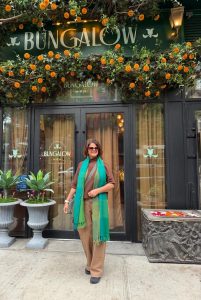
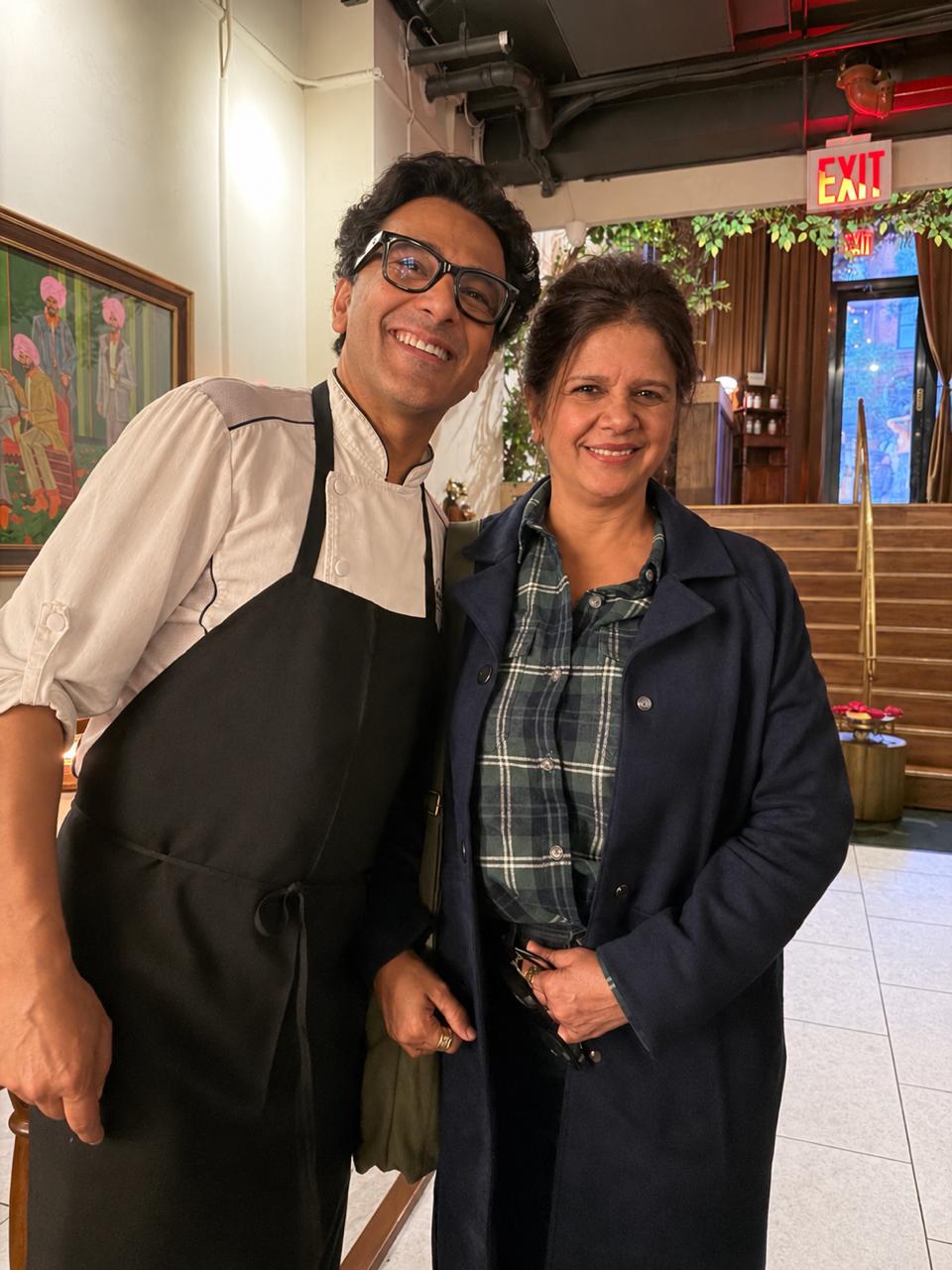
Meeting Vikas at Bungalow, his ‘karma bhoomi’, I soon understood that this is not merely a restaurant but a culinary outpost that brings alive the warmth and nostalgia of an Indian home. Vikas calls it a child born of a different DNA, created with one purpose: to make everyone feel at home. Here, celebrity takes a back seat and humility takes centre stage. At 5 p.m., Vikas himself stands at the entrance, tray in hand, greeting guests with delectable refreshments, an unexpected and deeply personal gesture that set the tone for everything that followed.
Step inside, and the bustle of New York melts away into a lovingly imagined slice of India, nostalgic yet thoroughly contemporary. Ornate rugs, floral wallpaper, rattan chairs and paintings fill the rooms, and a lounge library is lined with hundreds of vintage Indian cookbooks. The airy Garden Room, its greenery basking in sunlight beneath a glass roof, only adds to the charm.
What makes Bungalow truly special is Vikas’s own hand in everything. He guides his kitchen team constantly and serves guests himself. Menu and décor are reimagined for each Indian festival, down to the serving bowls, trays and flowers, a testament to his eye for detail and the immense effort behind the scenes. Vikas serves not just the flavours of India but its very soul, embodying the age-old ethos of Atithi Devo Bhava: the guest is God.
Little wonder that a table at Bungalow is among the most coveted in New York. Reservations reportedly vanish within seconds, and nearly 10,000 people try to book every day.
You were born in Amritsar, the culinary capital of Punjab. Do you bring its flavours and traditions into your creations, consciously or instinctively, even when experimenting with global cuisine?
Absolutely. I don’t pay much attention to global cuisine; India has more than enough to offer on its own. When you cook, you represent an entire country: your janam bhoomi, your birthplace.
I grew up in Punjab, but most of my culinary training took place in Karnataka, and my cooking is deeply rooted in the traditions of the Udupi region. I am extremely proud of that. At my first major job, at the Mughal Sheraton in Agra, I lived among people from Garhwal, and my food carries that accent too. Later, Kolkata broadened my understanding further.
I grew up before the internet. You learnt by working under a chef. That is how I learnt Bengali, Maharashtrian and so many other regional cuisines.
What made you choose ‘Bungalow’ as the name for a restaurant in New York? It evokes India’s old clubhouses, yet doesn’t immediately announce an Indian identity.
Bungalow comes from Bangla, and it is a beautiful word. Here in the US, people only connect ‘Bangla’ with Bangladesh. A bungalow means casual elegance, breezy verandas and a slower pace of life.
We gave the name a great deal of thought. It is ‘ek bangla family ka’, a family home where every festival is celebrated and the grandparents are the centre of gravity. While they are alive, the family stays together; once they are gone, everything is gone. So I call Bungalow the gravity. My sister wanted it to be that gravity for Indians.
What made you choose the kitchen as your calling? Was there a moment you knew?
I am a nonchalant person. When I chose the culinary arts, it was difficult for Papa, because back then there was no Indian chef representing the country on the global stage. Every parent wants security for their child, and this profession was full of uncertainty. He said, ‘Tu naukar hi rahega’ (you will always remain a servant). But my grandmother saw something in me. She said, ‘Why not, if he takes it up with dignity? Who knows, one day he may be cooking for American Presidents.’ And then she said one word: Tathastu, so be it. My whole career rests on that Tathastu. I am here by the will of God.
Are you happy in the present moment?
Nothing could make me happier. Lakhs of people around the world are watching what we do, and 10,000 people try for a table at barely three-year-old Bungalow every day. What could be better? And it isn’t pretentious. It isn’t here to impress the Western world. This restaurant does not seek the validation of the white man; it is whole and complete in itself.
Why did you choose New York City for Bungalow?
What would I have been doing in Amritsar? Every other city pales beside New York. Where else could you host the Met Gala? Hold it anywhere else and nobody would turn up! And nowhere else can you recreate Times Square, the crossroads of the world.
New York is the global stage for culture and influence. One evening I had Tom Cruise, Martha Stewart and Bradley Cooper sitting next to one another in my restaurant. How rare is that! Could it happen in any other city in the world? No!
Competing in a city like New York is no easy feat. One can only imagine the pound of flesh it takes to achieve so much, let alone sustain it.
This city is unforgiving. There is no proxy here; even some of the world’s best chefs couldn’t make it in New York. It demands that you are in your restaurant every day. Only when you compete with the best in the world does excellence step in.
I have been serving Indian food in New York for three decades. But if you pander to the West until every dish looks like theirs, they won’t be inspired by your food.
And I am very disciplined. Restaurants run on systems. If the room is packed at 5:01 p.m., the system must already be in place. In this profession the chances of human error are 80 to 85 per cent, so I keep a strict eye on everything. Whatever reaches a guest, a flower or a glass of water, passes through my eyes first. My Meta glasses are updated twice a day, so I know a little about every guest who walks through the door, their preferences and so on. The world never sees the planning behind the scenes. Proficiency, consistency and humility: you need all three to achieve anything.
At a conference in India, someone told me, ‘For us, you are a failure. A chef of your stature should have a restaurant in every big city.’ Everyone has a right to an opinion, so I just nodded. I am not chasing big things. As Mother Teresa said, it is never the big things; it is the small things done with love.
Success and humility are often seen as poles apart, yet greatness lies in balancing the two. How do you do it?
Few people get to become the symbol of an entire country. A poll here suggested that most Americans know only three or four Indians, and somehow a chef made it onto that list. Why? Because they have witnessed thirty years of consistent performance. That comes not from wanting more money but from a deeper purpose. When God gives you more, stay grounded. Stay humble. God checks your neeyat, your intentions.
With most Indian chefs I meet, within three minutes the talk turns to a brand with 300 restaurants. For me, that is ‘been there, done that’. Success isn’t about how many restaurants you own, but how proudly you put your country on the world map.
If I am not happy with what I do, I cannot perform. Maar kar artist se gaana nahin gawa sakte: you cannot beat a song out of an artist.
Indian cuisine has a wonderful tradition of culinary jugaad. Pav Bhaji, Sindhi Kadhi and Sambar were all born of leftovers. Has an improvisation of yours become a keeper?
Bungalow’s famous Dahi ke Kebab, born from leftovers. I was looking for sooji and ended up wrapping the dahi in seviyan instead. The New York Times called it the best dish.
Whose reaction to Bungalow genuinely moved you?
Shah Rukh Khan’s. He said, ‘Bahar se restaurant ek dukaan lagi, andar khol ke laga mandir mein aaya hoon.’ From the outside it looked like a shop, but once the doors opened, he felt he had walked into a temple.
Your most memorable guest?
The Obama family.
And your favourite guest?
My mother. She will always be my favourite guest.
When you’re not working, how do you like to spend your time?
I love biking around the city, and I’m a bit of a workout freak too.
What is still on your personal wish list?
Running the New York City Marathon.
Do you enjoy coming to Dehradun? What do you remember most vividly about your last visit?
Oh yes! I love Dehradun; it is so beautiful. I did a whole festival at Ellora’s Bakery. And the aroma of Doon’s basmati rice!
Swami Vivekananda once said that unless cooking is performed with a pure mind and concentration, the food is not palatable. At Bungalow, one sees exactly that: a heart that cooks and a mind that creates.
From the slow-cooked Daal Bungalow, made to a recipe passed on by his sister, to street-style kulchas elevated for the global palate, Bungalow isn’t just feeding New York. It is introducing the city to the soul and uncompromising warmth of regional Indian hospitality.
Opened in 2024, and due to close by Vikas’s self-fixed sunset date in March 2034, the restaurant has become a point of pride for the South Asian diaspora and visiting Indians alike: a cultural bridge where New Yorkers from every corner of the globe queue for a taste of authentic India.
As I stepped back onto the street that night, New York’s lights seemed a little warmer. In Vikas I had met a perfectionist who misses nothing, from a single flower to a glass of water, and a man whose iron discipline is matched only by his humility. Long after that evening, I kept thinking about him: the tray in his hands at the door, the quiet command he holds over his kitchen, the ease with which he makes a stranger feel like family. Evenings like this make New York worth the journey. It was magical, and I will carry Bungalow in my heart always.
Some build empires. Vikas Khanna builds legacies.