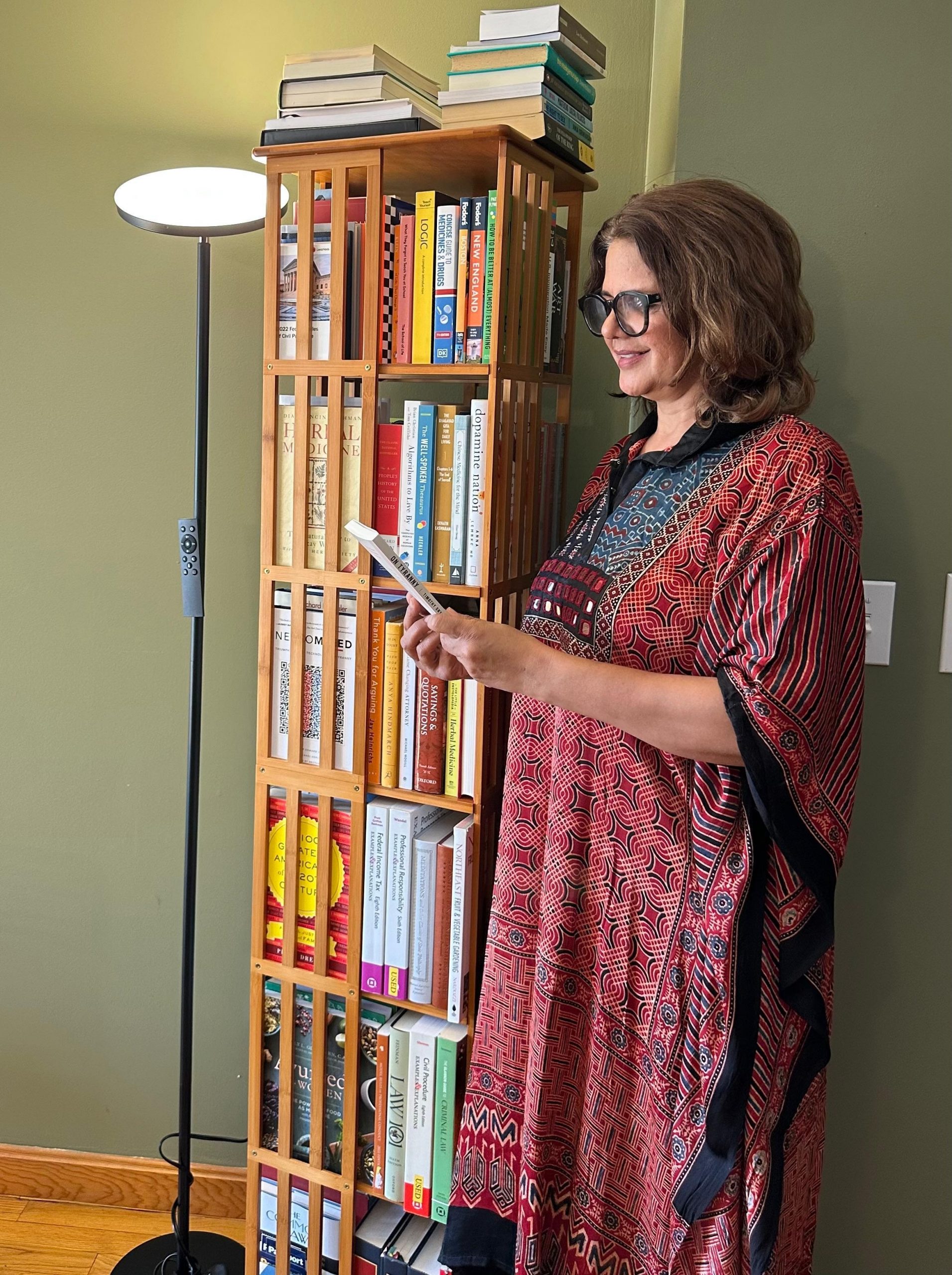
The Books from My Shelves
By Sunita Vijay
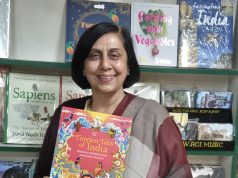
I am grateful to Mr Napalchyal for considering me for this piece and, in the process, taking me down a beautiful memory lane. As a child, the thrill of visiting a bookstore on Sundays, browsing the shelves, picking up more books than my little hands could hold, and receiving that approving nod from my father was incomparable.
Revisiting the books I had read brought forgotten images, people, places and experiences vividly back to life. Books do not simply occupy our shelves or memories; they become intertwined with our experiences, preserving fragments of who we once were. My relationship with books has changed with the seasons of my life, but the romance began early, with Jataka Tales, Amar Chitra Katha, Nandan, Tintin and Chandamama, followed by Reader’s Digest, Imprint and The Illustrated Weekly. Television was hardly competition then, and tired of textbooks, the obvious prescription before sleep was: read something else! Our weekly library period spent reading a non-curriculum prescribed classic quietly turned me into a lifelong reader.
As I grew and as a young woman, I looked to books for stories and worlds beyond my own. Marriage, motherhood, and the responsibilities of family altered what I noticed in those same stories. With the passing years, questions of health, inner balance, ageing, acceptance and purpose have naturally acquired greater meaning. Additionally, having spent much of my life with the Himalayas as an enduring presence, books about the mountains possess for me an intimacy that extends beyond literature. The ten books I’ve chosen are hence an eclectic collection.
- Malgudi Days | RK Narayan
(Indian Thought Publications, 1943 and later by Penguin Classics, 1982)
When I was younger, I loved Narayan’s humour and simplicity. With age, I came to appreciate something deeper: his respect for an ordinary life. Our lives are mostly school mornings, meals, neighbours, relatives, festivals, misunderstandings, arrivals and departures, the very things Narayan makes worthy of literature. Malgudi reinforced in me an affection for the everyday and the comforting truth that a life does not have to be extraordinary to be rich. I loved reading out this book to my daughter silently instilling in her the value of a simple life.
- The Inheritance of Loss | Kiran Desai
(Atlantic Monthly Press in the United States and by Hamish Hamilton in the United Kingdom in 2006)
I came to this book as an adult, when the idea of home had already acquired many meanings. Set against the mist-covered hills of Kalimpong, the novel spoke to my own enduring connection with the Himalayas, but what stayed with me most was its exploration of belonging: where we come from, where life takes us, and what of the old home we carry into the new. Desai writes, “Could fulfilment ever be felt as deeply as loss?” It is a question that acquires greater meaning with age. Life inevitably brings departures: from places, from earlier versions of ourselves, and eventually from the everyday closeness of people we love as their lives take them elsewhere. Yet loss is also evidence that something mattered enough to be missed. The book made me realise that our inheritance is not only what is handed down to us; it is also what we carry forward – memories, places, relationships and a sense of belonging that distance cannot entirely erase.
- To Kill a Mockingbird | Harper Lee
(B. Lippincott & Co.1960)
I first read this for its story; with age, I have come to value it increasingly for its lesson in empathy. Atticus Finch tells Scout: “You never really understand a person until you consider things from his point of view.” It is a simple thought, but one that becomes harder, and more necessary, to practise as life exposes us to people whose choices and circumstances differ from our own.
As a daughter, wife, mother and simply as someone who has lived long enough to see how incomplete first impressions can be, I have learnt that judgement comes easily; understanding requires effort. The book reinforced something I increasingly value: before deciding who someone is, we should try to understand the road by which they arrived there. To me, that willingness to see through another person’s eyes is not merely kindness; it is a form of moral courage.
- Man-Eaters of Kumaon | Jim Corbett
(Oxford University Press, 1942)
Corbett belongs to an earlier period of my reading life, when I was recently married to a forest officer, and when his stories gave the forests and mountains of Uttarakhand an almost mythic dimension. With time, however, the tiger became less important to me than Corbett’s extraordinary attentiveness to nature. That attentiveness accompanies my own love of plants, gardens and the hills. Gardening has taught me what Corbett’s forests did: we tend, observe and wait, but cannot command nature into existence. Nature operates according to a timetable larger than our impatience.
- King of Bollywood | Anupama Chopra
(Grand Central Publishing, 2007)
I picked up this book for the pleasure of cinema and as a big fan of Shah Rukh Khan but found in SRK’s journey something larger: the capacity for reinvention; how a Delhi boy became a superstar. Life rarely allows us to remain who we were at twenty, thirty or forty. Marriage, parenthood, changing responsibilities and children building lives of their own continually ask us to discover another version of ourselves. Films, too, have become markers of my own journey. Sometimes we remember a film because of the film; sometimes because of the person with whom we watched it. Cinema becomes an inadvertent family album.
- Quiet: The Power of Introverts in a World That Can’t Stop Talking | Susan Cain
(Crown Publishing Group, 2012)
I encountered Quiet after enough years of observing people to recognise how easily we confuse confidence with competence, and visibility with value. Susan Cain’s defence of the reflective, inward-looking temperament resonated with my own growing appreciation for people who do not need to be the loudest voice in the room to make their presence felt.
Her words “There’s zero correlation between being the best talker and having the best ideas” stayed with me. Life has taught me something similar: some of the wisest people I have known have also been the quietest. The book encouraged me to value listening as much as speaking, reflection as much as action, and solitude without mistaking it for loneliness. Quietness need not be an absence of strength; sometimes it is where strength gathers itself.
- The Death of Ivan Ilyich | Leo Tolstoy
I am glad I encountered Tolstoy as a mature reader. At twenty, I might have understood Ivan’s question intellectually; later in life, it feels far less theoretical: “Maybe I did not live as I ought to have done.”
Growing older changes one’s arithmetic. Achievement matters, but so do health, time, family and peace. Tolstoy made me think not morbidly about death, but more carefully about life: if something would seem utterly unimportant at its end, perhaps it deserves less anxiety in its middle.
- The Things You Can See Only When You Slow Down | Haemin Sunim
(Penguin Publishing Group, 2017)
I came to this book at a stage when I could understand its title before opening it. For much of adult life, particularly for women managing homes and families, there is always something more to be done. We become so accustomed to being useful that even rest can produce guilt. Haemin Sunim made me notice what haste obscures: a new leaf, morning tea, an unhurried conversation, a walk, the mountains. He taught me that slowing down is not withdrawing from life; it can be a way of returning to it.
- Train to Pakistan | Khushwant Singh
(Grove Press and later by Penguin)
I first encountered Train to Pakistan as a book about Partition; I finished it thinking much more about human beings. My generation grew up close enough to Partition’s memory for it never to feel entirely historical. As I grew older, the book’s lesson became broader for me. Religion, caste, nationality and community are important parts of identity, but none absolves us of the obligation to see another person first as a human being. Its final sacrifice remains with me because, when collective hatred becomes easy, individual decency becomes an act of courage.
- When the Body Says No | Gabor Maté
(Knopf Canada, 2003)
I encountered this book at exactly the right stage of life. Women become remarkably adept at caring for children, spouses, parents and homes, often saying yes simply because yes keeps everything moving. Maté’s line “If you face the choice between feeling guilt and resentment, choose the guilt every time” made me reconsider the value of a healthy “no”. I took from the book a simple but important lesson: the body deserves to be listened to before it is forced to shout. Rest, movement, emotional boundaries and time for oneself are not indulgences; they are part of health.
Looking at these ten books together, I realize that I have not really selected ten subjects. I have selected ten stages and concerns of a life: finding richness in the ordinary, understanding home and belonging, learning empathy, living with nature, embracing change and reinvention, discovering the strength in quietness, confronting mortality, learning to slow down, understanding the history we inherit and, finally, learning to listen to oneself.
Perhaps this is why our bookshelves become autobiographical without our intending them to. The books we choose at twenty are not necessarily those we need at forty or sixty. And even when the book remains the same, the reader does not.
We read books, but over a lifetime, books also quietly read us.
(Sunita Vijay is a freelance columnist, poet, motivational speaker, landscape consultant, trained Vedic astrologer, with a deep engagement in mindfulness-based living.)