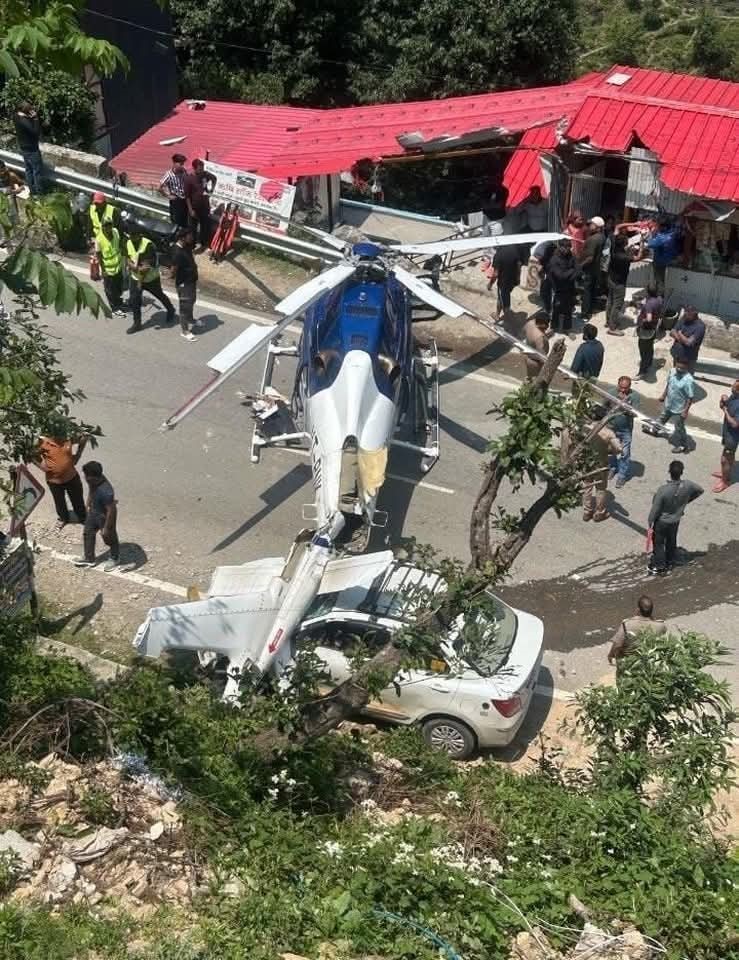
DEHRADUN, 7 Jun: Yet another helicopter mishap during the ongoing Char Dham Yatra on Saturday afternoon has raised serious concerns regarding the safety standards of aviation services operating in Uttarakhand. A helicopter en route from Sirsi helipad to Kedarnath Dham was forced to make an emergency landing on the Kedarnath National Highway near Barasu in Rudraprayag district due to a technical snag. The aircraft, operated by a private company, was carrying six persons, including the pilot.
Although all passengers were safely evacuated and the pilot suffered only minor injuries, the emergency landing caused damage to a roadside shop and a parked car. The prompt decision of the pilot prevented a major tragedy, as the helicopter narrowly avoided crashing into more densely populated areas. This is the fourth such aviation-related incident in a span of just 40 days since the commencement of the Yatra.
The Char Dham Yatra, which draws lakhs of pilgrims each year, is increasingly witnessing a worrying trend in aviation safety. The first major helicopter accident this season occurred on 8 May, when a Trans Aviation chopper heading from Dehradun to Uttarkashi crashed near Jhala, killing six persons, including five women. The aircraft lost balance mid-air and fell into a 200-metre-deep gorge. The Directorate General of Civil Aviation (DGCA) ordered an inquiry, which is reportedly still underway.
Barely five days later, on May 13, another helicopter returning from Badrinath developed a technical fault and began to wobble mid-flight. The pilot executed an emergency landing in Ukhimath, attributing the manoeuvre to poor visibility due to bad weather. Once again, lives were saved, but the incident triggered serious questions about aircraft maintenance and weather clearance procedures.
On May 17, an AIIMS Rishikesh medical helicopter narrowly escaped disaster while attempting to land near the Kedarnath helipad. Carrying a team of doctors, the aircraft crashed onto a hillside just steps away from the helipad. The rear section of the chopper was completely damaged, but thanks to the pilot’s alertness, no lives were lost.
This emergency landing at Barasu adds to the growing list of mid-air mishaps that have shaken public confidence. In this latest incident, despite damage to property, the passengers’ lives were spared due to timely intervention. DGCA officials have confirmed that an investigation has been initiated.
These repeated incidents have cast a shadow over the role and effectiveness of the Uttarakhand Civil Aviation Development Authority (UCADA), which is tasked with overseeing aviation operations in the state. Is UCADA ensuring that aviation companies strictly adhere to mandatory safety norms? Are the helicopters pressed into Char Dham service, undergoing comprehensive pre-flight technical inspections? Is pilot training and emergency preparedness being monitored by independent authorities?
With four serious accidents reported in just over a month, critics argue that mere post-incident investigations are not enough. There is increasing public demand for transparency and accountability in aviation safety practices, particularly during the pilgrimage season when helicopter demand surges exponentially.
There is also a growing sentiment that the state government needs to adopt a more proactive stance. Another pertinent question is whether any punitive action been initiated against the aviation companies involved in these accidents so far by the state government or UCADA? Are the helicopter operations being reviewed or suspended pending inquiry? More importantly, do these investigations delve deep enough to ascertain whether the aviation firms are cutting corners in safety compliance to maximise profit?
Experts point out that repeated technical failures could be symptomatic of broader systemic issues such as pilot fatigue, inadequate aircraft maintenance, over-scheduling of sorties, or outdated equipment. They stress the need for periodic safety audits, strict enforcement of weather-related flight restrictions, and real-time monitoring of helicopter traffic in the Char Dham zone.
Some sources claim that the choppers are making mulitiple trips per day from morning till evening to the dhams particularly to Kedarnath and thus making the regular maintenance and prevention of fatigue for the pilots not easy.
Unless immediate corrective steps are taken, including real regulatory action by UCADA and the state government, these incidents risk undermining the safety reputation of heli-services in Uttarakhand, a critical lifeline for pilgrims, especially the elderly and infirm.