Garhwal Post Bureau
Srinagar (Garhwal), 13 Apr: In an academic initiative aimed at strengthening democratic inclusivity and gender justice, Hemvati Nandan Bahuguna Garhwal University (HNBGU), Srinagar, organised a comprehensive deliberation on the “Nari Shakti Vandan Adhiniyam, 2023” today at the ACL Hall, Birla Campus. The programme brought together a gathering of students, research scholars, and faculty members to engage in structured discussions on women’s representation in governance and policymaking.
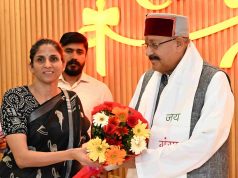
The event commenced with the rendition of Vande Matram, followed by the ceremonial lighting of the lamp, symbolising the pursuit of knowledge and empowerment. The inaugural session was graced by Nupur Verma, SDM, Srinagar Garhwal, who attended as the Chief Guest.
Welcoming the dignitaries and participants, Prof Seema Dhawan, Convener of the programme, delivered the welcome address and presented an overview of the objectives of the deliberation. She emphasised the importance of creating academic spaces where students can critically engage with contemporary constitutional developments and contribute to meaningful policy discourse.
In her keynote address, Chief Guest Nupur Verma highlighted the multifaceted efforts of the government towards women’s empowerment. She noted that while significant progress has been made in ensuring educational, economic, and legal empowerment, the Nari Shakti Vandan Adhiniyam, 2023 marks a crucial step towards political empowerment of women. She described the legislation as a “welcome and transformative move” that will enhance women’s participation in legislative bodies. At the same time, she stressed that empowerment must not remain limited to policy frameworks alone. “Women must also strive for mental and psychological empowerment so that they can confidently assert their rights and claim the status they truly deserve,” she remarked.
Addressing the gathering, Prof NS Panwar, Vice Chancellor (In-charge), congratulated the academic community on this important constitutional transformation. He observed that, while Indian society has historically witnessed strong women leadership, their representation in legislative bodies remains disproportionately low. “This Adhiniyam will not only increase numerical representation but also nurture and institutionalise women leadership in the long run,” he stated.
Prof MS Panwar drew attention to the unique challenges faced by women in mountainous regions like Uttarakhand. He emphasised that women in these areas encounter distinct socio-economic hardships in their daily lives. The Act, he said, will provide a vital platform for women from such regions to voice their concerns and bring attention to grassroots-level issues that are often overlooked but critically important.
Providing an academic perspective, Prof MM Semwal from the Department of Political Science elaborated on the key features of the Nari Shakti Vandan Adhiniyam, 2023, describing it as a historic milestone in India’s democratic journey. He strongly advocated for its immediate implementation and pointed out that the persistent under-representation of women in legislatures is a matter of serious concern. “This constitutional reform will not only improve representation but also transform societal attitudes and perceptions,” he said, adding that despite progress, social and cultural barriers continue to hinder women’s participation in policymaking. He reaffirmed that whenever given opportunities, women have consistently demonstrated their competence and leadership capabilities.
Expressing her views as Guest of Honour, Prof Manju Prakash Gusain reflected on the broader social context of the legislation. She posed a critical question—why was such a bill necessary? “Whenever society reflects a gap or imbalance, legislative intervention becomes essential. This Act is a historic step towards inclusivity and women’s empowerment,” she remarked.
During the session, Dr Amarjeet Singh Parihar read out the message of the Vice Chancellor, which underscored that increased representation of women in governance would ensure the incorporation of human values, sensitivity, and inclusivity in policymaking processes.
The session concluded with a formal vote of thanks delivered by Prof RS Fartyal, while Dr Kavita Bhatt efficiently conducted the proceedings as the host.
A notable highlight of the programme was the active participation of approximately 400 registered students, research scholars, and faculty members, who were divided into five thematic groups for structured discussions. Each group engaged in in-depth deliberations and later presented their findings and recommendations.