 By Ganesh Saili
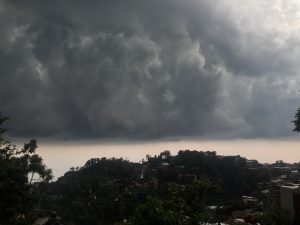
Landour’s legendary lightning strikes stopped only after the TV Tower came up in the 1960s. This place, more than others, has been prone to bolts from the blue. As my friend of old, Jayanta Sarkar recalls: ‘Our Landour house, just next to St Paul’s Church, was hit by chain lightning, two or more flashes repeated without intermission. Our ridge came alive with static at the approach of a summer storm, the trees took the thunderbolts at least five times and left our windowpanes rattling.’
This phenomenon is not new. In March 1838 Fanny Parks wrote: ‘Forked lightning was superb, the thunder resounded from hill to hill and for two hours the storm raged.’
Our pioneers were as hard as our oak trees. There’s Elizabeth King, the wife of Robert Moss King, the civil magistrate in Meerut, who in 1884 lived in Dahlia Bank. She writes: ‘Heavy thunderstorms this last week, accompanied by the increasing roll of thunder which I have never heard except in India. I am not nervous about lightning, but still unpleasantly alive to the fact that this house, from its position, is extremely liable to be struck. The whole ridge bristles with lightning conductors, and there is one to this house too, but it’s broken and useless. The last storm discovered all the joints in our harness. It was at night, and my endeavours to sleep through it were put an end to by heavy drops beginning to fall in my face. The first drop effectively killed sleep, and a few more made me jump up to drag the bed into a dry place.
‘The lightning was incessant. It produced the effect of a lamp flickering violently, but without going out. For at least half an hour, I was able to distinguish every object out of doors, and felt sorry that I did not make the experiment of trying to read by the flashes of lightning, of which I am sure was possible.’
I am thrilled to find she believes in my theory, that outsiders become slightly touched if they live here too long! She wrote: ‘Our next-door neighbour, Col___, has gone out of his mind, which explains the presence of several soldiers I noticed round his house as I returned from my ride. When he first became ‘queer’, he called frantically to his servants to come and help pull down the house, and he clambered on the roof and began energetically pulling off the thatch. He then called for matches and was just proceeding to fire the thatch when the servants thought interference would be justifiable, and sent for help. He now has a guard over him day and night.’
Author’s Collection
What needs no guarding is your arrival on level ground again after walking just six feet away from a khud. To ride on a mantel-shelf, even on a smooth and broad one, is a strain, though one is hardly aware of it at the time. She writes about a sad accident that happened to one of the Mussoorie volunteers. ‘He was returning from drill late one evening, when a storm came on with vivid lightning. He never reached home, and in the morning, his dead body was found down a khud; he had been confused by the alternate darkness and flashes, and had gone over the edge, falling ninety feet. He left behind a wife, poor fellow, and eight children.’
We all know that at Bala Hisar, Capt. Charles Dean Spread of the Invalid Establishment, was struck by lightning and killed on 3rd September 1879, while collecting rainwater from the drainpipes to develop some photographic plates. Believe-it-or-not, twenty-four years later, his cousin, Eleanor Amy Nunn, a teacher at the Abbey School, was killed on the same day, 3rd September 1903, when a bolt of globular lightning, which sometimes falls with an explosion, struck her as she bolted the door.
Next autumn, find yourself a cosy nook, and for once feel like a god on Mount Olympus, as you look down at the amphitheatre of the Doon valley, where the night sky is lit up as if by magic, fork and sheet lightning shimmering together.
Ganesh Saili, born and home-grown in the hills, belongs to those select few whose words are illustrated by their pictures. Author of two dozen books, some translated into twenty languages, his work has garnered worldwide attention.