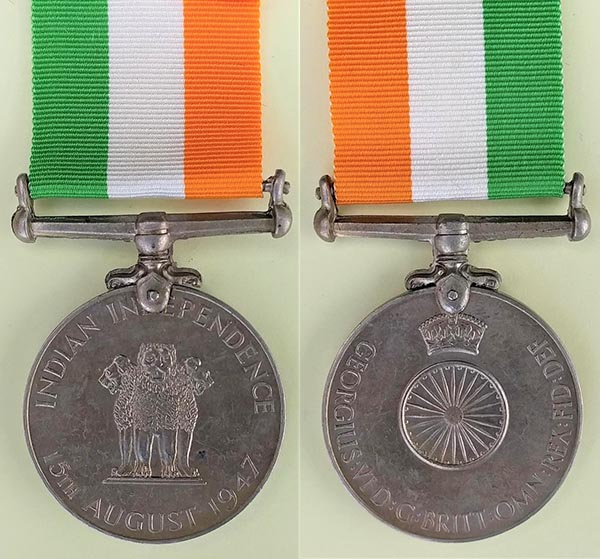
India attained Independence on August 15, 1947, but remained a ‘dominion’ and part of the British Commonwealth. The Governor General of India was Lord Louis Mountbatten (later, his successor, CR Rajagopalachari also retained the title; as did Jinnah who became the Governor General of Pakistan). As a matter of fact, even the Indian Independence medal, issued under the authority of King George VI in 1948, for grant to all members of the Indian Armed forces who were serving at the time of Independence has the Ashoka Dharma Chakra surmounted by the Tudor Crown, carrying the inscription GEORGIUS VI D:G: BRITT:OMN: REX: FID DEF on the obverse and the Ashoka Lions (which went on to become the national symbol) with the inscription INDIAN INDEPEPENDENCE and the date August 15, 1947 on the reverse.
The shedding of British Imperial trappings post-Independence was a very important step in the ‘nationalisation’ of the Indian Army, though the process was not without its hiccups and delay. The Indian Army had to wait till India became an Independent Republic in order to shed the last vestiges of British rule.
New Badge of The Garhwal Rifles
The robust response of the Indian Army to the Pakistani invasion of Kashmir in October 1947 scant months after Independence saw its leadership flower confidently. Yet at the end of the war in 1949, when India wished to honour its bravehearts for deeds of gallantry, a peculiar hurdle came in the way – newly independent India and Pakistan were both Dominions of the British Commonwealth, nominally under the British Crown and gallantry awards had to be approved by the Head of State (then the King of Britain). When recommendations for gallantry awards were made to the British for gallant action in the J&K Operations of 1947-48, they were flummoxed – squirming at the thought of giving the same medals to soldiers of two of their Dominions who had fought against one another! (And that too with British officers as Commanders in Chief of both warring armies!). It came as no surprise that the recommendations did not elicit any response from the British government.
Param Vir Chakra Front and Back
On attaining the status of a Republic in 1950, Indian gallantry awards were instituted and awarded with retrospective effect from August 15,1947. Hitherto, British gallantry awards like the Victoria Cross, Distinguished Service Order and Military Cross used to be awarded (these were gazetted in The London Gazette). There were also awards by the Viceroy like the Indian Order of Merit (IOM). The Indian gallantry awards instituted with retrospective effect from August 15,1947 were: Param Vir Chakra, Maha Vir Chakra, Vir Chakra for gallantry in wartime and Ashoka Chakra, Kirti Chakra and Shaurya Chakra for gallantry in peacetime. The designs were uniquely Indian. For example, the Param Vir Chakra is circular in shape, made of bronze, 35 mm in diameter, and has embossed on the obverse four replicas of Indra’s Vajra with the state emblem (Ashoka Lions) embossed in the centre. On the reverse is embossed ‘Param Vir Chakra’, both in Hindi and English, with two lotus flowers between the inscriptions. (Like the Victoria Cross, it is suspended from a purple ribbon).
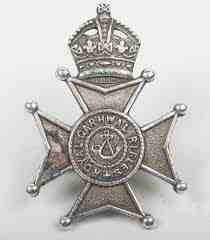
Old badge of the Garhwal Rifles
Almost all regiments underwent change in their titles. The word ‘Royal’, as also all allusions to British Royalty in regimental names were dropped. The ‘Governor General’s Body Guard (GGBG)’ became the ‘President’s Body Guard (PBG)’. All regiments dropped titles like “King’s Own”, “Queen’s Own”, “Prince of Wales’ Own” or “Duke’s Own” while retaining the titles ‘Horse’, ‘Lancers’, ‘Light Cavalry’, ‘Rifles’, ‘Grenadiers’ etc., as these had a unique historical context. For example, the senior-most cavalry regiment “Skinner’s Horse (1st Duke of York’s Own Cavalry)” became simply ‘1 Horse’ (though informally the better known name like Skinner’s Horse, Hodson’s Horse or Poona Horse are still mentioned). In the Infantry, ‘Royal Garhwal Rifles’ became simply ‘The Garhwal Rifles’. Regimental insignia carrying the British crown too were ‘Nationalised’ with the Ashoka Lions replacing the Tudor crown. For example, the Tudor Crown in the Garhwal Rifles Insignia was replaced with the Ashoka Lions, while retaining the Maltese Cross and the Buglehorn which are traditional emblems of all Rifle Regiments.
Badges of Rank also underwent changes on the same lines. For example, the badge of rank of a Lieutenant Colonel which used to be a Tudor Crown followed by a ‘pip’ (a form of a ‘star’) was replaced with the Ashoka Lions and the ‘Star of India’. The rank titles of Indian Commissioned Officers being the same as those in the English speaking world, were retained. Some rank titles underwent major change to reflect the Republican status. The designation ‘Viceroy’s Commissioned Officer’ (VCO) was changed to ‘Junior Commissioned Officer’ (JCO), with the existing ranks remaining the same as these were already ‘Indian’, like ‘Subedar’, ‘Naib Subedar’ (till 1965 – ‘Jemadar’) or ‘Risaldar’ and so on. The rank titles of Other Ranks were also retained as these were already ‘Indian’ like ‘Sepoy’, ‘Sowar’, or were universal like ‘Rifleman’, ‘Grenadier’, ‘Sapper’, ‘Gunner’.
Then followed changes to the Latin words in regimental mottos like in the Ordnance Corps’ ‘Sua Tela Tonanti’ (‘To the Warrior his Arms’). This had to be done carefully such that these retained ‘depth’ and were motivational. In the case of the Ordnance Corps the motto eventually changed to the Hindi ‘Shastra se Shakti’. Marching tunes which had no resonance with India too were gradually replaced. The Garhwal Rifles changed theirs from the Scottish highlands tune ‘Barren Rocks of Aden’ to the uplifting ‘Badhe Chalo Garhwalio, Badhe Chalo’. ‘Jai Hind’ has become a universal greeting in the Army, as have pride inducing marching tunes like ‘Sare Jahan Se Achcha Hindustan Hamara’.
A unique custom was introduced post-Independence: Junior Commissioned Officers (JCOs) invite the officers to the JCOs’ Mess on Independence Day which the officers reciprocate by inviting the JCOs to the Officers’ Mess on Republic Day, thus fostering camaraderie and interaction.
All armies are tradition-bound institutions, where the old ways are cherished because they give stability and generate pride. In this phase of ‘nationalisation’, the sage advice and guidance of much-respected officers like Field Marshal Cariappa was invaluable, ensuring continuity while assimilating change.
(SUDHIR ARORA is a Dehradun based publisher editor and military historian. He can be reached at sudhir.aroraddn@gmail.com)

 By SUDHIR ARORA