 By Atul Rawat
I was on a house-cleaning spree. After all, there is only so much one can store in a flat. The equation soon became painfully clear—it was either us or the stuff we had been collecting for a lifetime.
Rummaging through a box filled with my children’s old books, I came across an atlas. On impulse, I picked it up and opened it.
A whole new world unfolded before me—mountain ranges, oceans, continents, rivers, islands and deserts.
It seemed like a lifetime ago. In the age of Google Maps, who looks at an atlas anymore?
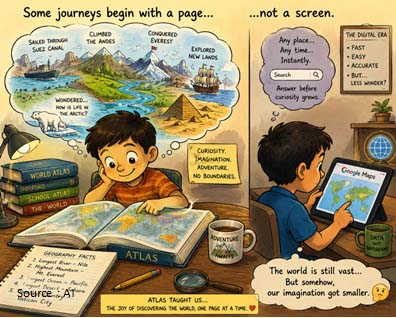
But growing up, the atlas was the window through which children looked out at the world and imagined what it must be like.
There was a time when the atlas was not just a book; it was practically a passport to the planet called Earth.
Long before we zoomed into digitised maps or watched travel vlogs, we traced London with our fingers and wondered what lay beyond its streets. Some atlases were massive volumes, and then there was the famous globe, proudly adorning the study table of anyone of consequence. One spin of the globe was enough for us to travel the world.
The moment we opened an atlas, adventure leapt off its pages.
Blue rivers sprang from mountains, wound through plains and disappeared into seas, some ending in magnificent deltas. No wonder civilisations flourished along their banks.
Mountain ranges stretched across countries, while vast blue oceans occupied enormous spaces both in the book and in our imagination.
One day we sailed through the Suez Canal, the next through the Panama Canal. One day we climbed the Andes, the next we conquered Everest.
Entire childhoods travelled across the globe without ever leaving the bedroom.
For a few magical moments, we became Columbus and Marco Polo.
Then came the obsession with records—long before the age of data analytics and artificial intelligence.
Longest river. Highest mountain. Largest desert. Deepest ocean. Biggest port. Smallest country.
It was endlessly fascinating.
We memorised facts—not data—with a missionary zeal.
Longest river: Nile.
Highest peak: Mount Everest.
Largest ocean: Pacific.
Whether any of it mattered in daily life was irrelevant. Knowing these answers by heart was a badge of honour.
Mr RC Sharma, my geography teacher, ruled the classroom with maps and pointer staff. He narrated the nuances of geography through the lens of an explorer. Wide eyed, we just followed his magical world expertly woven with words, phrases and personal incidents. In his clipped English, he was to us the person who had travelled the world. We fell in love with his classes.
We lovingly traced rivers with our fingers as though personally supervising their journey to the sea.
We wondered endlessly.
How did people live in the Arctic?
What did they eat?
How cold was Antarctica?
Did kangaroos casually roam Australian streets?
Why was Greenland called Green?
The mind travelled far beyond the boundaries of the syllabus.
Then there were the symbols—tiny airplanes for airports, stars for capitals and dotted lines marking borders that appeared permanent and unquestionable.
Technology is undoubtedly more powerful today. Any location can be found instantly. Any mountain can be viewed in 3D. Any river can be explored virtually.
The picture is certainly clearer.
Strangely, though, the imagination feels smaller.
The mystery has faded. Curiosity has become impatient.
Facts have quietly transformed into data.
Children rarely argue anymore about capitals or rivers. They simply ask Google. The search algorithm supplies the answer before curiosity has had the chance to fully develop.
The slow process of turning pages and searching through the index often led to accidental discoveries.
The atlas was a ticket to intellectual daydreaming.
One began with Delhi and somehow landed in Sydney.
There were no notifications.
No pop-up advertisements.
No “Skip in five seconds”.
Just pure curiosity.
Perhaps the greatest lesson the atlas taught us was that the world was astonishingly vast—deserts, volcanoes, rainforests, glaciers and endless possibilities waiting beyond the next page.
As we grew older, we gradually absorbed both the geography and the geometry of the world. We did not need Google to tell us where Florida was. Those pages had quietly etched themselves into memory.
I closed the atlas and looked at it with silent admiration.
Then reality returned.
In a small flat where every shelf is fighting for space, I stood torn between the past and the present.
Should I keep it?
Or should I let it go?
After a long pause, I smiled.
Perhaps I should just ask Google what to do.