 By Praveen Chandhok
Some of life’s most lasting lessons don’t arrive in classrooms or from the pages of carefully curated books. They come when you least expect them from the mouths of people who have simply lived long enough to know.
This one came from my grandmother.
We called her “Mama”. Ram Kaur. She had moved from Thailand to India with seven children in tow and eventually found her way to Dehradun, where her siblings had already put down roots. She was the kind of woman who held a family together not through authority but through sheer presence – steady, warm, and quietly certain of what mattered.
We were fortunate as children, though we didn’t fully appreciate it then. We were raised by two mothers, really. Our mother was Chai Ji. Our grandmother was Mama. Between them, they gave us more than we could ever account for.
But one afternoon stays with me.
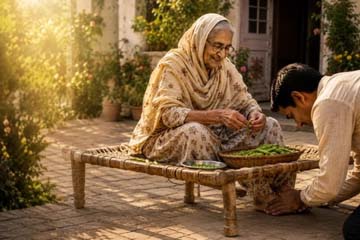
She was sitting in the courtyard on a charpoy, unhurried, shelling green peas. One of my cousin-uncles came in, bent down to touch her feet the way we all did, and she looked up at him with the kind of fondness only grandmothers carry.
“You haven’t visited in so long,” she said. Not as an accusation. Just an observation that held a little ache inside it.
He smiled the way you do when you know she’s right and said in Punjabi, “Maasi, kam hi nahin mukde.”
The work never seems to end.
She didn’t pause. She didn’t lecture. She simply said, almost to herself: “Bande mukk jande ne, kamm kade nahin mukkde.”
People come to an end. Work never does.
Everyone smiled and the moment passed. I was a child. I thought it was one of those clever thing’s elders say. I filed it away somewhere and forgot about it.
Years later, I was reading one of those books on achievement and the examined life the kind you pick up when you’re trying to make sense of where you’re headed and those words came back to me without warning. And this time, they landed differently. Heavier. Truer.
She wasn’t talking about work. She was talking about us.
We are remarkably good at postponing the things that actually matter.
After this project.
Once business settles.
When the children are older.
When things calm down a little.
We keep moving the threshold at which real life is supposed to begin, not noticing that life has been quietly unfolding the whole time with or without our participation.
Parents grow older while we’re in meetings.
Children grow up between our deadlines.
Old friendships thin out from simple neglect.
And we wear all of this busyness like it’s something to be proud of. The packed calendar. The relentless schedule. The no-time-to-breathe. Somewhere along the way, productivity became a measure of worth, and we quietly turned ourselves from human beings into human doings.
Osho once said something that I’ve never been able to shake: “The goal-oriented mind is always postponing life. It says: first achieve, then live. But by the time achievement comes, life has slipped through your fingers.”
My grandmother said the same thing. She just said it in fewer words, over a pile of green peas, on an ordinary afternoon.
There’s nothing wrong with ambition. Nothing wrong with hard work it’s what gives shape to a life. The trap is the quiet, convincing belief that life begins after the work is done. It doesn’t. Life is what’s happening while you’re carrying the work.
My grandmother knew this not because she had read it somewhere, but because she had lived it. She had crossed countries, raised seven children, buried people she loved, and kept going. She understood in her bones what most of us only arrive at too late.
The work will always be there tomorrow.
We may not be.
That is why we must remember to live while we work, not after we finish working.
Because work never really ends.
People do.
(Praveen Chandhok is a Proud Josephite; Entrepreneur; Socialite and Writer.)