All Around the World with the Most Travelled Indian
 By Nitin Gairola
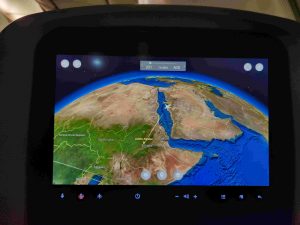
In 2012, on our first flight to Africa, our Kenya Airways plane had flown over the ‘Horn of Africa’, which is what the North-Eastern part of the continent is referred to, owing to its distinctive shape. From 36,000 feet I could clearly see the shape of the sharp coastline as we flew over Somaliland and then over Ethiopia before turning south and entering Kenyan airspace and eventually touching down at Nairobi, the capital of Kenya. After 2012, we have been to the African continent many times but somehow never to this north-eastern portion sitting right over the Great Rift Valley – the place where the Earth is literally moving apart under our feet, albeit at only 0.25 inch per year.
Geologically speaking, it’s a very special place. With the plate tectonic activity under this land, the area has regular earthquakes and volcanism and that has created some of the strangest and most surreal landscapes on Earth. Biogeographically too the place has incredible ecosystems, primarily deserts filled with volcanic lave flows. But it has some mountainous topography as well, besides there is diverse wildlife too that calls the place home. And coming to recent history, there is no escaping the fact that the Horn of Africa has been a troubled area. Somalia has had its fair share of problems and is now broken into main Somalia (where Mogadishu is the capital) and Somaliland, which lies towards the north. Then there is the relatively stable French speaking Djibouti where military carriers of many powerful nations (USA, France, China, Japan and Italy) are docked in its Red Sea facing ports. Further north is the sliver of land in between Ethiopia and the Red Sea that is called Eritrea and finally there is the big daddy of Eastern Africa (and maybe all of Africa) that we all know of as Ethiopia. Ethiopia now is also one of my favourite places on this ‘pale blue dot’, as Carl Sagan once called Earth.
In this new world travel series, every week I will take you to and through the Horn of Africa to show what is the on-ground reality and what is myth, as created by major media houses. Of course, a lot of what is shown in popular media is also true (no smoke without fire) but it’s nowhere as extreme as it’s portrayed to be. In this regard I find the UK government travel advisory map very balanced whereas the ones coming from US, Canada and Australia are a bit too cautious and that’s putting it mildly. But yes, if you are in the wrong place at the wrong time, things can turn bad quickly and that applies to many other places in the world too. So a lot of research is needed before you plant your boots on this ancient soil and you should know where to go and where to not go as well. I have used the words ‘ancient soil’ deliberately, since this is what many consider to be the birthplace of humanity. Some of the oldest hominid fossils (going back 4-5 million or 40-50 lakh years ago) have been dug up in Ethiopia. Seeing palaeoanthropology and ancient pre-history live adds so much colour to text books and to our understanding of the world.
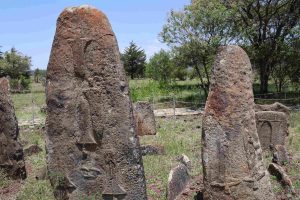
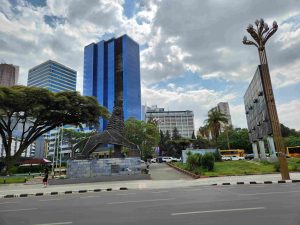
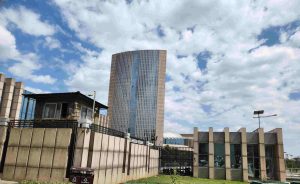
So this is an overland journey (with some internal flights too) that took us into some of the strangest ecosystems that we have ever seen, through the deepest human history and through the current situation that many people are stuck in. So as always, in this trip too I covered my 2 favourite school subjects – geography and history and that’s really the reason why I love the National Geographic magazine so much. Besides, I also enjoy showing Africa’s mega cities so that people know just how developed they are, contrary to the common perceptions from the past. As we went through Addis Ababa on day 1 we realized how developed it was. In fact early next morning we were on the way to the airport and en route we saw brightly lit pubs and restaurants buzzing with people at 4 am. It was a clear sign that Ethiopia has come a long way from 1983-85. And yes, there are lots of concerns that still persist, but it is definitely not all doom and gloom. Not by a long shot.
Before this visit, Richa and I were asking each other as to what it will take to really make us see something that we haven’t already seen. So I started scanning the political and physical maps pasted on the walls, the globe on my desk and the atlases on my bed. With the aim of visiting every desert on Earth being this close, I considered Namibia in Southern Africa, Senegal and Mauritania in Western Africa and Iran in Western Asia. When it came to the forests of the world, I looked at what was left for me – and that is only Borneo in South East Asia, Papua New Guinea in Oceania (above Australia) and the far eastern Primorye territories of Russia, right above North Korea. The problem was that this was to be a short visit, and none of these places could be done in that time. Then my eyes went to what I knew the answer was from the beginning. It had to be East Africa, but not the home of safaris and the big 5 (Kenya, Tanzania) or the home of large primates (Uganda, Rwanda, Congo) but instead the birthplace of humankind. The red mantle glowing and flowing out from Earth’s hot belly was of course one of the biggest draws, but so was the fact that we would be travelling over desert ecosystems that we are so fond of. This is home to the unbelievable Danakil Desert and also the Ogaden, Guban and Puntland ones.
So with our cheap flights booked (remember no business class) and visas sorted, we were ready to roll. The best part of this trip was that no pre-bookings on stays were needed barring for day 1 in Addis Ababa, Ethiopia, and this was asked by the passport officer at Addis. Avoiding these pre-bookings gave us a lot of flexibility, which is especially important when you try to pack in so much in such a short visit, since plans can change fast. Besides flights and stays, for the on-ground activities we had booked a few different overland tours but mostly through just one fantastic local tour operator named ‘Lucy Ethiopia Tours’. This tour company is owned by Kiros Zeray, a really lovely person who became a very good friend of ours too. Only Kiros knows how many pre-trip questions of mine he answered and this trip really couldn’t have happened without him as there were a lot of nuances we were unaware of such as you can get heavy discounts on domestic air tickets on Ethiopian Airways if you book them via a resident (but not on all sectors as in some airports they check).
Then the time had finally come to board the Mumbai – Jeddah – Addis Ababa flight on Saudi Arabian Airlines and I felt the same old excitement. And of all movies that I could choose from en route, I saw ‘Paddington in Peru’. I smiled through it and I guess it was my way to escape reality for a few hours before reality hit me hard in the Horn of Africa.
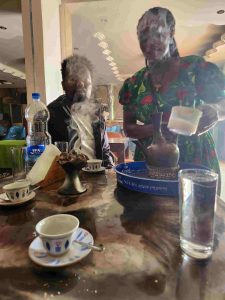
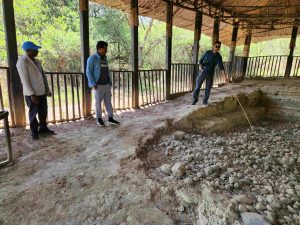
And there we were – in Addis Ababa, the pulsating capital of Ethiopia. We were received by Yosuf and Nico at the airport (arranged by Kiros). Yosuf was our very knowledgeable guide for the first tour to UNESCO World Heritage sites of Melka Kunture, Gombore and Tiya and we were really buzzing despite leaving Mumbai 24 hours earlier. We did get some good sleep at the Addis airport before heading out since we had landed at 2 am in the morning. Yosuf ensured our first morning in Ethiopia was memorable as we started the day with some very strong Ethiopian coffee, which here is more of an experience. It is really a ceremony with incense and all and not just a beverage. Move over Starbucks, Tim Hortons and our good old Nescafe. They are no match for the aroma and flavour of Ethiopian coffee. So with the adventure off to an incredible start, we looked forward to what was to come next. It would become less and less predictable…
[My heart goes out to those who lost their loved ones in the Air India flight 171 tragedy in Ahmedabad on 12th June’25]
Nitin Gairola is from Dehradun and has travelled the natural world more than almost any Indian ever. He has set world travel records certified by India Book of Records, has written for Lonely Planet, and holds National Geographic conservation certifications. He is also a senior corporate executive in an MNC and in his early days, used to be a published poet as well. More than anything else, he loves his Himalayan home.