 By: Ganesh Saili
Winter brings a reign of quiet in the hill station. Slowly, wildlife begins to visit the place to reclaim what originally belonged to them. I saw a CCTV grab of our hostelries, with a leopard loping around Camel’s Back Road.
I guess it’s that kind of season – one could believe almost anything.
When I last wrote of leopards lurking in Landour, I remembered our battered hundred-year-old burial register (since reported to have gone missing) of the Landour Cantonment Cemetery. It has but a single entry alluding to death caused by a man-animal conflict. ‘Clarence Thomas Wyatt, died in January 1949, aged 33 years.’ It records that he was ‘accidentally mauled by a panther.’
While writing, little did I know that his Mussoorie-born niece Roz Franken-Rebbechi had left for Cold Stream, Victoria, in northern Australia in 1971. She writes to me to tell me that among her parents’ belongings, she had found a clipping of the Mussoorie Times (January 14, 1949) that refers to the tragedy. Of this, she sent me a copy.
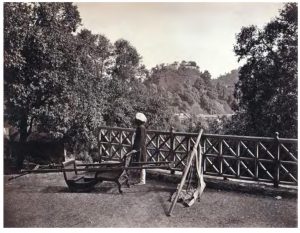
The clipping has Captain C. T. Wyatt, a 35-year-old retired military official, and his brother out on shikar at dusk within Maryville Estate in Barlowganj. They had improvised a drum with a rope drawn through it. It would mimic a leopard’s mating call so effectively that no sooner was the rope pulled than a full-grown leopard rushed straight at him. Of course, he fired shots, wounding the animal, but as dusk was settling in fast, he and his brother retracted their steps, decided to call it a day and headed home.
The next day they set out again, accompanied by a servant and a dog. Of course, the dog sniffed out his quarry almost immediately. No sooner had Captain Wyatt arrived on the scene than the ferocious feline attacked him and latched on to his skull. His brother intervened, but it was of no use. Mr Wyatt fired shots, and both he and the leopard rolled down into the khud below.
Later, reports continued to trickle in that, for many days afterwards, a female leopard with her two cubs could be seen prowling around Maryville, seeking to avenge the death of its mate.
Captain Wyatt had seen action in the Second World War in Burma and participated in the landing at Dunkirk. He belonged to the illustrious family claiming to be direct descendants of Lt. General J. B. Hearsey. It was one of the oldest and most celebrated families of Mussoorie.
Wyatt had simply been in the wrong place at the wrong time.
Sometimes, after days of heavy rain in the monsoon, the haze that usually envelops the Doon vanishes to allow a magnificent view of the vast plain, as if one were looking at a map spread flat on a table.
‘The beautiful undulations of Dehradun … And the low hills known as the Siwalik range, which separate the Dun from the spur of the Himalaya, were of pygmy height … Town after town, mere dots on the surface of the plains, were pointed out to me in succession. Even the ‘minars’ of Imperial Delhi (or at least their location) are sometimes visible.’
‘No such luck,’ I grumbled, wondering, ‘How does one put this genie back into the bottle?’
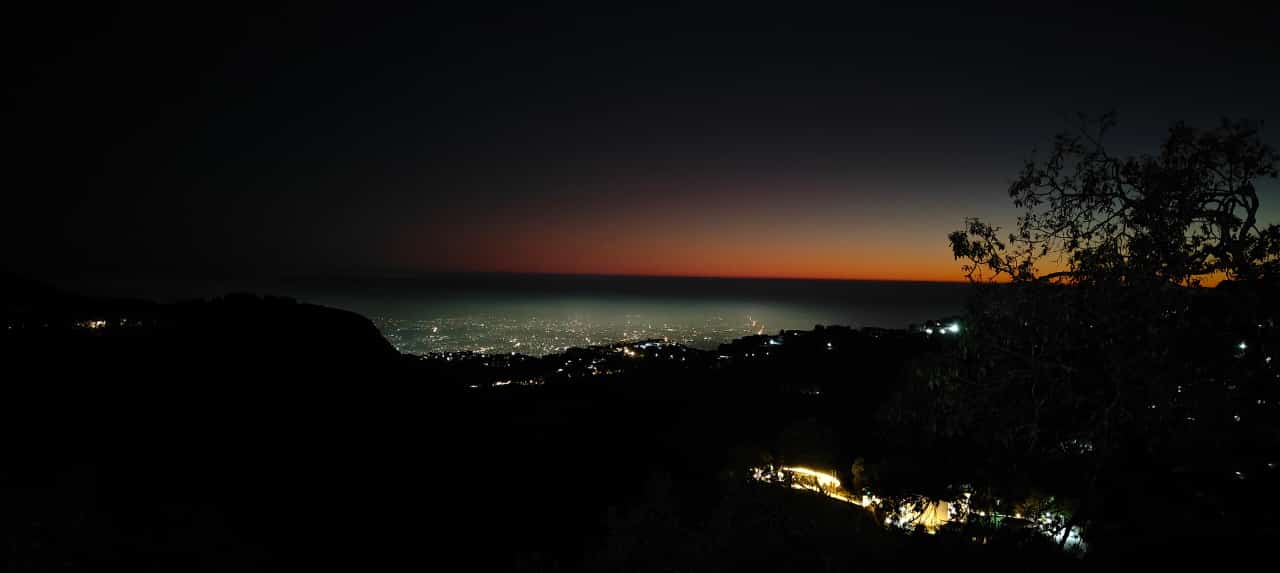
At times like this, I wish I were a child so that I could take an eraser and rub out the smog that has begun to hang perpetually over the Doon. Perforce, during the pandemic times, I changed my opinion after the Air Quality Index fell to record lows at night. It does that, albeit temporarily, after a good monsoon shower as well. You can see the pure magic with the naked eye from Landour’s razor ridge and see the twinkling lights of Saharanpur, Sarsawa, and Roorkee.
‘Never seen anything like this!’ gushes Swiss author Christian Kracht, who found himself stranded up here during the crisis.
‘The din of silence is so loud, it can knock you out,’ observed Abu Tripathi, a friend who lives in Mont George.
In life, often, the genie will not go back into the bottle – at least not willingly.
Ganesh Saili, born and home-grown in the hills, belongs to those select few whose words are illustrated by their pictures. Author of two dozen books, some translated into twenty languages, his work has found recognition worldwide