 By Ganesh Saili
Only one person could have named his son after the socialist writer Maxim Gorki, the Russian nominated five times for the Nobel Prize, and who gave us immortal lines like: ‘Happiness always looks small while you hold it in your hands, but let it go, and you learn at once how big and precious it is.’
In the dying years of the 1960s, a visitor to Mussoorie witnessed the most unusual scene. At the mouth of the Kingcraig bus terminus stood the Mussoorie College, where a lot of folks from the Punjab came to do their masters. Their many-coloured turbans brightened the place.
I find myself back in time with my classmate Rajpal, who had joined our small class of twenty students studying English. He had the gentlest eyes that lit up once we settled down to hear immortal lines of Milton’s Paradise Lost or, for that matter, the poems of John Donne.

We both became teachers. Consider it pure luck that we were able to pursue our dreams: he went on to take the dance forms of his part of the country all over the world. I found solace in scribbling.
One day, the drum beats wafted through the thin mountain air from the ground floor where the Assembly Hall was. Rajpal was a trailblazer. The ongoing erosion of traditional culture pained him, so he decided to take action. Furthering my education, he introduced me to the pleasures of Gidda and Bhangra. Over the years, it became an unwavering passion and his raison d’être. Accompanying him on this occasion was a drummer who had travelled all the way here. It was our first introduction to those beats that would possess a large part of our lives, mine and Rajpal’s especially.
Professor P.N. Mishra, the Head of English, did not like the commotion. It was not for him, and the less he heard it, the better. With a clatter of his ill-fitting dentures, he told us to get lost or go to the solitude of the Library and study instead. Mimicking the lines of a Hindi film song, he would say: ‘Someone else’s wedding and look who’s shaking a leg?’
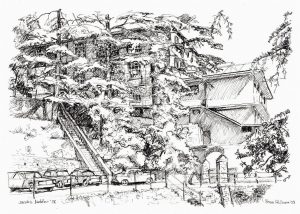
Pic courtesy: Bruce Skililcorn
Images of Rajpal flit through my mind. Perhaps he had resigned himself to accept that I was no dancer, except of the foot-tapping variety. I soon mastered the fine art of shuffling my feet. Henceforth, I remained an ordinary bystander.
‘Come! We are going to Woodstock School for a performance!’
Once we got to the school, we climbed up the steps of Jacob’s Ladder and got to Parker Hall, where the performance began. Towards the end, the entire audience ended up on the stage, stomping their feet with abandon. With no school uniform (Woodstock to this day has no dress code), seeing an ocean of youngsters clad in little more than T-shirts and jeans electrified the dancers. What with young girls, who danced cheek by jowl with them.
‘Oye! Are you trying to make sure that we end up in jail today?’ stammered the drummer to me, as a young girl sidled up to him. He gave his drum a burst of extra beats, hoping that by the time he opened his eyes, she would have disappeared. Sure enough, by the time he awoke from his self-inflicted trance, the girl had moved on. Though in her stead danced another! Indeed, this one was a little more amply endowed, a young teacher who had taken time off to watch the dance performance.
Later, I learnt that this was but the beginning of a long, illustrious career. Rajpal went on to spend his days organising performances around the world. As head of the Punjab Cultural Council, he took his troupe to Edinburgh and Lahore to showcase the talented youngsters under his charge.
And then, sadly, one day, in his usual quiet manner, without fuss, he walked away. Gorki, his only child, lives in Australia, where Rajpal, with a heavy heart, had sent him years ago to avoid attacks by fringe elements.
Grief is usually the price we pay for love. In our neck of the woods, you are greatly missed, my friend.
Ganesh Saili, born and home-grown in the hills, belongs to those select few whose words are illustrated by their pictures. Author of two dozen books, some translated into twenty languages, his work has garnered recognition worldwide.