All Around the World with the Most Travelled Indian
 By Nitin Gairola
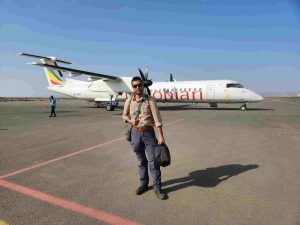
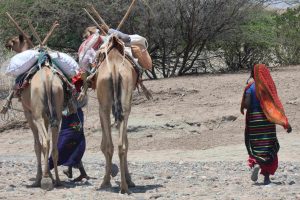
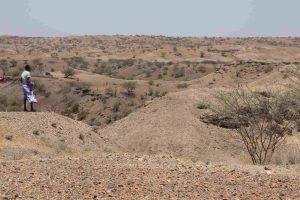
So, in our recent Horn of Africa trip (April-May 2025), after seeing World Heritage UNESCO sites such as Melka Kunture, Gombore and Tiya, we took a short flight from Addis Ababa to Semera which sits in the heart of the desert in the middle of Ethiopia. While Semera itself is a very boring town, it is the gateway for tours into the other worldly Danakil Desert and the Erta Ale volcano. But we had another place of interest that we had to visit, somewhere near the town of Hadar, in an area known as the Middle Awash in the Afar region. If you ask what Middle Awash is like to someone in anthropology, then he or she is likely to say it’s the place closest to heaven on Earth, since many fossils have been found in this tectonically active desert land. However, if you ask anyone else, they may say it’s the place closest to hell on Earth…
I have always said that my world travel guide was the National Geographic magazine and not Lonely Planet guidebooks, even though I wrote for them for a decade. This is since Lonely Planet was limited to what people were expected to have in their bucket list as ‘things to see in one lifetime’ and ‘how to see them’. I instead always wanted to have ‘things to experience’ and ‘things to learn’. Seeing them in real life was up to me – no push or marketing needed from any guidebook. And one of the areas of study that always fascinated me was palaeoanthropology – which is the scientific study of social behaviours of very ancient humans. That’s why it is made up of 2 words, which are ‘paleo’ or old and ‘anthropology’, which is the scientific study of cultures and social behaviours of humans. Unlike anthropology, where you study present living cultures, here with paleo we are talking about long gone ancestors who had once roamed Africa and later the entire planet as far back as 5-6 million years ago (50-60 lakh years ago).
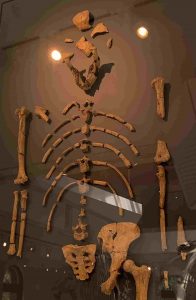
This is one of the reasons why I was so excited to visit the Middle Awash where the fossil of ‘Lucy’ was found. Lucy is easily the most famous hominid fossil in the world. ‘She’ (we don’t really know the gender for sure) was found in 1974 by celebrated paleoanthropologist Donald Johanson. The 3.7 foot Lucy fossil was dated to around 3.2 million years ago and that specific age made her very interesting as ‘she’ was considered to be the ‘missing link’ between apes and hominids, i.e., the early version of modern humans. One of the key distinctions made between ‘us’ and ‘them’ (ape and hominids, including Lucy) was bipedalism, or the ability to walk upright and Lucy seemed to be capable of, both, living in the trees and walking on the ground. This is because she yet retained the long arms (relative to height) for swinging from branch to branch and yet her opposable big toe on the foot was gone, which makes walking on 2 legs easier (but is not suited for a life only in the trees). Another defining ‘missing link’ feature was her brain size, which was larger than an ape’s but smaller than early hominid’s.
As a quick background, let me mention the march of evolution that I have explained in my earlier ‘Being Human’ article as well (can Google it up). Millions of years ago, from the lineage of monkeys, some individuals branched out (via genetic mutations) into the great apes such as Orangutans, Gorillas, Bonobos and Chimpanzees. The Chimpanzees, who are our closest living ancestors along with Bonobos, branched out to give rise to the early forms of hominids such as Ardipithecus (4-6 million years ago) and Australopithecus (2.5 to 4 million years ago). And after that it has been the age of man with around 14 species under the genus of ‘Homo’ such as Homo Habilis, Homo Erectus (from 2 to 0.1 million years ago), Homo Heidelbergensis, Homo Floresiensis, Neanderthals, Denisovans and us – Homo Sapiens or the ‘Wise Man’ (which at times is a questionable title). Many of them roamed the Earth together at some point in time but as a matter of sheer luck, only Homo Sapiens have survived till present day (I focus on the ‘luck’ part since this was not out of any specific superiority, but that’s a topic for another day).
Lucy is a 3.2 million year old member of the Australopithecus Afarensis species, right on the eve of the ‘dawn of hominids’. And while much older fossils have been found in Ethiopia since 1974 (such as Ardi Ramidus) and in Chad, the Lucy fossil yet remains the most famous dividing link because of the media frenzy and controversy it caused in the mid-1970s when evolution was proven for all to see. This was something many found hard to swallow.

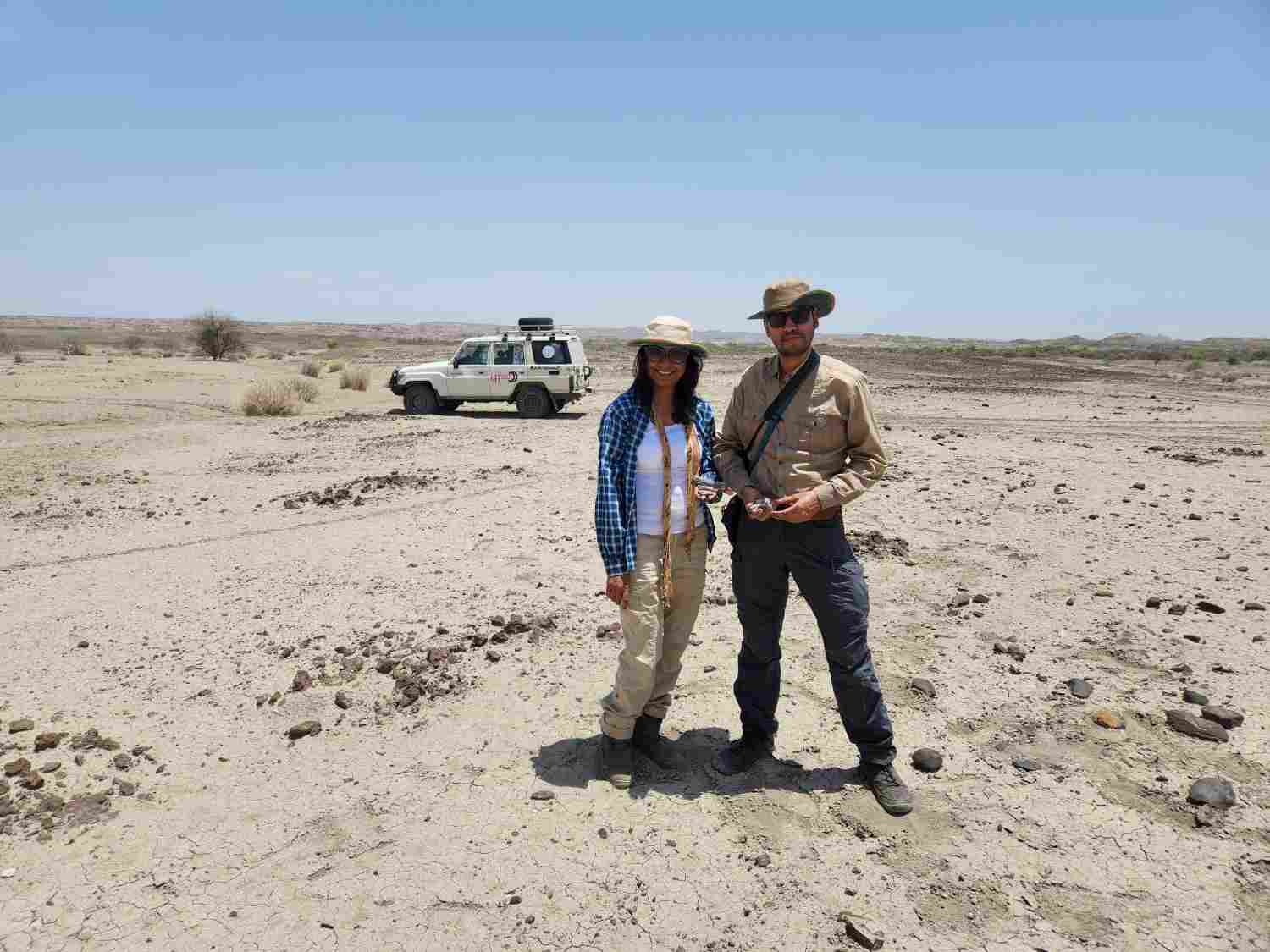
So, at the small Semera airport we met Efrem, who is the big boss of the tour company (and a good friend of Kiros) and he had arranged John to be our guide and Dave to be the driver of the brand new Toyota Land Cruiser, adorned in off-roading livery. John and Dave took us first to Hadar where we met Abdullah, who happened to be the local chief of the desert land there (and claimed that his father was part of Donald Johanson’s team that found Lucy). Without him, we were not allowed to access this remote Afar region and who were we to question someone backed by goons with guns? Abdullah was quite a character in his own right. He came in completely high at mid-day after chewing on the ‘chat’ leaves that many in this area are intoxicated on every day. And he just wouldn’t stop talking. John, Dave, Richa and I were mute for a long time, listening to Abdullah speaking in the local tongue which only John and Dave could follow. But as his chat high was fading, he later allowed us to speak as well. I realised that he really was a harmless soul, but just super excited to see foreigners interested in fossils (yes, we are weird).
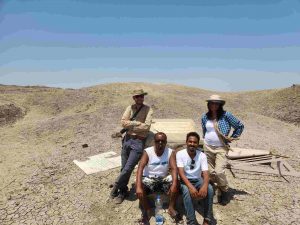
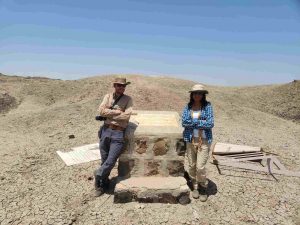
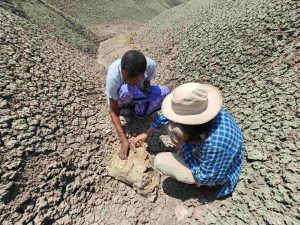
After many stops where we examined bones of mammoths, hyenas, primates and even other ancient humans (all lying in the open), we finally reached the marked site where Lucy was found. Naturally, the Lucy fossil was not there – just a mention of the site. We had in fact seen the Lucy replica in the Los Angeles Natural History Museum in 2022 and that had whet the appetite for seeing ‘where it all began’. In fact, we were a bit unlucky since the actual Lucy fossil is in the National Museum of Ethiopia at Addis Ababa and it is currently undergoing renovations, so we have to make do with replicas that are all around the world.
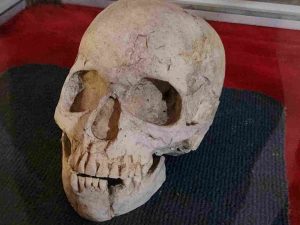
Nonetheless, this had to be one of the most amazing detours that we took since it didn’t feel like a tour at all. In fact, this foray into the desert would turn very scary later and that is a story for another day. In that moment, we were really happy, as we looked back at the deep past that we had just lived through and felt in our hands. The National Geographic is never enough – you have to step out of the library and see it for yourself. In that sense, we all become explorers in this journey of personal discovery.
Nitin Gairola is from Dehradun and has travelled the natural world more than almost any Indian ever. He has set world travel records certified by India Book of Records, has written for Lonely Planet, and holds National Geographic conservation certifications. He is also a senior corporate executive in an MNC and in his early days, used to be a published poet as well. More than anything else, he loves his Himalayan home. Reach him at: www.facebook.com/MostTravelledIndian/