By Arun Pratap Singh
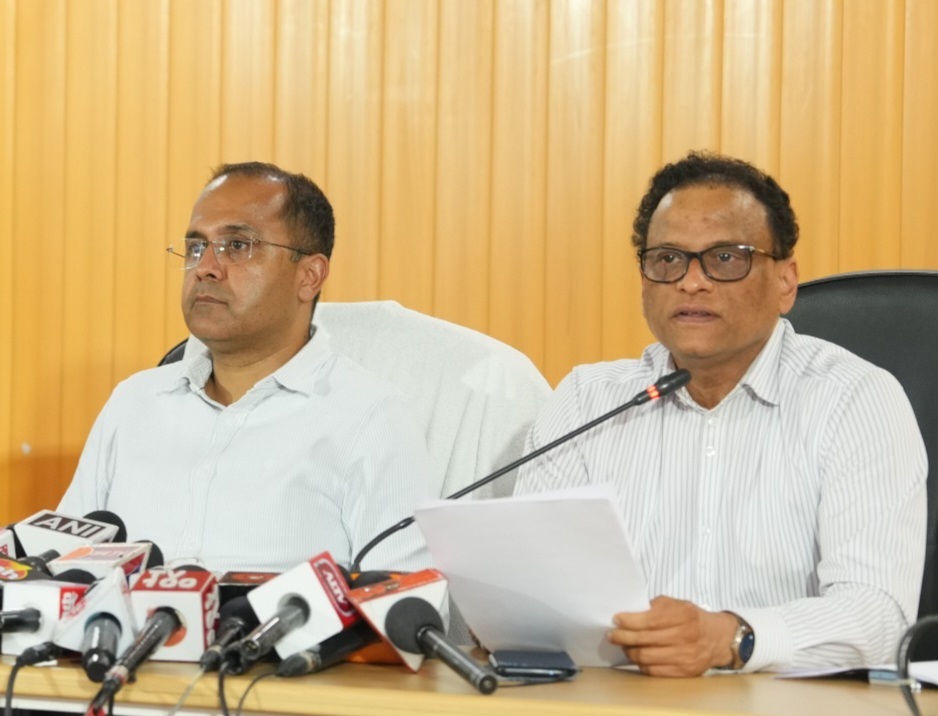
Dehradun, 28 May: In a landmark cabinet meeting chaired by Chief Minister Pushkar Singh Dhami here, today, the Uttarakhand government approved 11 major proposals, paving the way for significant reforms across key sectors. Secretary, Home, Shailesh Bagoli along with Secretary Ravinath Raman and others briefed the media here today after the cabinet meeting.
He shared that one of the most important decisions by the cabinet was the approval of Uttarakhand’s first-ever Yoga Policy, which aims to establish five dedicated Yoga Hubs in different regions of the state, leveraging Uttarakhand’s natural beauty and spiritual legacy. To strengthen the state’s healthcare infrastructure, the cabinet also sanctioned a substantial loan of Rs 75 crores to the Health Department. This amount will be primarily used for the Atal Ayushman Yojana and Golden Card scheme, ensuring timely payments to hospitals and uninterrupted healthcare services for beneficiaries. The government also announced plans to introduce a new comprehensive policy for these schemes, with stakeholder consultations to be held before finalisation.
In a humanitarian move, the cabinet approved arrangements for accommodation and food for attendants of patients at Dehradun and Haldwani Medical Colleges. The required land will be provided by the government, and construction will be carried out through CSR funds. This facility, modelled after the system at AIIMS Rishikesh, will provide affordable support to families of patients.
The cabinet has also brought about significant changes in the Procurement Rules to empower local contractors and foster employment. The government has claimed that new changes aim to promote local level contractors. Now, departmental works up to Rs 10 crores will be reserved exclusively for local contractors, doubling the previous limit of Rs 5 crores. The revised Uttarakhand Procurement Rules 2017 will increase employment opportunities for local residents. Working limits for E-category and D-category registered contractors have also been raised, enabling more local participation in government projects.
The Uttarakhand cabinet approved significant changes to procurement policies, aiming to empower local self-help groups (SHGs) and Micro, Small, and Medium Enterprises (MSMEs).
Previously, local SHGs could only be awarded works up to Rs 5 lakh. With the implementation of the new purchase preference policy, both SHGs and MSMEs will now receive a 10 percent purchase preference in the state government departments’ tender processes, even if their bid is up to 10 percent higher than the lowest quoted tender.
In a move to streamline the tendering process and enhance transparency, the requirement for physically depositing earnest money has been abolished. Instead, e-Bank Guarantees (e-BGs) will now be accepted online along with the tenders through a digitised process, thus removing bureaucratic hurdles. A dedicated grievance redressal mechanism will be set up on the IFMS portal for all tender-related complaints, and the use of the Government e-Marketplace (GeM) will be promoted for greater transparency and efficiency.
Furthermore, the cabinet has approved the activation of a Grievance Redressal Utility on the IFMS (Integrated Financial Financial Management System) portal to swiftly address any complaints related to procurement. This comprehensive set of changes is expected to significantly benefit local enterprises and improve the efficiency of government procurement.
The cabinet has given its nod to the Uttarakhand Mega Industrial Policy, which will be effective for the next five years. This policy classifies industries into four categories based on investment and job creation: Projects with investment of Rs 50 crores to Rs 200 crores, minimum 50 permanent jobs and carrying 10 percent subsidy, have been classified as Large Industries. Projects with an investment of Rs 200 crore to Rs 500 crores with a provision of at least 150 permanent jobs and carrying 15 percent subsidy have been classified as Ultra Large Projects. Mega projects will be the projects with an Investment of Rs 500 crore to Rs 1000 crores and a provision of at least 300 permanent jobs while the projects with an investment of higher than Rs 1,000 crores with a minimum provision for 500 permanent jobs will be classified as Ultra Mega Projects.
For the aforementioned investment, a timeframe of three to seven years has been stipulated from the date of the CAF (Common Application Form) application.
Under this new policy, enterprises that are established will be eligible for a 50 percent reimbursement (with a maximum limit of Rs 50 lakh) on the stamp duty payable for the execution of land purchase deeds or lease deeds.
The state has also been divided into four geographical categories to facilitate region-wise industrial development based on local resources and suitability. Subsidy will be given at 10, 12, 15 and 20 percent respectively to further incentivise establishment of large enterprises in the hill regions. This new policy includes a provision for an additional capital subsidy for Category-A and Category-B districts. Under this scheme, large enterprises setting up in Category-A districts will receive an additional capital subsidy of 2 percent, while those establishing in Category-B districts will be granted an additional capital subsidy of 1 percent. This is aimed at boosting industrial growth in the more challenging mountainous terrains.
In addition, the cabinet today also approved the ‘Uttarakhand Nibandh Lipikvargiya Karmachari Seva Niyamavali 2025’ (Registration Clerical Cadre Service Rules 2025), replacing the old 1978 rules to modernise and streamline service regulations for clerical staff. The inclusion of methyl alcohol under the Uttarakhand Poison Possession and Sale Rules was also approved, tightening control over hazardous substances. The existing framework for the State Department Subordinate Accounts Cadre Rules will continue.
Approval was also given by the Dhami cabinet for tabling the State Child Protection Organisation’s report in the Assembly, underlining the government’s commitment to child welfare.
In addition, the Uttarakhand Service Sector Policy 2024 was approved by the cabinet, specifying that subsidies will not be given to already established service sector institutions. Instead, incentives will be targeted at new ventures in under-served areas to promote balanced regional development. The cabinet also approved the creation of 11 new posts in the Uttarakhand Tea Development Board, aiming to boost the state’s tea industry.
The newly approved Yoga Policy is a significant step towards promoting wellness and tourism. Five new Yoga Hubs will be set up across the state. To encourage investment, the government will provide subsidies of up to 50 percent for projects in hills and up to 25 percent in the plains. Additionally, yoga institutions will receive a reimbursement of Rs 250 per yoga teacher, supporting the growth of a skilled instructor community.