Lord Karan Bilimoria’s Journey: From Cantonment Lanes to the House of Lords
 By KULBHUSHAN KAIN
It is a magical Doon evening — the kind where the air still carries a hint of pine from Mussoorie and the mellow warmth of the plains below. In a quiet home tucked away in the heart of Dehradun, Lord Karan Bilimoria — founder of Cobra Beer, former Chancellor of the University of Birmingham, and now a crossbench Lord in the Upper House of the British Parliament — sits across the table with the easy grace of a man at home. He is here for a few days, visiting his mother — returning, as he put it, “to the city that shaped our family and my earliest sense of belonging”.
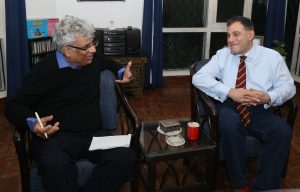
I am there to interview him. It was a difficult interview to do — even for a veteran like me. The difficulty was twofold. Firstly, Lord Bilimoria’s achievements are so many and so compelling that it would be easier to write a book about him than to restrict myself to a feature of merely 1,000–1,200 words. Secondly, he is so articulate that there is hardly anything in what he says that could be dismissed as “flab”. He goes straight into the muscle and bone of every question.
Yet these very qualities made the interview worth doing. It was challenging, exciting, and deeply educative. And, in the bargain, I got to have coffee and sandwiches — and a great deal more. This wasn’t the first time I was meeting him; I have had the privilege of meeting him earlier and exchanging greetings over email.
He is someone who seems to know everything. As I told him afterward: “I never felt as if I was probing you for answers. I felt like a student asking a professor to explain the complex questions of life and success. And you educated me.”
I asked him about his early years in Dehradun, where his father, Lt. Gen. Faridoon Bilimoria — an alumnus of The Doon School — was posted as the Deputy Commandant of the IMA.
“My father was posted here when I was young,” he recalled, his eyes softening. “Somehow, the calm of Dehradun — its honesty, its humility — stayed with me through everything that followed. Even now, when I walk these roads, I feel anchored. I learnt some of my earliest lessons here.”
He continued, with a touch of nostalgia: “My father never forced me into anything. When I was leaving to study abroad, he told me not to be hesitant or afraid. He said that everyone leaves home at some point — but the important thing is to stay true to what you believe in. And never compromise your integrity — not in business, not in anything.”
I believe those words — adaptability, honesty, and faith in one’s mission — define Lord Bilimoria as a human being.
If charm had a business card, it might just bear the name Lord Karan Bilimoria. The dashing founder of Cobra Beer — with his easy smile, Cambridge polish, and unmistakable Indian warmth — embodies the story of a man who brewed success with courage, grace, and a touch of Dehradun’s spirit.
Long before the House of Lords and global prominence, Karan Bilimoria was just another young boy walking the tree-lined avenues of Dehradun — its cool breezes and disciplined calm shaping his quiet confidence and gentlemanly poise.

From Hyderabad, the Nilgiris, and the Doon Valley to Cambridge, his journey reads like a modern fable. Armed with an accounting degree and unstoppable ambition, he set out to bridge cultures and tastes. When the British complained that Indian food deserved a better beer — one not too fizzy, not too flat — Karan decided to create it.
Thus, in 1989, Cobra Beer was born — brewed smooth enough to complement curry, yet strong enough to stand its own.
He began from scratch: borrowing money, stacking crates, and delivering bottles himself.
“At one point,” he recalls, “I owed more money than I could imagine earning in a lifetime. But I believed in my product. I believed in myself.”
That belief turned a struggling idea into a global brand.
But Lord Bilimoria is much more than a beer baron. He is a bridge — between East and West, tradition and innovation. His speeches in the British Parliament resonate with pride in India’s rise. His leadership in education and entrepreneurship reflects purpose beyond profit.
And yes — he is strikingly handsome. The debonair presence, now touched with silver, gives him the aura of a global statesman. Yet the sparkle in his eyes returns when he speaks of India — especially Dehradun.
“It’s where I spent a part of my youth,” he said. “And roots give you wings.”
I asked him what advice he would give young people who aspire to follow a path like his — and limited him to three lessons.
He thought for a moment, then said: “First, be adaptable. As a child of an Army officer, we moved every two or three years — Kerala, Rajasthan, Dehradun, Delhi… everywhere I made new friends, learnt new cultures. It helped me in life.
“Secondly, don’t take ‘no’ for an answer. Be persistent. If you are building something new, rejection is certain — but persistence is essential.
“Thirdly, you will face failure. But you will look back on those moments with pride.”
Then he paused and added gently: “Your family is your strength. Never forget that. Even in the toughest times, make time to enjoy your family.”
In an age where success is often measured in hashtags and headlines, Lord Karan Bilimoria stands apart — global yet grounded, suave yet sincere. He has met and known them all — Queen Elizabeth, King Charles, Sunil Gavaskar, Farokh Engineer — yet carries himself without the slightest pretension.
As the sun dipped behind the hills, our conversation lingered — like the soft hush of a Doon evening. His story mirrors Dehradun itself: graceful, steady, rooted, and quietly determined to rise.
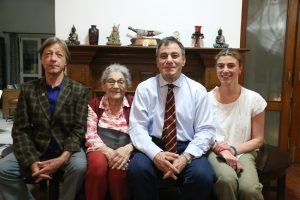
I also met his mother Yasmin, and his brother, Nadir. In that moment, I understood the source of the family’s quiet dignity. Among the greatest compliments I have ever received was when his mother told me that she waits to read my articles in the Garhwal Post. I felt my throat tighten as I held her hand.
“I will keep writing for you. Live a million years so that I can write for a million years.”
Every inch the gentleman that he is, Lord Bilimoria walked me to the gate. The moon hung between tall deodars. His parting words were simple — and perfect:
“Never forget where you come from. It’s the foundation on which you build everything else.”
(Kulbhushan Kain is an award winning educationist with more than 4 decades of working in schools in India and abroad. He is a prolific writer who loves cricket, travelling and cooking. He can be reached at kulbhushan.kain@gmail.com)