Books From My Shelves
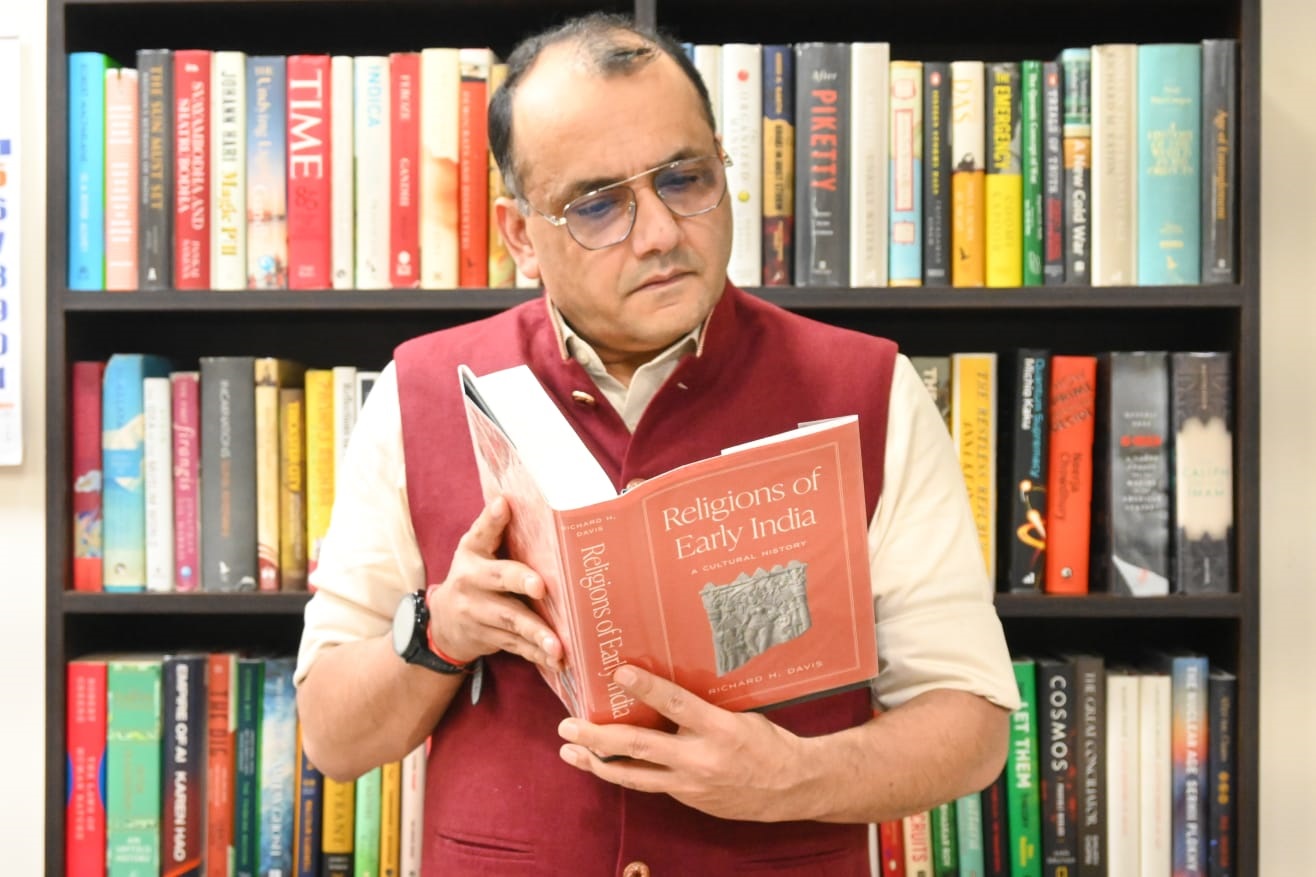
By Abhinav Kumar
- The Foundation Series — Isaac Asimov
I first read Foundation as a schoolboy and returned to it after years of public service, which is perhaps the right way to read it. Hari Seldon’s psychohistory, the idea that the behaviour of vast populations can be predicted even when individuals remain unknowable, is a fantasy every administrator secretly nurses. Anyone who has studied crime statistics, or managed a district during a communal flare-up, knows both the seduction of trends and the tyranny of the exception. Asimov understood both. The Mule, the single unpredictable man who upends the plan, is the most honest character in the saga. The prose is functional and the characters are often mouthpieces, but the ideas endure. The series asks a question that should trouble every civil servant: can institutions preserve knowledge through a dark age, or do they merely preserve themselves? For anyone in public life it remains essential, if unsettling, reading.
- The Discovery of India — Jawaharlal Nehru
Few books carry the burden this one does. Written in Ahmednagar Fort during Nehru’s longest imprisonment, The Discovery of India is less a history than a pilgrimage: a Cambridge-educated man searching for the country he was asking millions to sacrifice for. It is uneven, digressive, and sometimes romantic to a fault. Specialists will quarrel with his readings of particular periods and with his easy faith in science and planning. Yet I keep returning to it for its temperament. Nehru approaches India’s contradictions with curiosity rather than anxiety. He treats the palimpsest of cultures as a source of strength, not a problem to be solved. For those of us who serve the Indian state, that temperament matters. A republic is held together by laws and institutions, and also by a shared story. Nehru tried to write one in a prison cell. Whatever one’s politics, the attempt deserves respect and a careful reading.
- Midnight’s Children — Salman Rushdie
Saleem Sinai, born at the stroke of Independence and handcuffed to history, is one of the great narrators of modern fiction. Rushdie’s novel won the Booker in 1981 and later the “Booker of Bookers”, and it is easy to see why. It is exuberant, maddening, and overflowing with language, chutney and telepathy. For a policeman, the most haunting sections concern the Emergency, when the state turned on its own midnight children with sterilisation drives and slum demolitions. Rushdie captures, better than many historians, how power untethered from accountability becomes grotesque. The novel is not easy reading. Its digressions test patience, and its magic realism will not suit every taste. But it reminds us that the nation is not an abstraction. It is a multitude of private stories, each claiming the right to be heard. Those who exercise the state’s authority would do well never to forget that.
- India: A Million Mutinies Now — V.S. Naipaul
Naipaul’s earlier books on India were written in exasperation, and many Indians never forgave him. A Million Mutinies Now, published in 1990, is a different and better book. Here Naipaul mostly gets out of the way and lets people talk: Shiv Sainiks in Bombay, Dalit writers, Bengali Marxists, Sikhs living through the Punjab years, ambitious young men in small towns. What emerges is not decay but ferment. Millions of Indians were asserting identities and claims that the old order had suppressed. For anyone who has policed agitations, the title rings true. Much of what the state experiences as disorder is in fact people demanding to be counted. Naipaul’s insight is that these mutinies, however messy, signal a civilisation coming back to life. The book is long and occasionally repetitive. Its method, patient listening, is one every officer could profitably adopt.
- The Idea of India — Sunil Khilnani
Published in 1997, the fiftieth year of Independence, Khilnani’s slim book remains the most elegant argument for the Indian republic I know. He organises it around democracy, economic development, cities, and the question of who is an Indian. He treats each with a historian’s care and an essayist’s grace. His central claim is that India was not an ancient nation awaiting liberation. It was a political project, invented and sustained by choices, above all the choice of democracy in a poor, unequal and diverse society. One need not agree with every judgement to value the clarity. For those within the system, the book is a useful corrective. The state’s legitimacy is not given; it is earned daily, in every police station and every tehsil office. Nearly three decades on, some of its optimism has dated, but its questions have not. It is a short read with a long afterlife.
- The World Is Flat — Thomas L. Friedman
When Friedman’s book appeared in 2005, Bangalore’s call centres and outsourced software made it feel like prophecy. Reading it now is an instructive exercise in humility. His “flatteners”, from the fall of the Berlin Wall to open-source software and global supply chains, did transform how the world works, and India was among the great beneficiaries. But the book’s breezy confidence that technology would erode borders and geopolitics has not aged well. Pandemics, trade wars, sanctions and renewed great-power rivalry suggest the world is lumpier than Friedman imagined. Still, the book is worth reading as a document of its moment. It is also worth reading for its sharper insight – that individuals and nations who stop learning will be left behind. For Indian institutions, the police included, that warning about skills, adaptability and the pace of technological change is more relevant today than ever.
- Cosmos — Carl Sagan
Some books change what you know; Cosmos changes how you see. Sagan’s companion to his 1980 television series moves from the library of Alexandria to the surface of Mars, and from Kepler’s stubborn calculations to the chemistry of life. He writes with a warmth few science writers have matched. Its real subject is the scientific temper: the habit of doubting, testing and revising. Our own Constitution, not coincidentally, lists developing that temper among the fundamental duties of citizens. Anyone trained in investigation will find Sagan’s insistence on evidence over assertion deeply familiar, since a good case, like a good theory, must survive scrutiny. Some of the science is now dated, and his Cold War anxieties belong to another era. But the moral argument endures: a species capable of understanding the universe has an obligation not to destroy itself. Every young officer, and every young citizen, should read it.
- The Revenge of Geography — Robert D. Kaplan
Kaplan’s argument is simple and unfashionable. Mountains, rivers, deserts and coastlines still shape the destinies of nations, whatever globalisation’s enthusiasts may claim. Drawing on Mackinder, Spykman and Braudel, he surveys Europe, Russia, China, Iran and the subcontinent through the lens of terrain. His treatment of India is especially thought-provoking. He describes a subcontinent defined by the Himalayan barrier, vulnerable from the north-west, and open to influence across the Indian Ocean. Anyone who has served in border districts knows how geography dictates everything from smuggling routes to the pace of development. The book can be deterministic, and Kaplan occasionally lets grand sweep crowd out human agency. Read alongside Friedman, it is an excellent antidote. Geography is not destiny, but it is the stage on which destiny is played. Indian strategists, and those who police our frontiers, ignore it at their peril.
- The Hunt for Red October — Tom Clancy
Tom Clancy was an insurance broker when this novel appeared in 1984, and its technical detail reportedly startled naval professionals. A Soviet submarine captain attempts to defect with his boat. The Americans must divine his intentions before the Soviet navy hunts him down. It is a thriller, and an excellent one, but what holds my interest is its portrait of institutions under pressure. Jack Ryan succeeds through analysis rather than heroics. He reads incomplete intelligence, questions the consensus and persuades sceptical superiors. Any officer who has argued a hunch against the weight of hierarchy will recognise the scene. The prose is workmanlike, the characters are thin, and the Cold War certainties are dated. But as a study of how information, technology and human judgement interact in a crisis, it remains instructive. It is also thoroughly entertaining, and a rare thriller that rewards a second reading.
- The Wonder That Was India — A.L. Basham
First published in 1954, Basham’s survey of Indian civilisation before the coming of the Muslims remains, seventy years on, the best single introduction to ancient India. Basham writes as a scholar but also as an admirer, and it shows. He covers political history, but the real pleasure lies in his chapters on society, religion, art, language and everyday life. Particularly valuable for those in governance are his accounts of ancient ideas of kingship, law and punishment. They remind us that debates about the proper use of state power are far older than any modern constitution. Later research has revised some of his interpretations, and his chosen cut-off point invites debate. Yet Basham’s balance is exemplary: he neither romanticises India’s past nor condescends to it. In an age of shrill history wars, that sober generosity is perhaps the book’s greatest lesson.
(An outspoken, tough and decorated police officer, Abhinav Kumar (IPS batch 1996) has the distinction of being amongst the youngest officers to take over as DGP of Uttarakhand state at the age of 50. Kumar, belongs to Bareilly in UP, has an old Dehradun connection, having been an alumnus of the renowned St Joseph’s Academy and The Doon School, and then received his education from the prestigious Oxford University. Currently he is the State Intelligence Chief. Prior to joining civil services he also worked with the The India Today Group as a journalist).