 By Ganesh Saili
A stranger glares at me in the mirror, but he doesn’t seem to know me. Instead, what I see is a fat slob taking a peek at me through the shifting shade and smoke of the past. If only the fellow knew that I, who now runs like the winded, had once been a long-distance runner who ran like the wind. A song I had heard during my schoolboy days at Bala Hisar has kept me going. When the going gets tough, the song rings louder in my ears. So far, I have managed to hum the tune without the words. It helped on my jogs as I went up the incline near the little post office, past Whymper’s swimming pool, on to Sikander Hall and past the Douglas Dale spring to arrive breathless at the old Kincraig bus stand for the rest of the marathon. It was a song the Wynberg schoolgirls sang to the flickering flames of their crackling bonfire.
Every night when the winter line is forming
I can hear lonely Allen boys a-calling.
Down the pine trees, I want to go exploring.
We sing that Wynberg Allen lullaby. (1930)
My undying gratitude to the old boys and girls, especially Vidya Sagar Sharma, Grace Liddle and Roy Daniels, for resurrecting the lyrics from certain oblivion. What scribbler could survive without your special skills!

Pic courtesy: Author’s Collection.
How can one forget the handsome, rough-and-ready Rajwant Rawat? He lived with his father in the electric substation next to the Mussoorie Cooperative Club. A gifted cross-country runner, he was asked by the legendary Mr Wood, our sports teacher, to pace our cross-country runs (during the only year I spent at St George’s College, Barlowganj). On his father’s passing away, he slipped into his father’s position. Then one day, news trickled in that he had died of electrocution, trying to knock wild apricots off the tree in the substation for his children.
In my mind’s eye, I see him swinging that old metal conduit pipe and hitting the high-tension line, thus bringing an abrupt end to a life of much promise, like a candle snuffed out.
Who said life was fair or perfect?
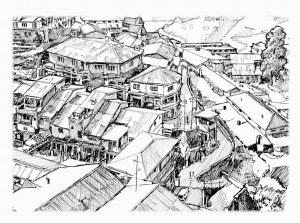
Pic courtesy: Bruce Skillcorn
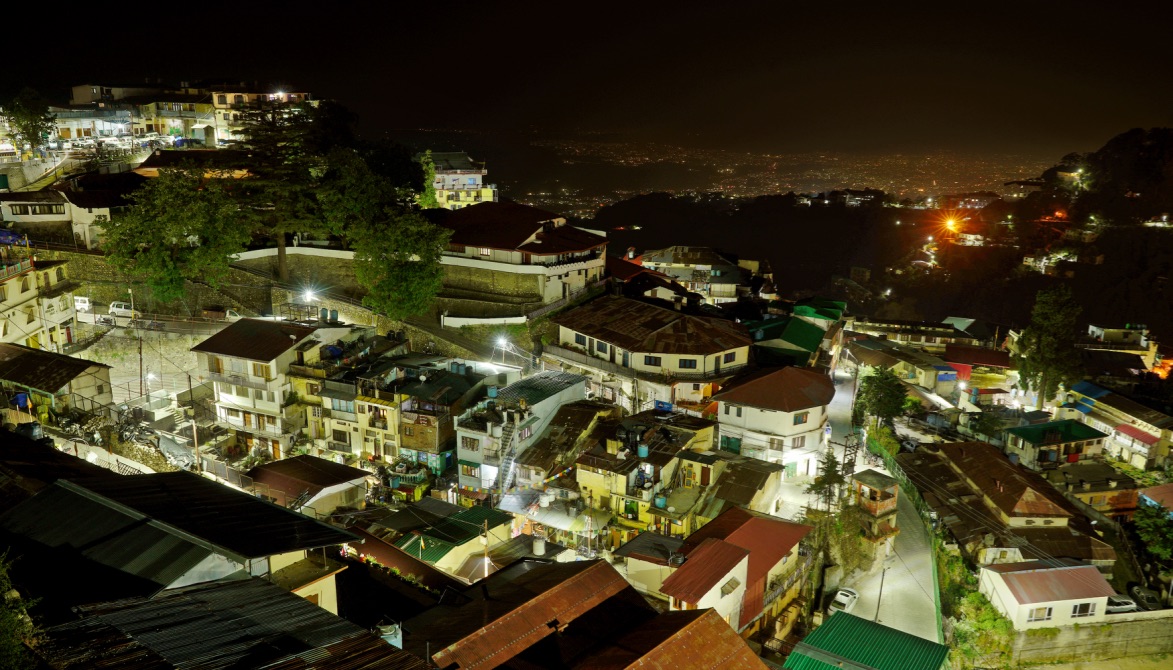
Life carried on as we put our grief on hold. Down below on the valley floor is spread the shadow of the Shivalik ranges. Above the horizon, the Girdle of Venus shines, as autumn brings flaming skies filled with atmospheric optics: streaks and whorls of orange, pink, lavender, mauve, and crimson, as the countdown of days left to go home appears on the classroom boards of the various schools that dot Mussoorie.
Legend has it that the goddess Venus wears a magical embroidered belt, made of gold filigree, lovingly crafted by her husband, the not-so-handsome Smith-God Vulcan. He felt guilty at being married to such a beautiful woman. So he hammered her a magical cummerbund so that anyone wearing it was irresistible. To switch on their love lights, other goddesses occasionally took to borrowing the belt.
‘Why do you go on and on about the winter line? Isn’t it just another sunset?’ strangers ask.
Of course it isn’t. Our sudden rise over the plains, temperature inversion and inverse air currents trapping dust, moisture, smog and smoke form a straight line. While the world over, the sun sets behind a fixed geographical feature, here it sets behind an imaginary line! The only other place this happens is in Cape Town, where Table Mountain is crouched 3,500 feet above the beaches of Clifton and Camp Bay. This is where the sun sets over the water of the ocean.
So to experience the real thing, to see the horizon step across the sky, make your way up here before dusk. Seating is optional. Be comfortable – you’re special too! Sit anywhere along the spine of the hill station from the looming cliffs of Cloud End to windswept Landour.
The sun’s journey southwards comes to an end on the winter solstice, the 22nd of December – on our shortest day, our winter line is at its most prominent. Afterwards, it fades and vanishes.
But the good news is, it will be back again next year.
Ganesh Saili, born and home-grown in the hills, belongs to those select few whose words are illustrated by their pictures. Author of two dozen books, some translated into twenty languages, his work has garnered worldwide attention.