Book Review
 By Dr Sanjeev Chopra
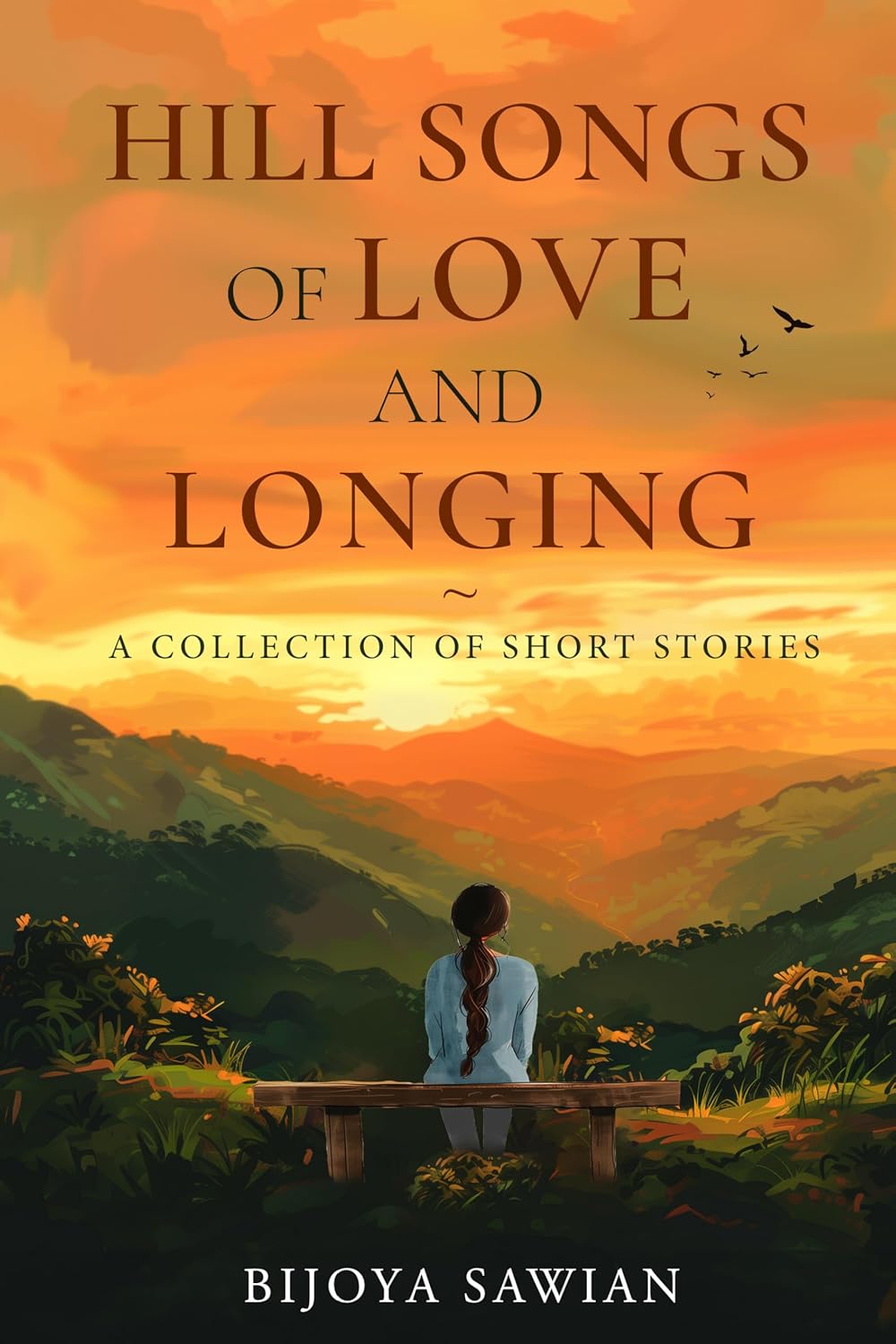
A caveat is in order. Bijoya Sawian is a wonderful friend, and an active participant in book discussions and outreach programmes of VoW. However, the curatorial team at VoW has absolutely no role in the selection of books for the Book awards – as this responsibility vests in the independent jury which rotates each year. So, I was delighted to note that her book Hill Songs of Love and Longing: A Collection of Short Stories is on the VoW English Fiction longlist for this year. Sawian has written extensively on the legends and myths of the Khasis and contributed articles to Sahitya Academy journals as well as books edited by Ruskin Bond and Namita Gokhale. She also has to her credit a debut novel, ‘Shadow Men’, and ‘From Sylhet to Shillong’, the biography of her father, Lala Bimalendu Kumar Dey – the last IGP of undivided Assam.
In this collection of eleven short stories, each (except Rosalynn) named after a Khasi female protagonist – Linsinora, Wanbok, Asorphi, Risalin, Riiaka, Betimai, Saphira, Iadmon, Mino and Dalinia, love and longing are juxtaposed: more often than not, longing is more lasting – one may say everlasting; for love is certainly beautiful but usually fleeting. So, we have moments of ecstasy, followed by years of yearning, and finally, for some, a deep understanding and acceptance of the way life pans out in myriad ways. Though most stories have a Khasi protagonist, the locales are spread beyond Meghalaya, in hamlets of Himachal, New Delhi, and of course Dehradun. For those who are not from the region, it gives us the flavour of Shillong and its environs. Thus, we learn that in July, the month of Naitung, people in the eastern hills do not marry mainly because of the inclement weather, just as they avoid April, the month of Iaiong because of the strong winds. Each story is unique, and has a twist in the tale, which often makes the reader take an extended pause after each to reflect on the way the characters have come to terms with the turn of events.
Linsinora’s first ever encounter with a man who is not her husband, father, brother, uncle, cousin or a member of the extended family leaves her with a sense of wonderment and awe: this is the first time ever that a male ever gave her a compliment. She is nonplussed, and left wondering if it was real, or the stuff of dreams! She confesses that ‘the cow dung mop’ on her head was through her British great-grandfather. Wanbok is excited about his mother marrying Uncle Boris – in fact, it is he who broaches the subject, little realising that Uncle Boris is actually his real biological father. Likewise, Asorphi gets to learn that the one relative she truly loved, adored and respected – her mother’s elder cousin San Phylis – Phylisdora Khargonkar – who lived in the rambling heritage home bought by her Anglo-Indian husband, an ex-air force officer, was her real mother. Fate had separated them, but circumstances brought them together again.
Risalin is also a story of unrequited love, but this came with an acceptance that Rangkynsai, whom she loved and adored could not have loved her in the conventional sense for he was not a heterosexual. But yes, they had bonded so well, and their conversation was marked with a deep sense of empathy and understanding of the social situation. Rang had plans of being a public figure – either through the IAS or politics. He had told her, ‘If I were the Minister of Agriculture, I would see that no one ever leaves his land by making sure he makes a decent living off it, and does not run off to the city… If I were the Education Minister, I would quote Mark Twain – Don’t let books interfere with your education, and if I were Health Minster, I would make Yoga compulsory…’
The young captain Vinod Sarin who is enamoured with Riiaka and her beautiful blue jainsem is not aware that she is actually his half-sister, the daughter of his father’s stenographer during his earlier posting in Shillong. But the story is more about why Riiaka is upset with her mother and grandmother for not extending any help to her brother because he had married a Christian girl!
Betimai, the youngest daughter, and the keeper of the family’s heritage as the khatduh, is the fourth wife of her ‘aristocratic’ husband, who does not consummate his marriage with her for eight years, for in his own words, excessive drinking had driven out the sex drive from his system. Yet, on his death, among the mourners was a young woman in her twenties with a ‘four-year-old son, who looked exactly like his father’. Saphira was fourteen, a student of the Ramakrishna Mission school in Sohara (Cherrapunjee). A letter from Chandigarh from her widowed aunt’s ex-husband’s family had shaken their world – but it was shattered when she looked into the eyes of her late uncle’s brother, and ‘in a single flash, knew that he was indeed her uncle’s murderer’.
Iadamon set in Shimla, Darjeeling and Shillong is about a mother’s helplessness, despair and acute agony when she collapses on receiving a call from the Police station that her bright son Erik ‘was part of a militant group, and some accomplices have been…’
The magical realism in the story around the grave in Kasauli with the inscription: ‘here lies Rosalynn Anne/Sweet fragrant violet/fading timelessly’ leaves one wondering: is this for real or is one imagining.
Mino is perhaps the only story in which the protagonist is her husband Khlainbor, who killed his wife and his sister when they scoffed him for his failure to make a fortune by smuggling red pine from the reserved forests – revered by his forbears – for the greedy tycoons of Shillong. Everyone is a victim in this macabre tale.
Last, but not the least, is Dalinia’s narrative set in the picturesque gold course of Shillong where her husband Bantei Roy, a senior IAS officer, was organising a gold tournament for the who’s who of the country. She too was looking forward to joining her husband in the century old club. Suddenly, and most unexpectedly she saw Rajiv Kapur from Cal (Kolkata), and then her mind was flooded with memories of her days in college with her ‘first love’ Ashwin. Theirs had been a whirlwind romance in Delhi, Mussoorie, Landour and Bombay, and promised to lead their lives together, and then he had gone to England, where he died in a tragic accident with these words on his lips ‘there is no such place as far away’.
Each story is a masterpiece in itself… no wonder it is on the list of VoW!
(Sanjeev Chopra (born 3 March, 1961) is a retired IAS officer of the 1985 batch, from Kapurthala, Punjab. He is a resident of Dehradun. He is a former Director of the Lal Bahadur Shastri National Academy of Administration and has written a book, “We, the People of the States of Bharat: The Making and Remaking of India’s Internal Boundaries”, published in 2022. He is now the patron and honorary consultant to a literary festival, the Valley of Words International Literary Festival, held annually in Dehradun. Chopra has held the Hubert H Humphrey Fellowship (Cornell), the Robert S McNamara Fellowship (World Bank) and positions at Royal Asiatic Society, London, the Lakshmi Mittal and Family South Asia Institute (Harvard).)