Garhwal Post Bureau
Dehradun, 21 Aug: Uttaranchal University organised a National Seminar on “Law & GST – Legal and Judicial Perspectives 2026”, today, in collaboration with the Indian Council of Social Science Research (ICSSR). Law College Dehradun and the Division of Research and Innovation jointly convened the event. The seminar was organised at Uttaranchal University and brought together distinguished academicians, legal professionals, researchers, faculty members, students, and participants to deliberate upon the contemporary legal, judicial, technological, and administrative dimensions of taxation and Goods and Services Tax (GST).
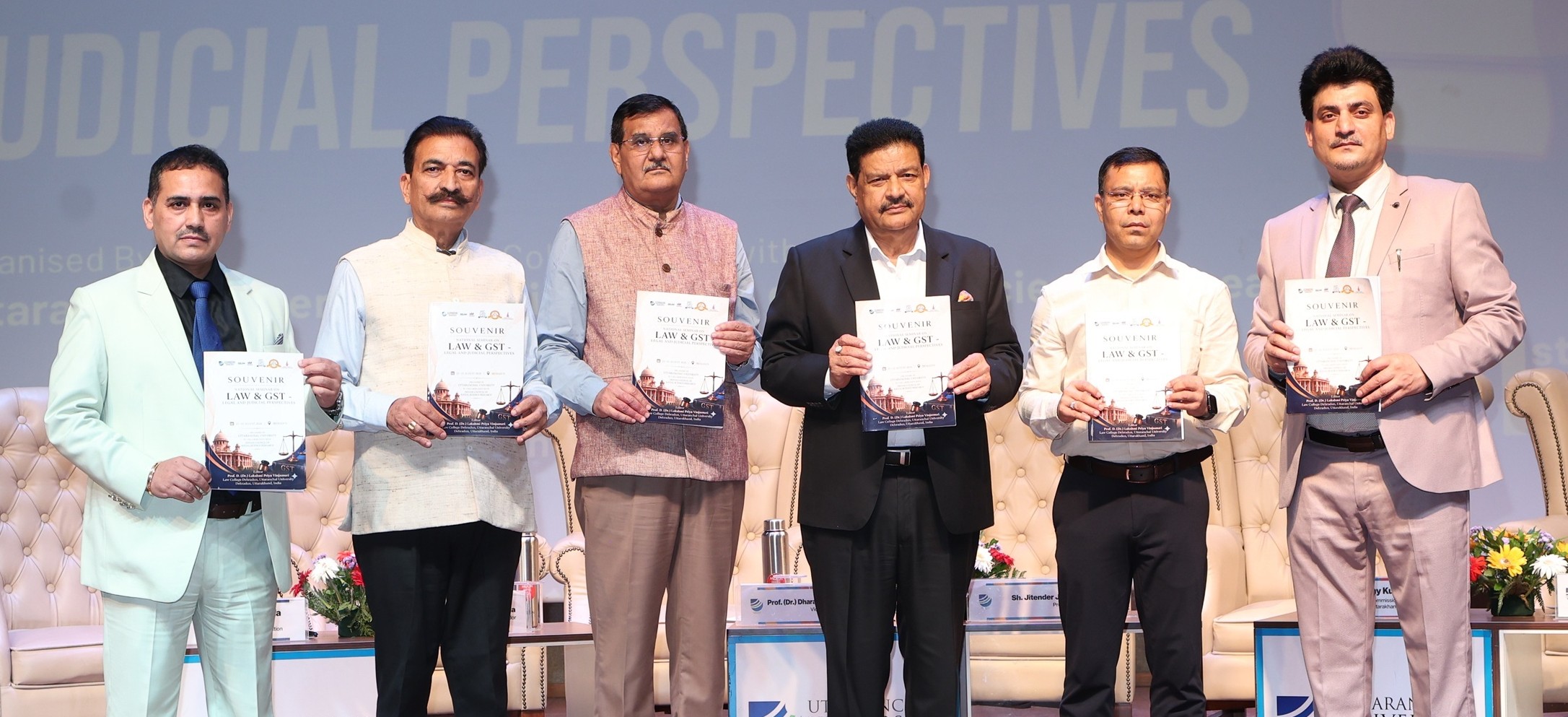
The event commenced with the arrival of the dignitaries, including the Chief Guest, Vijay Kumar, Deputy Commissioner, GST State, along with the Special Guest, Dr Mukul Sharma, clinical psychologist, Founder, Sankhyoga Foundation, Jitendra Joshi, President, Uttaranchal University, Prof Dr Dharam Buddhi, Vice Chancellor, and Prof Dr. Rajesh Bahuguna, Pro-Vice Chancellor. The inaugural ceremony began with a warm welcome address delivered by Prof Lakshmi Priya Vinjamuri, Convenor of the Conference, who welcomed the distinguished dignitaries, faculty members, researchers, participants, and students present. The felicitation reflected the university’s recognition of their contributions to academic development, research, innovation, and the successful organisation of the seminar. Following this the souvenir titled “National Seminar on Law and GST – Legal and Judicial Perspectives”, commemorating the academic contributions, was released.
The gathering was subsequently addressed by Prof Dr Rajesh Bahuguna, who welcomed all the distinguished guests, dignitaries, faculty members, researchers, participants, and students. In his address, he explained the relevance of selecting Law and GST as the central theme of the seminar and traced the historical evolution of taxation in India.
Prof Dr Dharam Buddhi, in his address, emphasised the importance of Law and GST as a relevant area of study for law students, highlighting the close connection between taxation, law, governance, and society. He encouraged students to understand the structure and functioning of the taxation system not merely as a theoretical subject but as a field having a direct impact on individuals, businesses, and the common citizen.
President Jitendra Joshi addressed the gathering and encouraged students to develop a deeper understanding of the structure and functioning of the taxation system. He emphasised the growing importance of taxation law as a specialised field and encouraged students to explore this area of legal practice and research.
Vijay Kumar, Deputy Commissioner, GST State, in his address provided an overview of the historical development and contemporary framework of Goods and Services Tax (GST). He explained that taxation has a long legacy in India and referred to Kautilya’s Arthashastra in the context of the historical taxation system. He discussed the distinction between direct and indirect taxes and explained the introduction of GST in India in 2017.
Dr Mukul Sharma addressed the gathering by shifting the focus beyond the conventional discussion of GST and highlighting the human and mental-health consequences faced by victims of legal and financial difficulties. His address provided the audience with valuable insights into mental well-being, professional responsibility and the importance of empathy in the legal profession.
The seminar then proceeded to its main academic segment comprising the keynote addresses and scholarly presentations. Prof Lakshmi Priya Vinjamuri, Convenor, introduced the titles of the research papers submitted for presentation at the conference. The diversity of the papers reflected the broad scope of the seminar and its focus on contemporary developments in law, GST, taxation, technology, and related fields.
The keynote session featured distinguished speakers from the legal and academic domains. Advocate Sameer Mahala, High Court of Punjab and Haryana, delivered a keynote address focusing on contemporary legal and taxation-related issues. He was followed by Prof Nitin Gupta, Dean & Professor, World University of Design, who contributed an academic perspective to the deliberations. Dr Rajesh Singh, Parul University, also addressed the participants and contributed to the scholarly discussion. The keynote segment further featured Prof Lokanandha Reddy, Central University of Hyderabad, who shared his academic insights with the participants.
The keynote addresses and academic presentations provided an opportunity for researchers and participants to engage with diverse perspectives on law and GST. The discussions demonstrated the interdisciplinary nature of contemporary taxation and its connection with constitutional law, technology, governance, economic policy, environmental concerns, and judicial developments.