 By Rajat Aikant Sharma
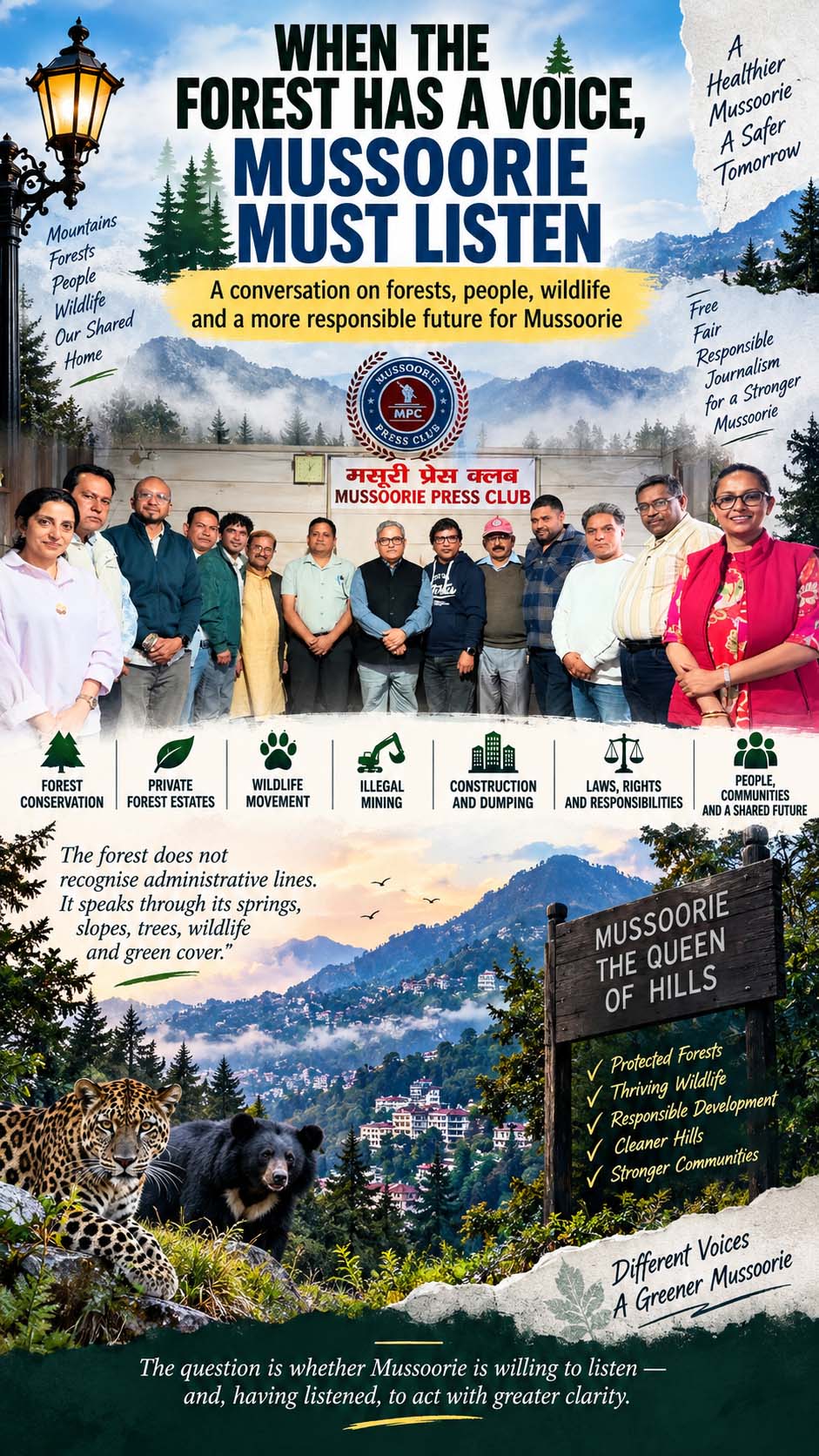
As Mussoorie’s forests, private forest estates, wildlife movement, illegal mining and expanding construction become part of public debate, the Mussoorie Press Club’s latest “Mussoorie Samvaad”, held under the leadership of Mussoorie Press Club President Sunil Silwal, offered something the hill town often needs but rarely gets in one room: a direct conversation between citizens, journalists and the people responsible for protecting the landscape.
The interaction with Divisional Forest Officer (DFO) Devi Prasad Baluni, accompanied by Sub-Divisional Forest Officer Dinesh Nautiyal, was more than a departmental briefing. It was an attempt to clear the fog around laws, responsibilities, restrictions and the realities of managing a forest division whose jurisdiction stretches across two districts.
The Mussoorie Forest Division covers nearly 39,000 hectares. Nearly 75 per cent of its area falls in Tehri district, while about 15 per cent lies in Dehradun district, according to the DFO. Its ranges extend across the district boundary, a jurisdictional reality easily overlooked when people speak loosely of “Mussoorie forests”. The forest, after all, does not recognise administrative lines.
Baluni’s larger message was clear: the basic role of a territorial forest division is protection and conservation. Timber sales and logging are not its primary function; those responsibilities lie with the Forest Corporation. The department’s fundamental responsibility is to protect the forest, prevent offences, act against illegal activity and conserve the ecosystem. Other activities come within that larger framework.
He also explained why forest administration cannot be driven by individual preferences. The division works under a ten-year Working Plan, while annual action plans are prepared according to the silvicultural year, from October to September. Plantation work, Assisted Natural Regeneration (ANR), soil and moisture conservation, resin-related work and treatment of dry or fallen trees are taken up within this planned system. Funds may come through CAMPA, the state sector or centrally funded schemes, but the principle remains: forest work is planned, budgeted and governed institutionally, not by personal choice.
That clarification matters because public expectations often collide with the legal structure of forest administration. During the Samvaad, questions revolved around private forest estates, notified and denotified areas, construction, fencing and the extent of what a property owner can legally do. Baluni emphasised that there cannot be a blanket answer. The legal status of a property, its classification and applicable permissions determine what can and cannot be undertaken.
Mussoorie has around 218 notified private forest estates. According to the discussion, demarcation has been completed in about 100 estates, while the remaining 118 are proposed to be taken up in a second phase, subject to budget availability. The issue is not merely drawing lines on a map, but creating clarity over which legal framework applies and what responsibilities follow.
The discussion also brought fencing into the larger reality of wildlife movement. Where private properties, roads, settlements and forests exist side by side, a physical boundary can mean something very different to a wild animal. Questions about private fencing therefore have to be viewed alongside wildlife movement and the legal framework governing the land. In the hills, a boundary on paper does not always translate into a boundary in nature.
Wildlife was another major thread. Hotspots for leopards and Himalayan black bears have been identified, and the department is engaging with villagers in these areas. Baluni spoke of efforts to create trained local volunteer teams who could become first-line responders in wildlife-related situations, with appropriate training and equipment. Communities closest to forests are often the first to encounter wildlife, making awareness and communication as important as enforcement.
Illegal mining came under direct discussion as well. Baluni said areas vulnerable to illegal mining have been identified and that frequent as well as night patrolling is being carried out. Departmental barriers are being strengthened, teams are being deployed for short- and long-range patrols, and senior officers are monitoring the field situation. He also said that three to four vehicles carrying illegally extracted material had recently been intercepted. The position stated during the interaction was clear: illegal mining is not permitted, and violations are being acted upon.
Construction debris and dumping raised another question about overlapping responsibilities. The forest cannot become an informal dumping ground simply because a convenient empty patch is available. During the interaction, the need for agencies such as the MDDA and Nagar Palika to manage their respective areas and designated dumping zones was also highlighted. A truck carrying waste does not stop to ask which department owns the ground; the environmental consequences remain on the landscape.
The Samvaad also touched upon trees, creepers and the changing condition of forest areas. Concerns about vines and climbers affecting healthy trees were discussed, with the DFO indicating that such interventions should be addressed through the appropriate forest planning process rather than personal or ad-hoc decisions. Forest areas around Khatta Pani and the Cantonment were also part of the discussion and were noted for attention.
Perhaps the most useful part of the interaction was its attempt to separate perception from law. Public questions are often simple: Can I build here? Can I dig on my own land? Can I fence it? Can I remove a tree? Can I carry out work in a private estate? But the answer may depend on notification status, forest classification, applicable court directions, permissions and the exact nature of the proposed activity.
That distinction is crucial for Mussoorie. Private ownership does not automatically remove forest or environmental restrictions. At the same time, the existence of forest-related restrictions does not mean every private property is treated in exactly the same way. The legal status of each parcel matters. The Forest Department’s role, as described by Baluni, is therefore to enforce the framework and explain it.
That is where dialogue becomes more valuable than confrontation. Confusion creates suspicion; clarity creates the possibility of cooperation. A citizen who understands the rule can ask sharper questions, while a department that hears them directly can explain its position more clearly. That can help solve problems before they become disputes.
The Samvaad also brought into focus a larger question: how should a mountain town develop without slowly dismantling the landscape that gives it meaning? Development is necessary. Roads, homes, tourism and public infrastructure are part of a living city. But Mussoorie’s natural systems are not an unlimited background resource. Forests hold slopes, influence water systems, support wildlife and shape the climate and character of the hills.
This is why the most important takeaway from the interaction may not be a single figure, rule or departmental statement. It is the need for conversation before conflict. When citizens understand the law, departments hear questions directly, and different agencies recognise where their responsibilities meet, many misunderstandings can be addressed before they harden into disputes.
The Mussoorie Press Club’s “Mussoorie Samvaad” created that space. The discussion brought together forest officials and members of the local media fraternity, including Vijendra Pundir, Shoorveer Bhandari, Tanya Saili, Monika Mehra, Deepak Rawat, Mohsin Tanha, Naresh Nautiyal, Ashish Bhatt, Shiv Arora, Rajat Aikant Sharma and Arvind Semwal, along with Press Club General Secretary Surat Singh Rawat and President Sunil Silwal.
For a town where forest, private property, wildlife and development meet at the same doorstep, such conversations are not ceremonial. They are part of the work of keeping the hills informed, protected and livable.
Perhaps that is the deeper meaning of a dialogue about forests. A forest does not speak in the language of meetings, files or notifications. It speaks through its springs, slopes, trees, wildlife and green cover. Every damaged tree, blocked passage, illegal extraction, disappearing patch of green or changing water source carries a message.
The question is whether Mussoorie is willing to listen—and, having listened, to act with greater clarity.
(Rajat Aikant Sharma is a writer, journalist, photojournalist and digital storyteller exploring people, places, culture, history and the changing life of the hills. Through AntarSaga, he blends reportage, visual storytelling and digital media to bring overlooked stories and local voices into wider conversations.)