 By Kulbhushan Kain
The great tragedy of history as it is taught in schools and colleges is that it is biased in its interpretation. I have no complaints about the facts. I have complaints about selective facts as also their interpretation. I was taught History in Delhi University by historians who had a very Marxist approach. It was only later that I got exposed to history that was “different”. While in college, I was taught about how we as a nation had been hammered time and again by invaders and how we succumbed without resistance. Absolutely not true. Sample this.
How many of us have heard of Banda Bahadur? And, even if one has heard of him – how many know of his bravery and the bleeding nose he gave the Mughals?
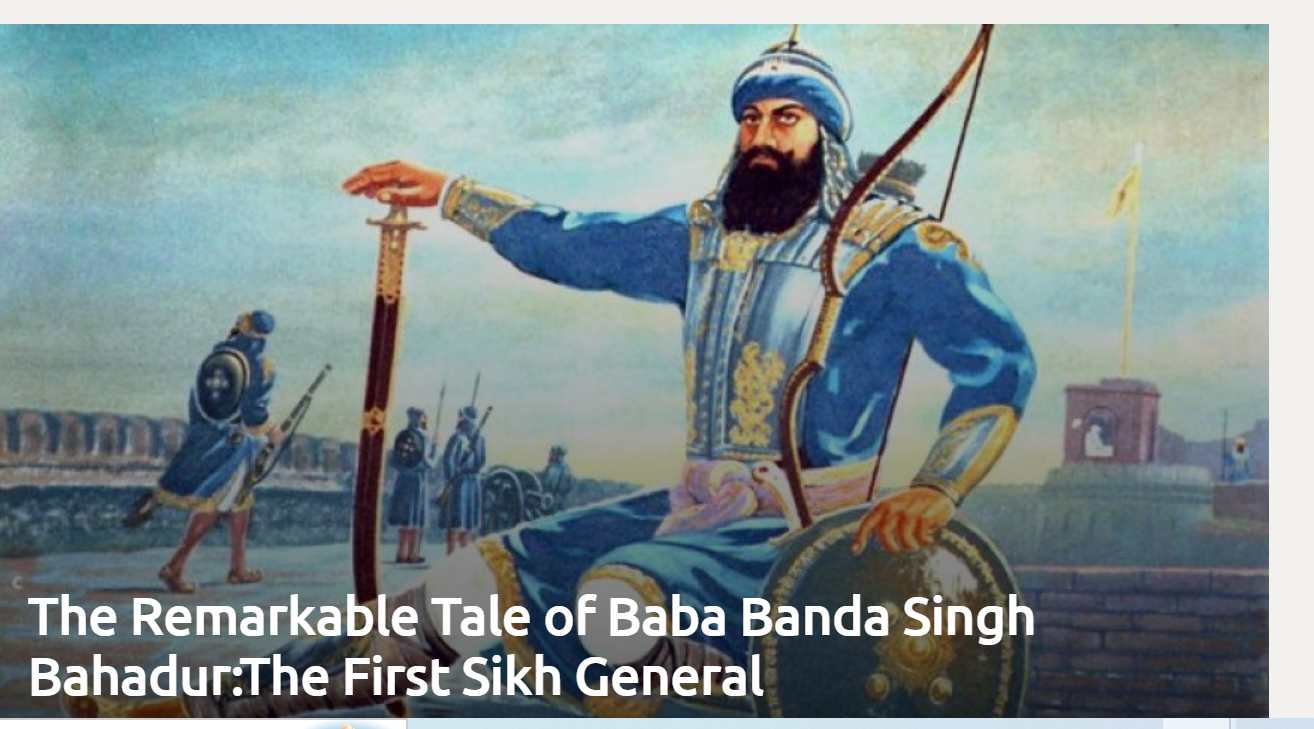
Banda Singh Bahadur, born Lachman Dev, was a Sikh warrior and a general of the Khalsa Army. At age 15, he left home to become an ascetic, established a monastery at Nānded, on the bank of the River Godāvarī. Guru Gobind Singh, when in southern India, met Banda Singh Bahadur in 1708. Banda became a disciple of Guru Gobind Singh, who baptised him. He was given five arrows by the Guru as a blessing for the battles ahead.
Upon learning of the killing of Zorawar Singh and Fateh Singh (Guru Govind Singh’s sons), Banda Bahadur is said to have wept. Soon after, Guru Gobind Singh was stabbed by 2 Pathans sent by Wazir Khan, who was the Faujdar of Sind. This is said to have sent Banda Bahadur into a fury. Guru Gobind Singh told Banda Bahadur, “When tyranny has overtaken men, it is the duty of the more sensitive to fight against it and even to lay down their life in the struggle.”
From then onwards Banda Bahadur became a thorn in the flesh of the Mughals.
It is not the purpose of this article to go into the details of the many battles that Banda Bahadur fought against the Mughals. However, I do want to point out as to why we have ignored teaching them in our schools. Atal Bihari Vajpayee spoke once about his visit to Ghazni in Afghanisthan. When he asked people there about Mahmud Ghazni, he was surprised that no one had heard about him! He further recounted that from just across where he stood was a hotel named “Kanishka”! Sad, that in India, more people know about Ghazni than Kanishka.
Getting back to Banda Bahadur (even fewer people have heard of him), he started with a force of a few hundred soldiers and went on to wage a relentless war with the Mughals and their local lackeys. He emerged victorious in battles in Sehri, Khanda, Samana, Kiratpur, Majha, Doaba, Malerkotla, Ropar, Kunjpura, Mustafabad, Sadhauara and Kapuri.
The Sikhs were planning to wage “dharamyudh” against the city of Sirhind, its Governor Wazir Khan and Dewan Sucha Nand, to avenge Mughal oppression and the savage execution of the two young sons of Guru Gobind Singh.
This was the main goal of Banda Singh.
Both sides faced off at Chappar Chiri on 12 May 1710. It is one of the most historic battles in Indian history. Yet how many of us have read, taught, or heard of it?
According to Suraj Granth and Max Arthur MacAuliffe, Wazir Khan was killed by Banda Singh with an arrow given by Guru Govind Singh. As soon as Wazir Khan died, the Mughal force fled. Wazir Khan’s body would later be tied to an animal and dragged around before being hung on a tree.
The entire province of Sirhind and its 28 parganas was under the control of Banda Singh. It extended from the Sutlej to the Yamuna and from the Shivalik hills to Kunjpura, Karnal and Kaithal.
Banda Singh Bahadur developed the village of Mukhlisgarh and made it his capital. He then renamed it to Lohgarh (Fortress of Iron).
He briefly established a state in Punjab for half a year.
The rule of the Sikhs over the entire Punjab east of Lahore obstructed the communication between Delhi and Lahore, the capital of Punjab, and this worried Mughal Emperor Bahadur Shah I.
The entire imperial force was organised to defeat and kill Banda Singh Bahadur. All the generals were directed to join the Emperor’s army. To ensure that there were no Sikh agents in the army camps, an order was issued on 29 August 1710 to all Hindus to shave off their beards.
After 6 years, in March 1715, the army under the command of Abd al-Samad Khan, the Mughal Governor of Lahore, drove Banda Bahadur and the Sikh forces into the village of Gurdas Nangal, 6 km to the west of Gurdaspur, and laid siege to the village. The Sikhs defended the small fort for eight months under conditions of great hardship, but on 7 December 1715 the Mughals broke into the starving garrison and captured Banda Singh and his companion.
The whole nation is shocked by the way Indians were shot dead by barbarians from across the border. They forced them to recite the “kalima”. I was reminded of what the Mughals did to Banda Singh after they captured him. He, along with his followers, was taken near Qutab Minar in Delhi. He was offered the option between death and conversion to Islam. Obviously, he refused. His four year old son was placed on his lap and Banda Bahadur was asked to kill him. He obviously refused. In front of Banda Bahadur, the son was hacked to pieces and the quivering liver put into Banda Bahadurs mouth. Banda Bahadur stood like a statue – unmoved. Banda Bahadur’s turn was next – his eyes were gouged out, his limbs were cut, and his body skinned with red hot pincers.
The above account is not a figment of my imagination. It is from a book by Ganda Singh, a Padma Bhushan historian – “Life of Banda Singh Bahadur” (pages 233-235).
In every Indian, there is a bit or should be (a wee bit) of Banda Singh Bahadur. But why don’t we teach it to the children and other Indians?
We must never ever forget the icons of our history. As long as we remember them – the cowards will always lose. That’s why we as a civilisation have survived for more than 5000 years.
(Kulbhushan Kain is an award winning educationist with more than 4 decades of working in schools in India and abroad. He is a prolific writer who loves cricket, travelling and cooking. He can be reached at kulbhushan.kain@gmail.com)