All Around the World with the Most Travelled Indian
 By Nitin Gairola
Ancient India is often considered as an insulated culture of kingdoms that didn’t spread into the world both in terms of people and ideas. But is this historical view actually true? Well with my limited understanding I believe some part of it is true, should you compare Ancient India to Ancient Greece, Rome or Mesopotamia whose architecture styles and philosophical ideas did spread across the ancient Mediterranean world and further, both in terms of geography and time. For example the ancient Greek philosophers such as Socrates, Plato, Aristotle and others are quoted even today or for that matter the Marcus Aurelius masterpiece called Meditations is selling in the present day as well (of course the Roman emperor didn’t publish it 2 millennia ago since it was 1,500 years before the invention of the printing press). There were also celebrated travellers from the Hellenistic World as well but we don’t hear many tales of travellers from the Indian sub-continent. But I feel this might in part also be due to a lack of documentation, more than anything else. However what we may lack in terms of books and other evidences, we do have it in architecture and modern day beliefs which shows just how far and wide the Indian influence or the ‘Indo-sphere’ was. This wonderful term ‘Indo-sphere’ has recently been coined and published by William Dalrymple in his book called ‘The Golden Road’ and it presently rests on my desk.


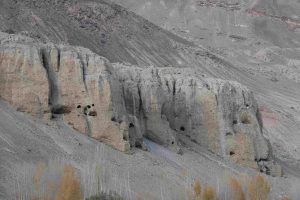
This Indo-influence is particularly pronounced in today’s South East Asia – In Indonesia, Cambodia and Thailand. But the Indian trade and influence didn’t go towards the eastern front of Asia. If we go back in time to 2,500 years ago, we know that Buddhism started in India in present day UP & Bihar. However it passed through to the outside world from both sides of the country. But since the passage from the east was not easy, with the swamps of Sundarbans and the dense Burmese rainforests in the way, majority of the migration took place from the north-west route out of India and into Central Asia. This would have been via the plains of the Ganges, the Thar Desert and the Indus plains. The route would have gone through Afghanistan and hence you see the Buddhist influence in the region such as the recently destroyed Buddha statues at Bamiyan (made in the 6 century AD). In fact we saw quite a few Buddhist caves and stupas during our recent trip to the Wakhan Corridor in southern Tajikistan and northern Afghanistan. That is where these migrants would have encountered the steep Hindukush and the Pamirs mountains. But somehow Buddhism did reach China via this long north-western route since Himalayas blocked the path directly up north from the plains of the Ganges. We of course know that in China Buddhism flourished and finally reached the island of Japan too, where in now peacefully coexists with Shinto, a religion where ancestors and nature spirits are worshipped.
So in that sense our first international export was Buddhism, even though in India it got merged into the ancient polytheistic belief systems under Hinduism. This initial export of religion to China didn’t lead to cross-learnings or trade later since China was still very remote and cut-off and most of their trade took place with the Europeans in the first millennium A.D. via the so-called Silk Route (a name that was coined much later in the 20th century as per William Dalrymple). However our exchange of goods and ideas did take place with South-East Asia but what really came as a big surprise to me is when I saw the ancient wooden vessel building industry in Mandvi, Gujarat that is active even today. These are to this day used to exchange goods with the Middle East. Way back in our past the marine route to Middle East and even Rome was at its peak as we exchanged spices, pepper, cotton, ivory, gems, teak, sandalwood and rhubarb for gold.
We have a lot of evidence of this exchange as we have found Roman coins all over the country especially in Kerala and Tamil Nadu. In fact it’s been clearly proved and chronicled that India was an active trading partner of the Roman Empire probably from the time of the first Roman Emperor Augustus Caesar who came to power in 27 BC, 17 years after the assassination of Julius Caesar. But on this side of the continent, unlike the remnants of the Buddhist trail in Afghanistan, you don’t have any major architectural wonders from India. To look for these outside our borders, you have to look eastwards only.
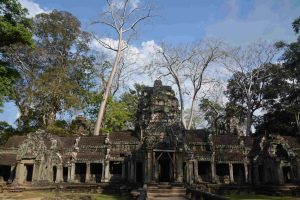
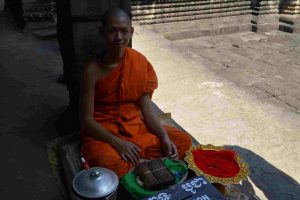
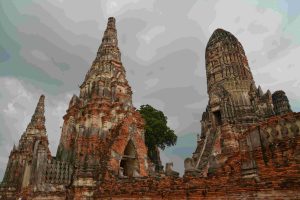
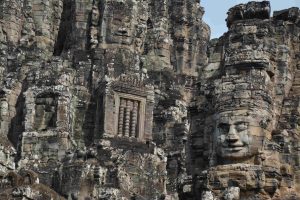
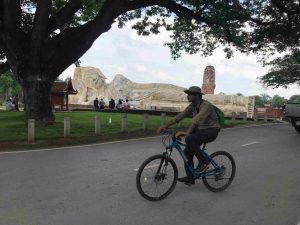
And one of the greatest Indo-influenced wonder outside India surely has to be the Buddhist-Hindu temple complex of Angkor Wat in Cambodia. It is built on an unimaginable scale during the Khmer regime by King Suryavarman II (notice the name) and while it may look fragmented today with modern constructions between architectural ensembles, it wasn’t always so. Besides Angkor Wat, another fascinating place we visited in 2019 was called Ayutthaya in Thailand. This was the capital of the Kingdom of Siam from the 1300s to mid-1700s and its name is taken from Lord Ram’s Ayodhya itself, even though it has no direct link to it as Ayutthaya was a Buddhist city. Another ancient city from the same time is Sukhothai and I must clarify that this is not the spa chain that is spread all over India and it is not a case of reverse influence (but in a way it is). Jokes apart, in both these ancient cities, we had hired bicycles and we were going around from one ensemble of monuments to the other, soaking in the past, so well preserved. Besides Cambodia and Thailand, Indonesia also has a deep Hindu influence in both Bali and Java islands – look no further than the Prambanan and Borobudur Temples to witness that influence. I don’t have to tell where Bangkok’s Suvarnabhumi Airport and Indonesia’s Garuda Airlines got their names from.
Dalrymple has very carefully used the term ‘Golden Road’. It is a very informal term but as per him the Silk Route is not any different either. According to the author there is no mention of the term ‘Silk Route’ in any literature until the 19th century. While Marco Polo did his famous travels in the 1200s, for most part, these 2 hemispheres were just vaguely aware of each other’s existence. Most of the trade was with immediate neighbours who in turn traded with theirs, thereby loosely connecting the kingdoms. But there certainly was no end to end caravan route as it is romanticized to be. However our informal ‘Golden Road’ was also not always a ‘road’ since marine trade was far easier and faster to conduct than taking the road (remember the dense jungles and what lay hidden in those jungles). So here the ‘Golden’ bit refers to the monetary value which India received for the goods it sold internationally and hence it is rather apt. But I wish he would have called his book ‘The Golden Way’ or ‘The Golden Route’ instead, since the ‘Road’ bit is slightly inaccurate and can confuse the readers. But regardless, I love his coinage of ‘Indo-sphere’ which is the sphere of influence that originated outwards from ancient India. Indo-sphere is a proper original and that’s what makes Dalrymple a proper historian.
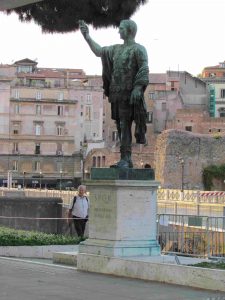
I also believe there were many big Indian travellers in the past but none had documented their travels the way Xuanzang from China, Marco Polo from Italy or Ibn Battuta from Morocco did (I just covered the 3 known continents from that time – Asia, Europe and Africa). This tells you the importance of recording your story for others. Maybe that’s the reason why ancient India was always (possibly inaccurately) seen as an insular country, with people arriving in waves but neither people nor ideas moving out. But maybe that wasn’t the case, but in any case we can’t rest our case just yet. How I wish somebody would stumble on some ancient travel texts from India and unravel the mysteries of the past. I am sure it will be an instant best seller.
Nitin Gairola is from Dehradun and has travelled the natural world more than almost any Indian ever. He has set world travel records certified by India Book of Records, has written for Lonely Planet, and holds National Geographic conservation certifications. He is also a senior corporate executive in an MNC and in his early days, used to be a published poet as well. More than anything else, he loves his Himalayan home. Reach him at: www.facebook.com/nitingairola/; www.facebook.com/MostTravelledIndian/