Cake with Kids, Capital in the Hills:
 By PC Jena
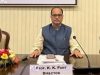
Chief Minister Pushkar Singh Dhami cut a cake with children at the National Institute for Empowerment of Persons with Netra Divyang in Dehradun on his birthday, September 16, marking a celebratory moment amid a demanding governance schedule. When he took the helm of this Himalayan frontier on July 4, 2021, he inherited a profound structural crisis: a post-pandemic economy facing its first-ever contraction, dormant capital investment pipelines since 2018, and a persistent demographic haemorrhage from hill districts to the plains. Five years later, as Uttarakhand’s longest-serving Chief Minister, his political longevity is validated by hard economic data. Reviewing his tenure requires looking beyond rhetoric to conduct a clinical assessment of the state’s economic ledger—crediting genuine structural expansion while remaining candid about unfulfilled governance pipelines.
The macroeconomic transformation begins with topline volume. Uttarakhand’s Gross State Domestic Product (GSDP) rose sharply from Rs 2.55 lakh crore in FY2021-22 to Rs 3.78 lakh crore in FY2024-25, adding an absolute Rs 1.23 lakh crore to the economic baseline. This 48.24% expansion in total output over a three-year fiscal window equates to a nominal compound annual growth rate (CAGR) of 14.1%, indicating a genuine structural shift, with real growth consistently above the 7% threshold. Crucially, per capita income mirrored this trajectory, surging by an absolute Rs 98,000 to reach Rs 3.20 lakh—a 44.14% leap that makes the average Uttarakhandi roughly 60% wealthier than the national average. Supported by an annual state budget that broke through the Rs 1 lakh crore frontier for the first time, the state’s fiscal engine has shifted from defensive crisis management to an offensive developmental paradigm.
Yet the true test of an economy lies in its capacity to translate fiscal expansion into human equity. The answer lies in NITI Aayog’s 113-indicator SDG India Index—a rigorous scorecard that tracks health, education, poverty alleviation, and institutional governance and resists fiscal manipulation. In 2020-21, Uttarakhand ranked ninth nationally. By the 2023-24 evaluation, the state had climbed to joint first place alongside Kerala, scoring 79 out of 100. Paired with a Human Development Index (HDI) reading of 0.72—well above the national baseline of 0.633—this shows Uttarakhand is converting its fiscal dividends into real social mobility.
This economic momentum is reinforced by bold socio-legal architecture. On January 27, 2025, Uttarakhand became the first state in independent India to operationalise the Uniform Civil Code (UCC). While the code remains a subject of intense civic and legal debate, from an economic standpoint, standardising personal laws governing marriage, divorce, and inheritance across religious lines is framed as a long-term institutional driver of gender-inclusive asset ownership and workforce equity.
Simultaneously, the state’s industrial policy has shifted from passive facilitation to active global engagement. The December 2023 Global Investors Summit recorded Rs 3.56 lakh crore in Memoranda of Understanding (MoUs). By 2025, the administration had grounded Rs 1.00 lakh crore of these commitments into active, physical projects. This represents a 28.09% grounding efficiency rate—a respectable performance within India’s highly competitive investment landscape. This capital deployment is projected to deliver 81,000 direct industrial jobs and approximately 2.5 lakh ancillary livelihoods. While recent investigative scrutiny has rightly highlighted instances of standard data padding in minor entries, the underlying industrial push remains a reality.
This momentum is further supported by deep structural realignments across our sectors. Services now account for roughly 40% of the aggregate state economy, propelled by an internal structural shift where tourism’s share within the service sector itself expanded from 37% to 43.7%—representing a powerful 6.7 percentage point increase in under 24 months. Securing the top rank among all Himalayan states on the Export Preparedness Index and maintaining “Achiever” status in the Centre’s Ease of Doing Business rankings verify that aggressive regulatory simplification has systematically dismantled bureaucratic inertia. Even the quieter agrarian economy shows signs of modernisation: a decade of targeted interventions has increased milk yields by 18.18% (climbing from 1,656 to 1,957 thousand tonnes), supported by high-value initiatives such as India’s first category-specific GI tag for Badri cow ghee and the Chief Minister Gokul Embryo Transfer Scheme
These initiatives are organised under the ‘GYAN’ grid (Garib, Yuva, Annadata, Nari), which has been institutionalised as a strict allocation filter within the ‘SANTULAN’ fiscal architecture for 2026-27. GYAN ensures that capital expenditure is directed towards rural asset creation, infrastructure, and human capital, rather than being absorbed by revenue inefficiencies.
However, a truly difficult analysis must confront our ongoing challenges. The demographic imbalance between our growing plains and the depleting hill districts remains unresolved. Primary agriculture continues to lag behind the high-flying service sector, and the shortage of specialist medical practitioners in our difficult topography requires urgent, unconventional intervention. The Chief Minister’s stated objective of doubling GSDP within five years remains a steep uphill climb. Yet, as we evaluate this milestone, the empirical evidence speaks clearly: an administration that inherited a contracting economy and has delivered a top-tier national development ranking, a calibrated investment pipeline, and a historic legal blueprint has earned its place in the state’s economic history on the strength of the ledger alone.
(The Writer is an Economic Advisor in the Advisory Support group, Chief Minister’s Office. And a consultant at CHIEF Policy and Strategy Advisors, New Delhi. Views are personal.)