The Books from My Shelves
 By Pankaj Naithani
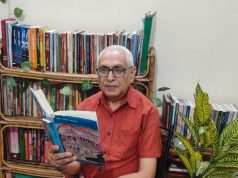
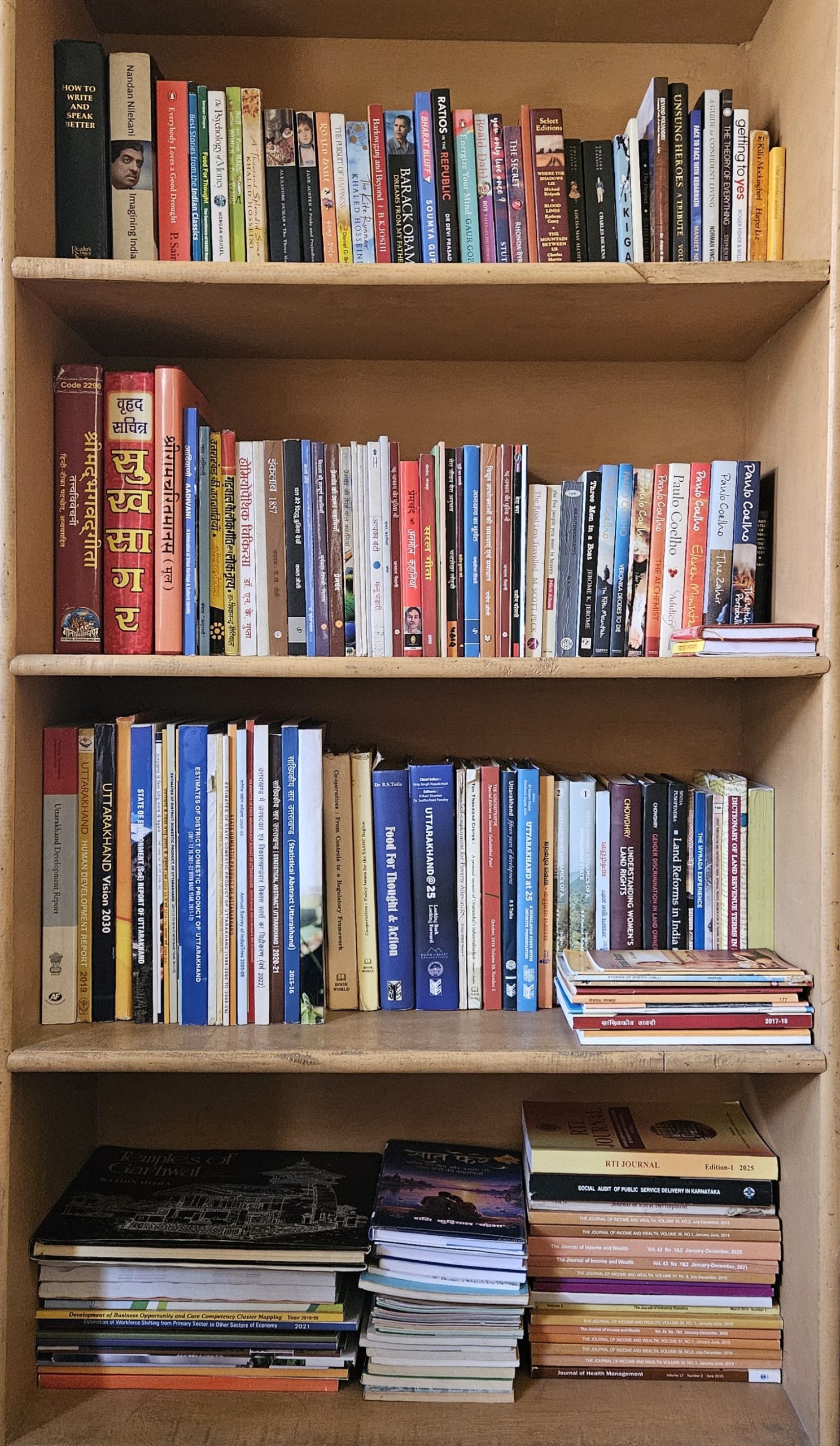
A personal library is rarely built in a day. Mine certainly was not.
The books on my shelves have arrived by different routes: some carefully chosen and bought, some received as gifts, some purchased for my daughters and later discovered by me, and perhaps a few borrowed books that somehow became permanent residents of the shelf!
For someone in government service, especially one who has moved through different assignments and places over the years, maintaining a personal library is not always easy. Books have weight, literally as well as emotionally, and transfers bring questions of space, packing and carrying. Yet one continues to collect them because books are more than objects. They carry memories of the people who gave them to us, the places where we bought them and the particular stages of life during which we read them.
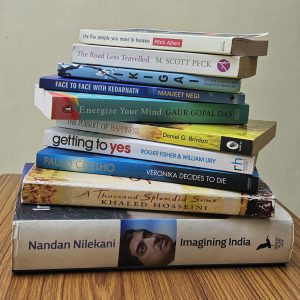
The ten books gathered here are not necessarily a list of the “best books” I have read. They are simply works that have occupied a meaningful place on my shelves and, at different moments, in my life. Together, they travel across questions of purpose and happiness, the mind and personal growth, human relationships, resilience, conflict, nature, place and the larger story of India.
The Search For Meaning
Ikigai: The Japanese Secret to a Long and Happy Life — Héctor García and Francesc Miralles (Penguin Random House)
Ikigai explores the Japanese idea of one’s reason for being. What stayed with me most was the thought that one may retire from a job, but should never retire from whatever gives meaning to life. Drawing upon the habits of Okinawan centenarians, the book speaks about purpose, activity, moderation and community. Its ideas are simple, but perhaps that is its strength: a meaningful life is often built through small habits rather than grand declarations.
Veronika Decides to Die — Paulo Coelho (HarperCollins Publishers)
Paulo Coelho’s Veronika Decides to Die explores the fragile space between despair and the discovery of a reason to live. Veronika’s decision to end her life leads her on an unexpected journey of self-discovery, challenging her ideas about normality, freedom and the value of life. What stayed with me was its central question: are we truly living, or merely following expectations? The novel ultimately becomes a powerful reflection on awakening to life and living authentically.
The Pursuit of Happiness: A Book of Studies and Strowings — Daniel G. Brinton (Fingerprint! Classics)
This is perhaps one of the more unusual books on my shelf. Written in 1893, it asks a question that remains timeless: what is happiness? Brinton reflects on pleasure, self-mastery and the art of living with the calm voice of another age. Reading such a book today, in a world constantly in a hurry, has its own charm. Some books entertain us immediately; others invite us to pause and think. For me, this belongs to the latter category.
The Five People You Meet in Heaven — Mitch Albom (Sphere)
This small book has a surprisingly large emotional reach. Through Eddie’s meetings with five people after his death, Mitch Albom explores the invisible connections between human lives. It made me think of the teachers, friends, colleagues and even strangers who quietly influence our journeys without our fully realising it at the time. It is not merely a story about heaven; it is a gentle reminder that no life and no relationship is entirely without consequence.
The Journey Within
The Road Less Travelled — M. Scott Peck (Arrow Books)
- Scott Peck begins with a simple but powerful observation: life is difficult. The book does not offer easy formulas. Instead, it speaks about discipline, responsibility, love and spiritual growth. Its central message is that growth begins when we stop running away from difficulties, and this remains relevant. Peck reminds us that the road leading to genuine growth is rarely the easiest one, and perhaps that is why the title itself stays with us.
Energize Your Mind — Gaur Gopal Das (Penguin Ananda)
Energize Your Mind addresses something almost everyone experiences today: the constant movement of thoughts, emotions and anxieties. Gaur Gopal Das presents his ideas in an accessible and practical manner, encouraging us to observe rather than be controlled by every passing thought. In a world full of information and distraction, the ability to pause and understand one’s own mind is itself a valuable discipline. The book offers useful reminders about emotional balance and self-awareness.
Resilience in the Face of Adversity
A Thousand Splendid Suns — Khaled Hosseini (Bloomsbury Publishing)
Few novels leave behind the emotional silence that follows the last pages of A Thousand Splendid Suns. Against the background of war-torn Afghanistan, Khaled Hosseini tells the story of Mariam and Laila, whose lives become deeply intertwined. Their suffering, friendship and sacrifice reveal extraordinary human resilience. The novel reminds us that war is never merely about politics or headlines; its deepest cost is borne by ordinary people. It is painful reading, but profoundly moving.
Understanding People and Relationships
Getting to Yes — Roger Fisher, William Ury and Bruce Patton (Random House Business Books)
Getting to Yes offers practical wisdom that extends far beyond formal negotiation. Its central principle, focusing on interests rather than positions, can transform the way disagreements are handled. Separating people from problems, creating options for mutual gain and using fair standards are ideas relevant to professional as well as everyday relationships. I have always felt that communication becomes easier when the objective is not to defeat the other person but to solve the problem. This book gives that idea a clear and useful framework.
Beyond the Self: Nature, Place, and Nation
Face-to-Face with Kedarnath — Manjeet Negi (Halfcrow)
Face-to-Face with Kedarnath by Manjeet Negi is a moving account of the 2013 Kedarnath disaster and its aftermath. Drawing on his ground-level reporting, Negi brings alive the devastation, the desperate rescue operations and the extraordinary courage of those who risked their own lives to save others. The book also records the arduous reconstruction of Kedarnath, including the work of the Nehru Institute of Mountaineering under its Principal and the efforts of the DIG (Special Task Force). For me, it is ultimately a story of courage, compassion, service and the indomitable human spirit.
Imagining India: Ideas for the New Century — Nandan Nilekani (Penguin Allen Lane)
For someone who has spent much of his professional life working with development, planning, statistics and public institutions, Imagining India naturally holds special interest. Nandan Nilekani examines the ideas shaping modern India: population, democracy, education, urbanisation, technology and governance. India, the book reminds us, cannot be understood through a single story. It is a country of enormous possibilities and equally enormous challenges. The book encourages us to look beyond immediate events and think about the larger forces shaping the country’s future.
Looking at these ten books together, I realise that they do not offer a single philosophy of life. Some speak through fiction, others through philosophy, practical methods, human experience or reflections on society and the world around us. Yet all of them, in different ways, return to questions that continue to matter: What gives life meaning? How do we meet difficulty? How do we understand one another? And how do we locate ourselves within the larger human and natural world?
A personal bookshelf eventually becomes more than a collection of books. It becomes a collection of conversations accumulated over a lifetime. Each book opens a different window, allowing us to enter another time, another mind and another human experience.
As George R. R. Martin, the acclaimed American novelist, aptly observes: “A reader lives a thousand lives before he dies.”
That, for me, is one of the greatest gifts of reading. Every book adds something to our own life: a new question, a different perspective or another human experience. The book itself remains the same, but when we return to it years later, we often discover that we have changed.
The answers may change. The questions often remain.
And perhaps that is why some books continue to stay with us, quietly waiting on the shelf, ready to speak again when life makes us ready to listen.
* * * * * * *
(Pankaj Naithani is a statistical researcher and academician with extensive experience in public administration, planning and development. He has contributed to research, institution-building and policy initiatives, and has published research papers and edited books. A lifelong reader and writer, he is now exploring poetry as a new field of creative expression.)