Book Review
 By Yauvanika Chopra
——–
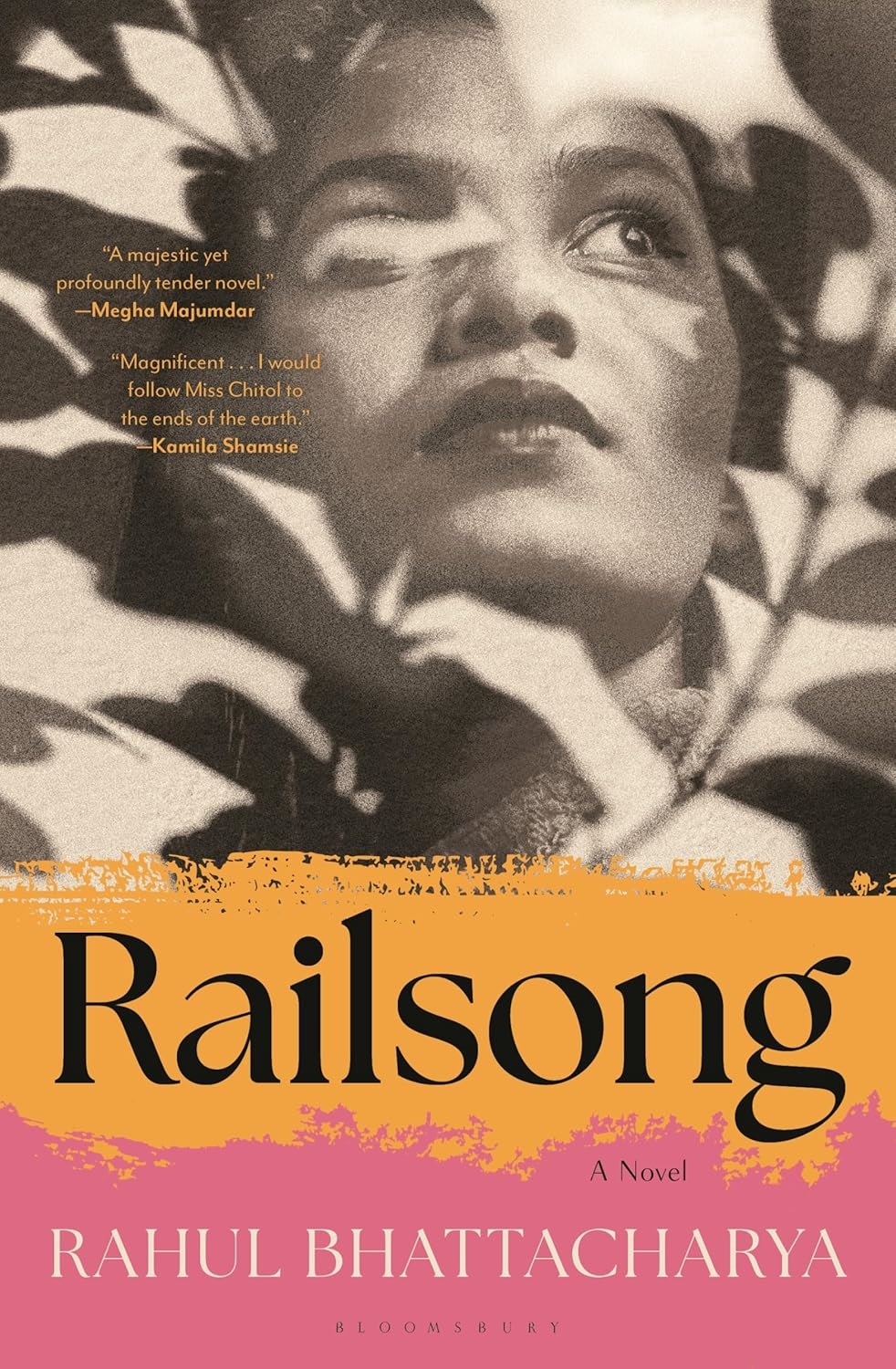
Railsong
By Rahul Bhattacharya
Bloomsbury
VBA Shortlist 2026:
English Fiction
———–
The art of composition doesn’t always require starting at the very beginning. You could start with an arresting scene — a three-year-old child named Charulata wanting to count people from the door of a moving train — and then crescendo in steady harmony from gently tumbling notes into a marvelous song of echoing spirals.
These little lessons on composition are learned by a slightly-older Charulata through eavesdropping on English tuitions delivered in tuneful cadence by her floral-dress-wearing neighbour Pearl Flanger. Charu, named after nature’s beautiful and tractable vines, proves resistant to domestic training but understands early the magic of poetic prose from behind the fence which divides her railway quarter home from that of the Flangers’. “How fulfillilng to jettison people for words! For in those words were people more real than real people. With them she could laugh and cry, at them she could stare, she could observe them without judgment or even comprehension. They expected nothing of her, yet they were always there for her, indeed gave her so much of themselves she felt accountable towards them.”
Another of Charu’s favourite words is “crack” — a term frequently employed between her and her best friend Salima. Everybody is crack, agree the two world-weary pre-teens; this is one amongst other animating truths of life which they record. Charu’s aptly-named mother Jigyasa – a Bihari Kayastha with an irreverent delight for life – has passed away. Her earnest father Animesh – a Kulin Brahmin who altered his surname from Chattopadhyay to a fish-derived “Chitol” for the amusement of his delightful wife – is alive but unattuned to the dreams of his young daughter.
The rhythm of thought and the thought of rhythm, wanting to find catharsis, see our troubled motherless urchin tire of her innocence being misread for insolence, amongst other legitimate grievances which like metal broaden out upon hammering. The same railways that bind one in also take one out in the unpredictable journeys of life. Thus Charu Chitol, with an English book in her bag, adventures away from the railway township of Bhombalpur towards the working women’s hostels of Bombay city.
“But the city will test you, it will flick its fingernails against you and listen for the sound. Real and counterfeit will both be admitted but it can tell them apart and it will let you know.” Miss Chitol is made of resonant metal. Smart girls are required for sales work, and she smiles her way through the duty of making everyone feel special. There is college too, and debatable young men of varying facial symmetries and musical affections, friends who harbour and family which anchors. Bombay is a place where crisis can become opportunity if it is turned upside-down and examined anew: palti kar dene ka. Miss Chitol dares, persists, repents, and receives. “A bit of her was dissatisfied that she who deserved much got bas this much; much of her was astounded that she who deserved nothing had got sab, all this.”
Life and file align as the lyrical Miss Chitol sets about establishing tracks for herself. Every senior clerk and railway woman carries within her the cosmic debris of a poet. She meets fellow travellers who are sometimes fatigued and often fearful. The variety and volume of personalities she encounters defy and confirm personnel categorisation. Differences are stark between an elite gazetted officer with a father and husband who are also gazetted officers, versus a Group D health department worker with a husband who is also a Group D sanitation worker, although they are employed by the same Indian Railways. Miss Chitol sees the rot of inequality within the intractable system — she has seen famine, and she knows how the brutal repression of protest during the Emergency was measured in deliberate cruelty and patronising oversight against those in the lower grades of disposable labour.
One citizen amongst 685 million in the census collection of 1981, Miss Chitol attempts to calculate whether she has represented herself in an unfaithful refraction to the enumerator. “She wondered whether she was improperly formed censally. In between languages and places and studies and employment, in between the mother’s side and father’s side, in between inner truths and outer facts. But then are most lives not so? Could it be that there were people whose everything is so neat and clean and stable so as to be tabular?” Can the heart, for one example of the provocative and fitful human body, ever really be columnised? Is it possible to draw stories from statistics in following threads to their intertwined itinerant networks?
Cogs in the wheel turn in the wheel of time, vacancies arise, lonely hearts occasionally sing together and lock into place. Miss Chitol sees it all and experiences occasional ecstasy, thinks deeply about the frequencies of a good life, and hones those wonderful qualities of curiosity and appreciation which help solve the biggest mysteries of the world. To see well — identify reasonable dissatisfaction and unreasonable desire — and to be seen well: the restless raga, the pleasure of the waiting and wandering, the cultivation of surrender, the condition of divinity, being accountable and negotiating accountability from the world…
This melodic novel by Rahul Bhattacharya is a universe imagined so vividly within the real that we can recognise it in the inheritance around us as a reminder of our own current implications. It sweeps out and returns in loops and full circles with a surety that must in part be attributed to Bhattacharya’s editorial collaboration with the brilliant literary agent Shruti Debi. All in all, Railsong is an excellent composition. As Kamila Shamsie has written for the book, one could follow the artless and artful Miss Chitol – gazetteer of India’s inexhaustible complexities and life’s extraordinary beauties – to the very ends of the earth.
(Yauvanika Chopra was Associate Director at the New India Foundation and earlier an editor at Speaking Tiger.)