Book Review
 By Yauvanika Chopra
——–
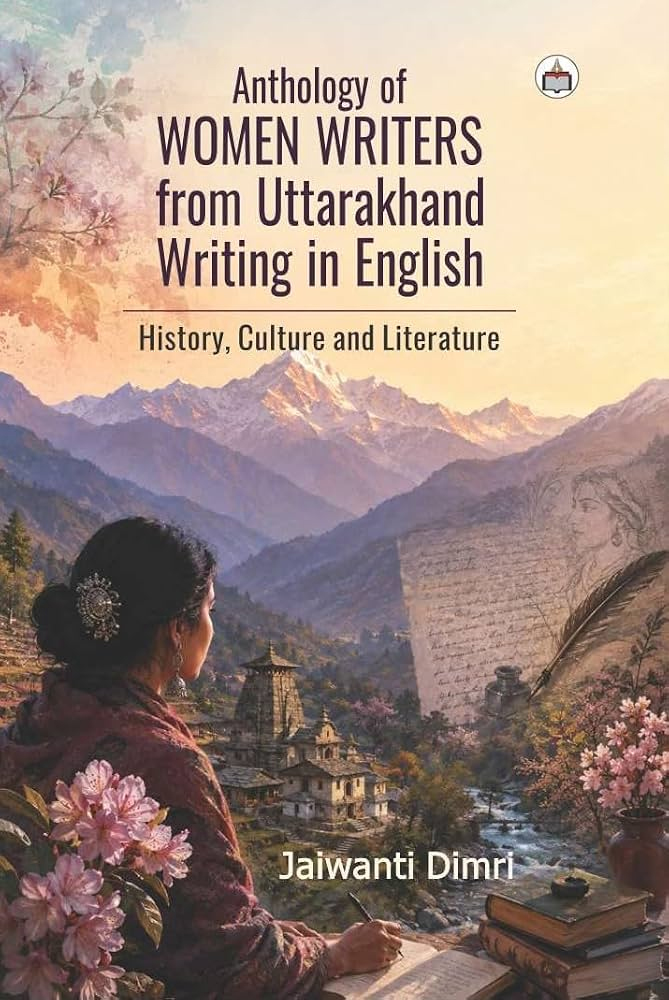
Anthology of Women
Writers from
Uttarakhand Writing
in English: History,
Culture and
Literature
By Dr Jaiwanti Dimri
Authors Press,
New Delhi 2026
————-
Four years ago, Dr Jaiwanti Dimri typed “Women writers from Uttarakhand writing in English” on Google. Her initial search led to a modest list of eleven authors. Eventually, as she kept following threads of conversation and investigation, the list grew to an astonishing sixty — with pages left for more in the next anthology, hopefully: “Sixty women writers of Uttarakhand origin by birth, ancestry or stay in the hill state of Uttarakhand writing across genres who have enriched the literary and cultural landscape of not only Uttarakhand but have registered their presence on the national and global platform.”
Beginning with an introduction about historical and literary contexts, this anthology of the “author daughters of Uttarakhand” (as described by the inimitable Himalayan scholar Shekhar Pathak) aims to illuminate the female legacies of writers from the Devbhoomi. The effort is aligned with a larger desire to decolonize our understanding of world literature through a focus on Indian literature from these mountains which have stood guard on the subcontinent for 50 million years.
There are acclaimed English-language writers like Anita Desai (born in Mussoorie), Nayantara Sahgal (based in Dehradun), Anuradha Roy (based in Ranikhet), Tavleen Singh (born in Mussoorie) and Vandana Shiva (born in Dehradun). There are also women who translate from within and outside of Uttarakhand: Usha Naudiyal, Smita Karnatak, Madhu D. Singh, Madhu Joshi, Madhu Mehrotra, Deepa Agarwal, Surekha Dangwal. Women who extend the spiritual traditions of the Devbhoomi are featured as well, including Bettina Bäumer, Maria Wirth, and Sadhvi Bhagwati Saraswati.
The book pays tribute to the late Colleen Gantzer (1934-2024), born in Gujarat but much beloved to Mussoorie, who was posthumously awarded the Padma Shri for her invaluable contribution to travel literature in the country. Her writings with her husband, retired naval commander Hugh Gantzer, include the series Intriguing India: Colourful East / Vibrant West / Historic South / Alluring North published by Niyogi Books between 2011 and 2013.
Readers of Garhwal Post and our other publications from Uttarakhand will be familiar with the pleasure of the years when one would read the Gantzers’ occasional columns. They may also recall Dr Jaskiran Chopra, whose poetry has been known to most everyone who has visited the Valley of Words over the years. She would take a keen interest in our city’s cultural development, and I remember how she would make it a point to develop editorial workshops for young VoW volunteers who wanted to be part of the writing teams. Her love for Dehradun was reflected in her collection of Urdu poems in “Mera Sheher”.
A Garhwal Post columnist who will be immediately recognizable to Dehradun readers is the prolific Ratna Manucha, who published Unfiltered: The Little Things, about life’s irrepressible daily tribulations and joys about a year ago. This very week, she has released another book titled From My Bookshelf which contains an edited selection of book reviews by Dr Sanjeev Chopra. Another delightful name is that of Dr Tania Saili Bakshi, whose work is well-known not only to readers across this state and beyond, but is also deeply appreciated by those Uttarakhandi artists and entrepreneurs whom she has consistently platformed through her journalism over the years. And certainly everyone who reads the Garhwal Post will likely know its distinctive Features Editor, Anjali Nauriyal — her book Retelling the Story of Traditional Ballads of Garhwal preserves the rich cultural memories of folk songs for future generations.
There are profiles of remarkable historical authors like the crime fiction writer Patricia Wentworth, the Gandhian activist Sarla Behn, and social reformer Tara Ali Baig. The long arc of the book accelerates to cover tectonic shifts in time to contemporary authors like bureaucrat Ekta Uniyal (The Mountain Girl) along with Sunita Pant Bansal and Kiran Manral. Also included are profiles of screenwriter Advaita Kala who published the novel Almost Single and the film Anjaana Anjaani, among others, alongside the poetry of the brilliant Urvashi Bahuguna who writes from around the world: “A woman in the distance / waves. Who, me? I step away from the cliffs. / Two girls ask if I will photograph them & I ask / back: in the photo, I look small & full of wonder. / A pinecone tightly wound into itself.”
The pages on Nergis Dalal are followed by biographical detail about the writings of her daughter, Dr Roshen Dalal, who has authored several popular books on spirituality for children. Ira Pande has written about her mother, the acclaimed author Gaura Pant “Shivani” (Diddi: My Mother’s Voice; 2005) and so has her sister Mrinal (Daughter’s Daughter; 1993).
In an interview, the unmatched author Namita Gokhale made a statement which perhaps braids together the many diverse lives which are profiled in this anthology: “My way of looking at the world remains trapped in that primary identity: once you start loving the hills they hold on to you”. Similarly, there is a quote from Bacchendri Pal, first woman to scale Mount Everest, from her self-narrative: “We, the hill people, have always worshiped the mountains. My overpowering emotion at this awe-inspiring spectacle was, therefore, devotional.”
There are many legacies which are still missing. Women like Gaura Devi, who raised a movement of ecofeminism without due credit, have still not been written about adequately and far too little survives of their own voices. Yet it can also be said that their focus on “Jal Jangal Jameen” needs no inscription in print to animate our resonating need for harmony with nature. Anandamayi Ma did not write either, but conveyed meaning beyond words and established ashrams in Dehradun and Haridwar which continue to pulsate with the quiet beauty which characterised her mystic life. There are several other women whose histories have to be reclaimed — Teelu Rauteli, Jasuli Amma, Tincheri Mai, Chandraprabha Aitwal — and women whose histories are yet to be written — the mountaineer sisters Tashi and Nungshi Malik, for example.
“Loving and zealously guarding one’s space is a virtue, not a disqualification by any account,” writes Dr Dimri. There have been other women writers with unexpected connections to these hills — Qurratulain Hyder writes about Mussoorie with a vividness that is impossible to replicate — and there are many whose names add to Google’s inventory of Uttarakhandi women writers today: Shivya Nath, Bijoya Sawian, Madhu Gurung, Niraja Gopal Jayal, Mohini Gupta, Anju Rana, Pooja Marwah, Neha Mittal, Sunita Vijay, Kusum Ansal, Pratibha Katiyar… May these verdant valleys and hills keep uplifting writers — writing in English or Garhwali or Kumaoni or Jaunsari or Pahari or Nepali or Dogri or Hindi or any other variant of the many expressions gathering across the vast range of our beloved Himalayas.
(Yauvanika Chopra was Associate Director at the New India Foundation and earlier an editor at Speaking Tiger.)