By GANESH SAILI
Some call it a paunch. Kinder souls – seeking to somewhat soften the blow – say: ‘Maybe his chest has slipped !’
However, if you were to ask me, I would say that I look like this because I have come a long way from the starting line; some of the roads I travelled on were potholed, causing my chest to move southward and merge with my midriff giving it the appearance of a protruding balcony in Delhi’s kitsch Rajouri Garden.
Please, don’t remind me of how beautiful it is to be young. Let me assure all the millennials (and the GenZs and the alphas too): I have seen days when every passing shower revealed a rainbow. But to be old is to be more comfortable, as one tends to be more relaxed. You learn to mock at trouble. If you don’t learn that early enough, you end up finding in your dotage that there is not much to laugh at. So I have learnt to laugh at myself.

I learnt to do this from the leonine Jack Gibson. I first met him at St. Helen’s Cottage, where he was staying as a summer guest of Princess Sita of Kapurthala. I had come to see him, looking for a picture of the Wilson coin for a book that I was doing at the time. I had found the legendary JMT Gibson seated near a plate-glass window smoking a pipe clenched between his teeth, looking down at the Doon Valley.
I had chanced upon a picture published in Imprint magazine by Mady Marty, who was the wife of John Martyn the Principal of Doon School. The story was about Fredrick E. Wilson’s charming homestead in Harsil. Illustrated as it was with black-and-white photographs, it was hard to tell if the coins were gold or silver. Who knew then that the Wilson rupees were brass tokens that came into circulation to simplify bookkeeping? At the logging season’s end, workers traded them in at Wilson’s Haridwar Depot for the official silver rupees. Brass coins have no intrinsic value and it is no wonder they vanished. These two had come from the Jadhganga valley when Jack found his porters gambling with them. In the 1930s, he was trekking in the Bhagirathi valley.
Central to Jack’s life was the fact that he single-handedly turned around Mayo College, Ajmer which in the 1950s was close to perishing. Falling in love with the place, he threw himself into its rejuvenation with a passion; it was his Cleopatra for whom he had given up the world, and it was a world well lost!

Anyway, I photographed the coins, and that was that! Or so I thought, until a few days later came a letter by registered mail. Sandwiched between two pieces of cardboard, in a flimsy envelope, were the coins. ‘They came from Garhwal, they must now go back home!’ the enclosed note said. He added: ‘In exchange, around Christmas, send me a picture of the Banderpoonch ridge at leisure.’
For the life of me, I could not figure out why he’d want a picture of a Himalayan massif soaring high in the sky at 20,722 feet. Till I found out that around 1937, Doon School masters were keen alpinists including Gurdial Singh, R.L. Holdsworth, J. T. M. Gibson, J. A. K. Martyn and Tenzing Norgay. By 1946, this mountain was affectionately called ‘the Doon School Mountain.’ This affinity for the peak was shared by schoolmasters and pupils alike. It is the most prominent Himalayan peak visible from the ridge of Mussoorie.
A tale lives on in legend that has Jack and his charges out on a trek when they find their supplies running out. All they had left was some atta. Seizing the chance to teach the boys the economics of barter, Jack walked up to the village Pradhan and declared, albeit in pidgin Hindi: ‘Hum Atta! Tum Ullu!’
Fortunately, a Dosco explained to the headman that no offence was meant. It was merely a suggestion for swapping flour for potatoes!
Men like Jack Gibson leave more than just imprints on the sands of time.
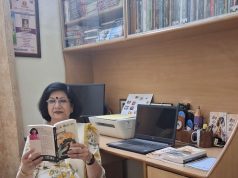
Ganesh Saili born and home-grown in the hills belongs to those select few whose words are illustrated by their pictures. Author of two dozen books; some translated into twenty languages, his work has found recognition worldwide.