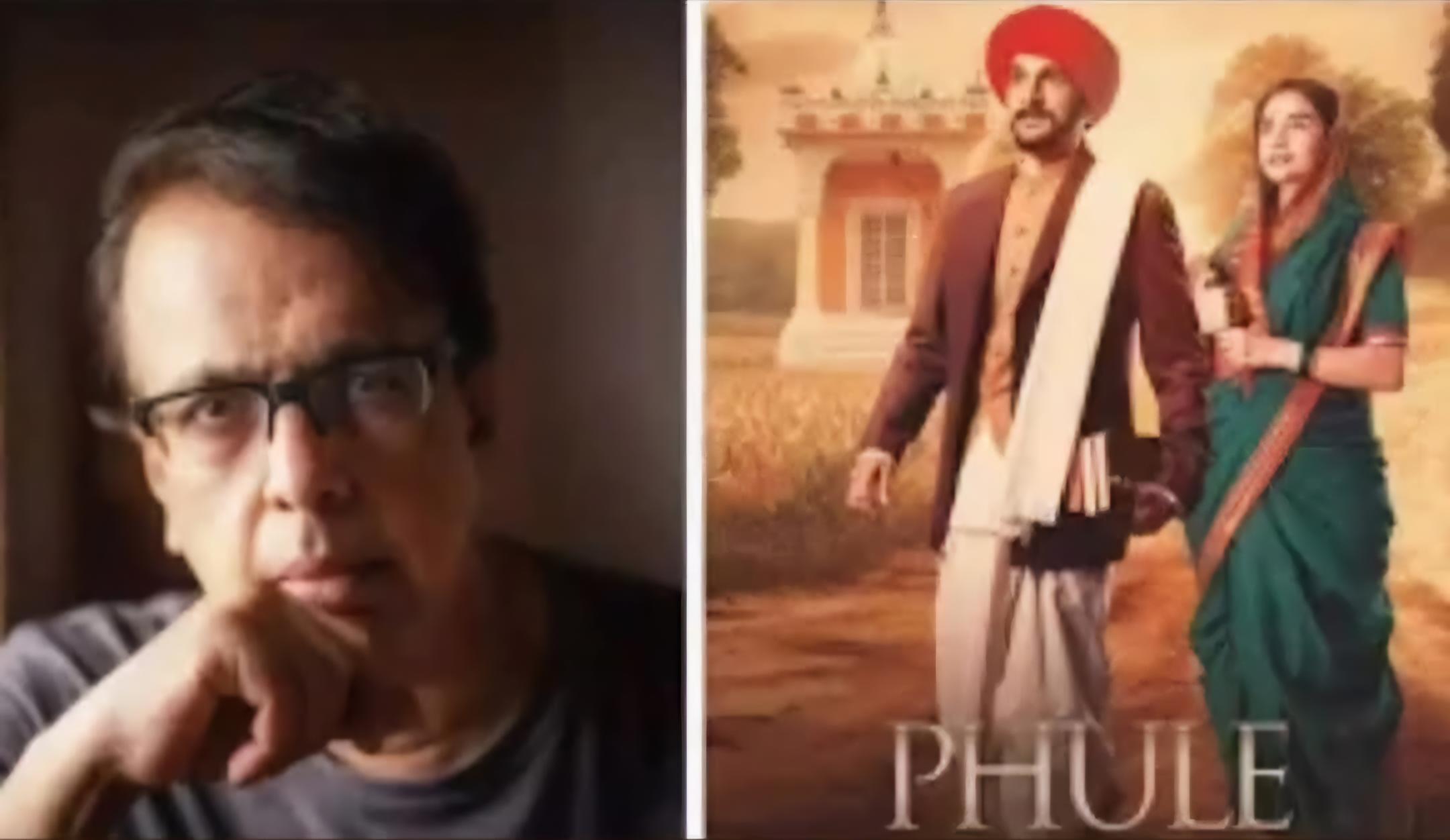
Phule- Film Review
 By Sunita Vijay
Phule, directed by Ananth Mahadevan, is a sincere and educative portrayal of the remarkable lives of Jyotirao and Savitribai Phule — visionaries who became the voices of the voiceless. While filmmakers often gravitate toward commercial subjects, Mahadevan dares to tread a more challenging path. He delves into the lives of a pioneering Maharashtrian couple from the early 1800s who questioned deeply entrenched caste and gender inequalities and became symbols of social reform.
Films like Phule are difficult to make — they lack the commercial ‘masala’ that mainstream audiences often seek. Yet Mahadevan succeeds in capturing the essence of the Phules’ struggle and simplicity with authenticity and restraint.
He brings to life the quiet yet revolutionary existence of the couple, who imagined an India where education, dignity, and justice belonged to everyone, not just the privileged few. At a time when caste and gender oppression permeated every layer of society, the Phules stood tall with nothing but courage and an unshakable belief in equality. They established schools for girls and the marginalised despite facing hostility, violence, and social boycott. They challenged orthodoxy not through aggression, but through relentless knowledge-sharing, compassion, and action. Their efforts laid the foundation for India’s social awakening.

Phule is a simple yet deeply inspiring film — a journey of courage, conviction, and quiet revolution. The film opens in a marigold field, a symbolic reference to the surname ‘Phule’, derived from the word phul, given to Jyotirao’s family by the last Peshwa ruler for their work in floristry. Yet the irony was painful — the same maali (gardener) was denied entry into temples, girls were denied education, Shudras were barred from wells, and even their shadows were considered impure.
These were the oppressive practices that Jyotirao Phule (Pratik Gandhi) set out to challenge. Inspired by the ideals of the French Revolution and Thomas Paine’s Rights of Man, he embarks on his journey of reform, beginning by educating his wife, Savitribai Phule (Patralekha), who would go on to become India’s first female teacher. Together, they dreamed of a progressive society where education was the key to empowerment — especially for women.
Their journey was filled with unimaginable resistance. The Brahmins, unwilling to educate the lower castes, wanted to exploit Shudra labour against the British, while the British, on the other hand, sought to educate them with the hidden agenda of religious conversion. Navigating between these forces was a daunting task.
Yet the Phules dared to do the unthinkable — they opened secret schools for young girls, dug their own well to protest water discrimination, married widows, and offered shelters to abandoned women. Jyotirao even performed wedding rituals, defying religious sanctions and facing death threats and physical attacks in return. Through intelligence, insight, and strategic thinking, he braved every storm, with unwavering support from the equally strong Savitribai.
Pratik Gandhi delivers a restrained and impactful performance, illuminating the screen with his presence. His portrayal anchors the film, rising above an ensemble of seasoned actors like Vinay Pathak, Joy Sengupta, and Amit Behl, who play more subdued roles. Patralekha supports him well, though her accent feels a bit modern and doesn’t entirely match the period.
The film consciously avoids dramatisation. There is no overt rage — instead, the couple quietly adapts to every obstacle without violence or protest. Eventually, Jyotirao was given the title ‘Mahatma’, and Savitribai is rightfully remembered as the Mother of Indian Education.
Phule unfolds at a gentle pace, with performances that sometimes feel more like theatrical renditions. While costumes and sets are period-appropriate, the characters appear too well-groomed for their rural context, and their conversations often feel like didactic exchanges rather than organic reflections. The emotional and physical toll of their journey — especially scenes where Savitribai is pelted with stones and cow dung — lacks the raw intensity one would expect.
Still, nearly every chapter of their inspiring lives is touched upon, and the film remains emotionally compelling. The dialogues, especially Jyotirao’s observation — “Hamara desh ek bhavuk desh hai… yahan dharam aur jaati ke naam par logon ko ladhana bada saral hai” — resonate powerfully and reflect the film’s core message.
Recreating 19th-century Maharashtra with its language, customs, and aesthetics is no easy feat. Mahadevan deserves credit for capturing the rural lifestyle authentically, using beautiful locations like village homes, banyan trees near water ponds, and fields of marigold. The attention to cultural and visual detail gives the film a grounded charm.
Phule is not just a biopic — it is a reminder of the power of education, empathy, and quiet resistance. It urges us to reflect on how far we’ve come — and how far we still have to go. I give 3.5 stars out of 5.