 By Kulbhushan Kain
Not every city gets to watch itself being born. Dehradun did. When Uttarakhand was carved out of Uttar Pradesh on 9 November 2000, most of us who called it home felt a strange mixture of pride and apprehension. Pride, because this was our moment. Apprehension, because we had seen what development could do to a place and we were not entirely sure we were ready for it.
Before statehood, the hills were administered from Lucknow, a distant capital that could not fully understand the aspirations, the terrain, or the tempo of a mountain people. The High Court was in Lucknow. The Secretariat was in Lucknow. Every file, every petition, every development proposal had to travel hundreds of kilometres down to it before it could receive the nod of authority and then travel back up again. The internet was in infancy and the people of the hills, governance was not just slow- it was remote. And remoteness in matters of administration is mostly another name for neglect.
When the new state finally came into being, it came with all the promise and all the chaos that new beginnings invariably bring. There was no blueprint. There was no capital ready and waiting. No well-oiled institutions in place. What there was, instead, was a collective will – the stubborn, highland determination of a people who had always known that their mountains asked more of them than the plains asked of others.
The challenges were formidable, and one must not gloss over them. Development in mountain terrain is not the same as development on flat land. A road that costs a few crore rupees on the plains costs many more in the hills. A hospital that can be built in six months in a city takes years when you are fighting gradients, landslides, and access roads that vanish with every monsoon. The state’s geography, which is its greatest glory, is also its greatest obstacle. But obstacle is not the same as impossibility – and Dehradun has proven that more than once.
Dehradun, as the capital of this young state, has changed visibly and profoundly. As someone who has spent a significant part of his life in this city, I have watched the change from close quarters, and the view is not without its ambivalence. In fact, my voice has often been one of lament rather than over-enthusiastic joy. We lost the canals that once ran clear and unhurried through quiet neighbourhoods- narrowed, buried, or simply gone. We lost the unhurried intersections where cyclists and pedestrians once moved at a pace that matched the town’s temperament. We lost stretches of forest to projects that promised connectivity and convenience. We lost a certain quietness- that particular small-town stillness that, once gone, cannot be legislated back into existence. These losses are real. They deserve to be named, not softened. And yet I love and stay on because, as Ruskin Bond so beautifully wrote, “The trees my father planted here, these old family trees are still growing in Dehra.”
I think of development the way one thinks of medicine. A good medicine heals, but it almost always carries side effects. The question is not whether the side effects exist, but whether the cure was worth the cost. On balance, I believe it was, because of what Dehradun found in return.
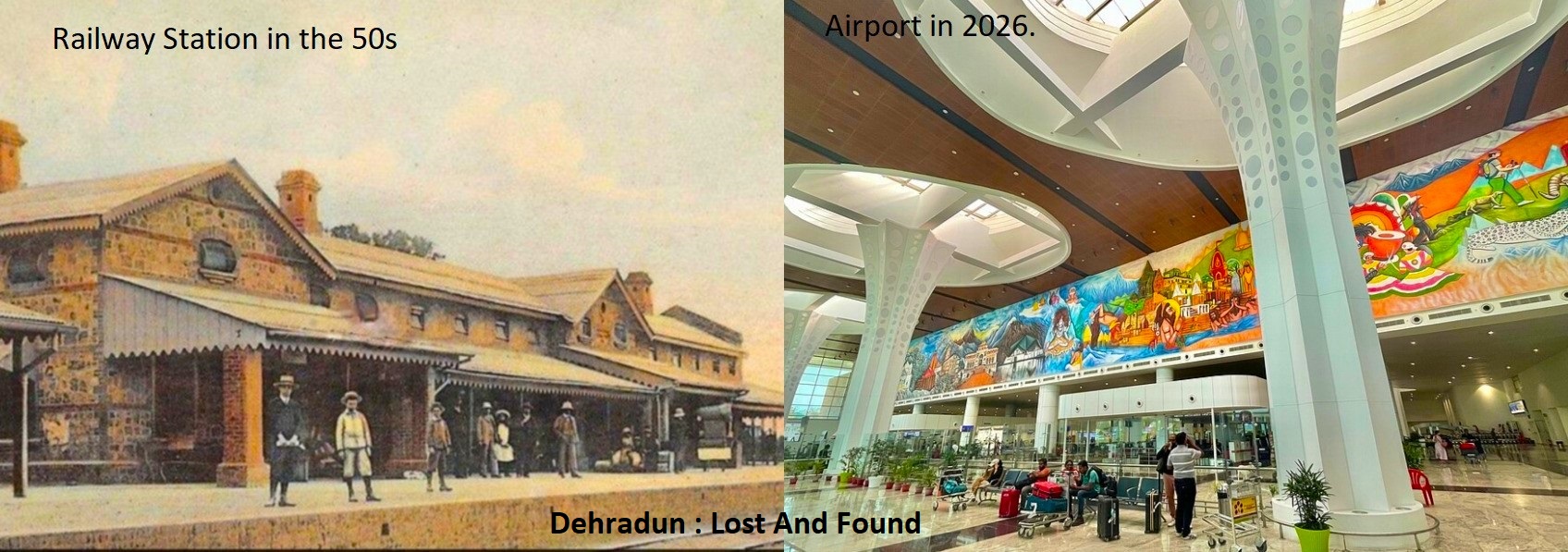
It found connectivity. A small but beautiful airport, excellent trains, and world-class roads now link this city to everywhere else. It found commerce – the malls, the big brands, the five-star hotels that play host to celebrities and commoner alike. It found a new cultural confidence: literature and crime festivals that draw voices from across the country, a film industry beginning to discover our landscape, and a community of educated, accomplished, often retired professionals- people who have seen the world and chosen to come back to these hills, lending the city a particular intellectual texture. Conversations here can move from poetry to policy in the space of an evening. As a generation Z person would say, “It’s all happening here.”
Above all, Dehradun found its identity. It is no longer a footnote in the story of a larger state. It is a chapter unto itself.
What strikes me most, however, is what has NOT changed — because some things, thankfully, held their ground.
The schools held. Dehradun’s reputation as a centre of educational excellence was built over many decades, and it has not been surrendered in the rush of change. When parents in other cities talk about where their children study, many do not name the school. They name the city. “My child is studying in Dehradun,” they say, with a quiet satisfaction, as if the address itself is the credential. That is the weight of institutional trust, earned over generations.
The rivers held and still carry the mountains in their water. The air held and. through most of the year, its quality remains something that citizens of Delhi and Mumbai can only dream about. There is a clarity to the Doon air, a freshness that is the gift of geography, one this city has not yet squandered, though it must be guarded with the same vigilance with which it was inherited.
The writers held. Dehradun and Mussoorie together produce more writers per square kilometre than perhaps any comparable stretch of geography in the world. The hills here seem to do something to the imagination – they slow the mind down just enough for it to become observant. Ruskin Bond still walks these streets, sits in this light, and writes. That, perhaps, is why you still find people reading books in cafes rather than fiddling with smartphones.
Dehradun also connects to something timeless in India’s civilisational offering. Its doorstep is the gateway to some of the most sacred geography on earth. Pilgrims, practitioners, and seekers from every continent pass through this city on their way to the high Himalayas, in search of something no metropolitan city can provide. They arrive here first. They rest here. They breathe here. And many, having once passed through, find reasons to return- not to the shrines alone, but to the city itself. That is not coincidence. It is character.
As the capital of a new state, Dehradun is twenty-five years old which is barely a moment in the life of a city. In that moment, it has lost things it misses, but found things it needed, and kept the things that truly mattered. It has built an identity from its geography, its people, and its history. Dehradun stands today not merely as a state capital, but as proof of what a city can become when it has both the pressure of new ambitions and the anchor of old values.
The Garhwal Post marks thirty years of bearing witness to this story. That itself is a revolution. In thirty years, Garhwal Post has raised issues, has got the best writers to contribute to it, and linked Dehradun to the world with an internet edition.
It is worth pausing to acknowledge what the balance sheet shows. Yes, we lost some things. But the mountains are still here. The schools are still excellent. The rivers still run. The air is still clean. The writers still write. The people, warm, resilient, and quietly proud- are still, unmistakably, the people of Dehradun.
That, in the end, is the story. It is a short one at the moment. But as Seneca wrote: “As in a book, so in life- it is not how long, but how good it is.”
And the story of Dehradun so far is a good one. And it is unfolding every day!
(Kulbhushan Kain is an award winning educationist with more than 4 decades of working in schools in India and abroad. He is a prolific writer who loves cricket, travelling and cooking. He can be reached at kulbhushan.kain@gmail.com)