 By SUNITA VIJAY
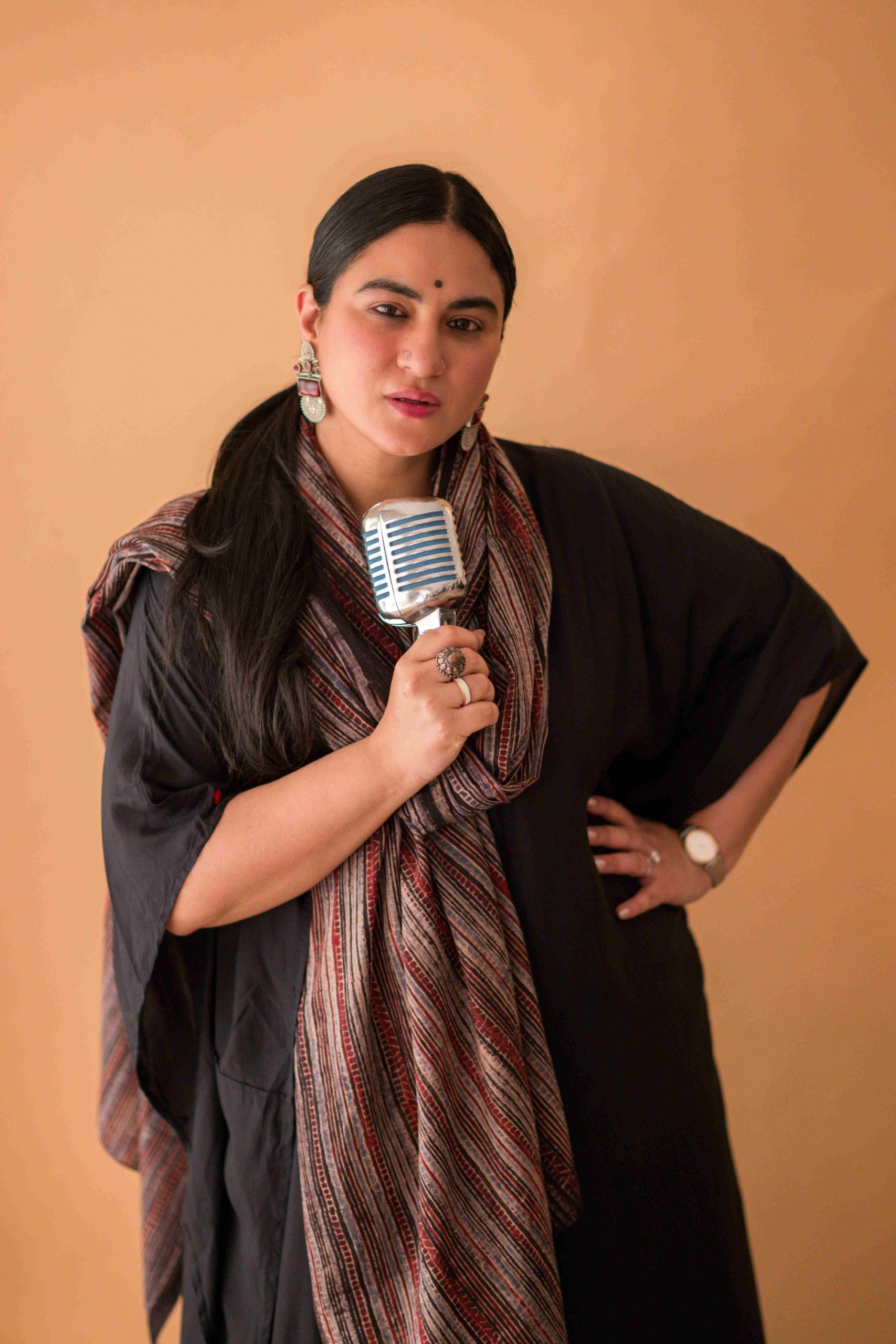
Priya Malik is a poet who does not merely recite verses; she inhabits them. With an enviable command of the English language, an effortless blend of wit and wisdom, and a remarkable ability to distil profound emotions into simple words, she has emerged as one of India’s most captivating spoken-word artists. Crisp in expression, compelling in delivery, and deeply relatable, Priya possesses the rare gift of forging an instant connection with her audience, making every performance feel less like a recital and more like an intimate conversation.
Born and raised in Dehradun, she studied at Carman School and Convent of Jesus and Mary, Dehradun, before earning an English Honours degree in India and a Master’s degree in Australia. Last month, Priya was in Lekhak Gaon, India’s first Writer’s Village in Dehradun to attend the Ruskin Bond Literature Festival, where we had a short chat with her.
You are such a multitalented person – poet, performer, speaker. Do you think these abilities were innate, or did you consciously work on polishing your rough edges to become the shining gem people admire today?
It has always been a blend of both. Creative people are born with a certain spark. You cannot teach a horse to swim, but you can certainly teach a fish to swim better. That has been the case with me.
I was born with a talent for words. In school, the only complaint teachers had about me was, “She is a very good student, but she is a chatterbox.” Almost every report card carried that remark. I was academically inclined, but somewhere along the way, I turned that complaint into a strength. My teachers recognised my flair for public speaking, and at CJM, they identified me as someone who thoroughly enjoyed debating and representing my school.
Over the last few years, I have consciously worked on honing my craft. I consider myself a perpetual learner. I am currently learning ghazal writing and studying Urdu because I often use Urdu words in my poetry. Talent may be innate, but refinement is always a conscious pursuit.
You wear many creative hats so effortlessly. Among acting, writing, and poetry, which medium gives you the strongest sense of self expression?
Poetry. I am a poet before anything else. Everything else was a distraction. When I started performing spoken-word poetry in 2017, it was not considered a viable career. To make a living, I was doing acting, television shows, and news anchoring. I even played a ‘Dayaan’ in a show on Star Plus to pay the bills. But I pursued poetry simply because I loved it.
I began writing when I was 12 years old, and my school teachers knew me as someone who wrote poems. Around 2020, brands started paying poets for commissioned pieces. Hindustan Unilever approached me for a brand collaboration and asked if I could deliver a poem within 24 hours. And I did. They offered a substantial budget, and that became a turning point in my journey. So, for the last six years, I have been nothing but a poet.
Behind every successful artist is a story of transformation. What were the ‘rough edges’ you had to work on to become the person you are today? And are you still working towards it?
I think the last few years have been one of the most beautiful phases of my life. I found the love of my life, got married, and became a mother. With all this, life changes you; it takes you inward. When I did Bigg Boss and Big Brother, I was more outward-looking. My eyeliner would be so bold, that was a form of self-expression. I was expressing myself through fashion. Now, I express myself through words.
I still have a very distinct sense of style, but I have gone more inward. Today, I focus more on who I am as a person rather than on what people think about me.
We would love to know more about your background and your connection with Dehradun. How does it feel to return here for events and performances?
Home is home. When I was growing up in Dehradun, all I wanted was to leave. I dreamt of moving to bigger cities. But once I left, all I wanted was to come back. You may leave Dehradun, but Dehradun never really leaves you. It stays within your system and becomes a part of who you are.
I value home far more today than I ever did before. Often, you only realise the true worth of something after you’ve been away from it. I love coming back and find every excuse to return.
The city has changed. There are new people, new aspirations, and new developments. Economic growth is wonderful, as long as a city does not lose its soul. We saw Dehradun in its gentler days. Today, it feels warmer and busier, with apartments rising everywhere. My home is on Rajpur Road, and there was a time when we could happily walk from Rajpur Road to Dalanwala. That feels almost unimaginable now.
Ironically, when you’re in Mumbai, you meet so many people from Dehradun doing exceptionally well in the film industry. It reminds you that no matter how far you travel, a part of you will always belong to the city that raised you.
From Dehradun to international stages, when you look back, what part of your journey feels the most surreal?
When I was in school, every annual function meant stepping onto the stage and reciting poems by celebrated poets. Recently, someone sent me a video of a young girl from Balaji International School reciting one of my poems at her annual function.
That moment was deeply emotional and beautiful for me. International tours and accolades are wonderful, but there is something profoundly moving about seeing your work being passed on to the next generation. Becoming a mother has changed the way I look at children and such moments. It makes you cherish them even more.
You’ve lived many lives: teacher, actor, poet, storyteller. Which version of Priya Malik feels the most authentic to you today?
Definitely the poet. It took me time to recognise who I truly am, but today I know poetry is where I belong.
Your poetry often speaks about love, heartbreak, identity, and womanhood. How much of your work is deeply personal?
Most of what I write comes from what I have lived, observed, or deeply felt. I don’t think I can write pure fiction. Although I am currently co-writing a film script, even that incorporates many elements drawn from real life.
I am most comfortable writing from lived experiences and genuine emotions.
Australia seems to have played a major role in shaping your artistic voice. How did living away from India change your relationship with language and identity?
Actually, India has had a far greater influence on my poetry than Australia.
I rediscovered the Indian in me only after moving abroad. When certain things are no longer around you, you begin to miss them more deeply. I found myself wanting to wear Indian clothes, celebrating Diwali and other festivals with greater fervour, and feeling increasingly drawn towards my roots.
Living away from India made me realise that I needed to be closer to where I came from. I truly believe you can only fly high when your roots are strong.
You chose poetry over conventional television success. Was that decision liberating, risky, or both?
It was definitely risky when I started because I had no idea whether poetry could become a sustainable career.
At that time, my husband, who was then my boyfriend, saw my work and said, “Actors toh bhare pade hain. You write differently.” That stayed with me. It made me pause and seriously think about what made me unique.
‘Right To Pleasure’ became a cultural moment in India. Did you realise while performing it that it would create such an impact?
Not at all.
It was originally written as a commissioned project for Cultural Machine, and I wasn’t even supposed to perform it. The plan was for Kalki Koechlin to recite it, but there were some issues.
I remember thinking, “This is such a powerful poem; maybe I should recite it.” And I did, with an open mind, and within a couple of days, it garnered millions of views.
That’s when I realised it had become much bigger than a poem. It had sparked an important conversation and evolved into a cultural moment.
Your work gives voice to difficult conversations around women, relationships, and societal expectations. Have you ever faced resistance for being so unapologetically honest?
You will always face resistance when you are trying to do something right. If you look at history, both culturally and historically, whenever someone has attempted to bring about meaningful change or stand up for what is right, there has been resistance. There have always been critics and haters. It is only a small part of the process. The love you receive, the appreciation you earn, and the adoration you get are far greater. You simply have to focus on that.
You’ve performed across the world. Do audiences abroad connect differently with your poetry compared to audiences in India?
Audiences abroad are hungry for Indian stories and poetry. They cry, and they connect deeply with the work. Having lived abroad for ten years, I know what it feels like to long for a slice of home.
We did a very successful show in London recently, which was perhaps the highest-selling spoken-word show. We had distinguished guests such as Gurinder Chadha, Akshata Murty (wife of Rishi Sunak), and Seema Anand in attendance, and it was a big cultural moment for me to see these people in the front row. We did a private show for the Mittal family. It was wonderful to witness how Indians abroad miss home and how well integrated the community is. It was an eye- opening experience for me. We took the show to Canada and Australia, but the UK was a very different experience. I would love to return to the UK and Canada for more performances, and we are already planning that very soon.
As someone often compared to Amrita Pritam, do such comparisons inspire you or create pressure?
It is deeply inspiring. Amrita Pritam is one of the biggest reasons I returned to India. Around the time I was contemplating moving back, Gulzar recorded her iconic poem Main Tenu Phir Milangi. When I heard it, Tenu became India for me. I suddenly felt a profound longing to come home.
That poem was not just literature; it was a deeply personal cultural moment that helped me make an important life decision.
Among all your poems, is there one piece that feels closest to your heart even today?
“2019 Mein 1999” was a life-changing piece for me. It is incredibly honest, simple, and effortless in its expression. Its beauty lies in its accessibility, it resonates with everyone.
Through it, I was also able to touch upon themes of feminism.
You became the first poet to walk the ramp reciting poetry at Lakme Fashion Week. How important is it for art to exist beyond traditional spaces?
It is extremely important to be different. Art must constantly evolve and find new spaces to breathe. If you do what everyone else is doing, you risk blending into the crowd; you will not stand out.
What would today’s Priya Malik say to the 12-year-old girl in Dehradun who had just started writing?
She has no idea what life has in store for her. I would tell her to find her own voice, remain consistent, and never create solely for fame, virality, or money. Everything else eventually falls into place.
What can we expect next from Priya Malik? What keeps you creatively restless even after achieving success across so many fields?
My book is finally finished: Ishq ke Saat Padaw. It comprises 52 poems.
Another English book, For Those Who Love Too Much, is also in the works.
I often look at Gulzar for inspiration. He is well into his nineties, yet he continues to write, perform, and recite poetry with the same passion. He could easily choose to rest, but he doesn’t. That relentless commitment to one’s craft is incredibly inspiring to me.
If your life had to be described in one line of poetry, what would it be?
Mujhe pyaar nahin ishq chaahiye.
Known for her soulful poetry that every woman can relate to on a personal level, Priya Malik is ready with her Hindi poetry book comprising around 52 poems. Very soon, she will be coming out with her English collection, For Those Who Love Too Much. She often looks to Gulzar for inspiration.
“He is well into his nineties, yet he continues to write, perform and recite poetry with the same passion. He could easily choose to rest, but he doesn’t. That relentless commitment to one’s craft is incredibly inspiring to me,” adds Priya.
She continues to weave beautiful words into poetry that readers return to, cherish, and carry with them.