All Around the World with the Most Travelled Indian
 By Nitin Gairola
How does one witness the rhino – that prehistoric beast that we all love? Well, when I was 6 years old, I saw a couple of them at the Lucknow zoo. At that time, I had no idea of what I was looking at, as I had no concept of what a rhino was or what the natural world was. At that time, we didn’t have the access to information as we have now, let alone the perspectives, worldwide views and wisdom which we can acquire more easily now through relevant exposure. It was many years later, as most regular readers of this weekly feature would know, that I started traveling the world and fell in love in particular with the natural world of animals and their habitats. So, I wanted to see the prehistoric rhino in its home, free from the captivity of a zoo.
Early on in our travels we went on multiple East African safaris and saw the incredible White and Black Rhino species in their homes. Surprisingly, I am yet to see the Great Indian Rhino in its natural habitat of Kaziranga ecosystem in far eastern India (it’s the 2nd largest species after the White Rhino). In fact, my mother has a fascinating tale from her childhood when she along with her two siblings (my aunt and uncle) were taken on a trip by my grandparents to Kaziranga National Park. Their jeep had come face to face with a rhino and, in a separate incident, with an angry male elephant blocking the hill side road. Not a comfortable situation to be in, but my granddad, being the military man that he was, took over the wheel from the driver and safely manoeuvred past the giant and in a way saved his family. Such is the power of memories created in the untamed wild that my mother, my aunt and my uncle remember these incidents very vividly over six decades on. The rhino is the shop stopper of Kaziranga.
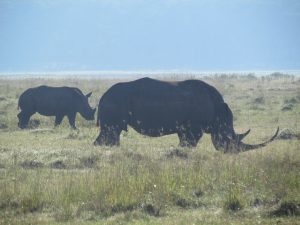
I have already mentioned in a previous feature on Lake Nakuru (do google it) just how incredible it was to see both the Southern White and the rare Black Rhinos for the first time in the wild in 2012 and in huge numbers – not just the odd one here and there. And while the ‘Southern White Rhino’ is more common (it’s the Northern White Rhino sub-species which is down to just 2 females) but to witness the very rare and heavily poached ‘Black Rhino’ was very fulfilling to say the least. And as I penned down earlier in the same feature, the White and Black species names have nothing to do with colour but simply the fact that the White Rhino has a ‘wide’ mouth and so thanks to the local accent it became ‘white’ and the other one doesn’t have a ‘wide’ mouth so it became ‘black’. The actual real difference is first the size (White Rhinos are huge) and the second is that they are grazers (designed to graze at the grass on the ground) whereas Black Rhinos are browsers (not the internet browsers but those animals who are designed to pluck leaves, etc., from trees and bush).
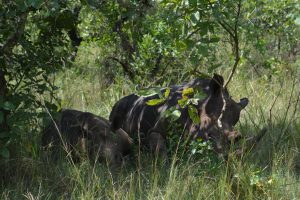
But as amazing as watching rhinos from a jeep was, I thought we should take it one notch up. How about tracking rhinos on foot? It sounded crazy at that time in 2016 when we had done only jeep safaris but not any walking safaris (now we are veterans), however we decided to go for it. There was great anticipation in the air that morning in Uganda as we met our guide, carrying a gun for a bit of assurance. The gun was strictly for the poachers and, as a last resort, to scare off the rhinos, should they charge at us. After about half an hour, our guide did track down the rhinos, but since it was already a bit late in the day, the mighty White Rhino family had gone to sleep under the shade of a tree. The largest male there was called ‘Obama’ and he was the first rhino born in Uganda 30 years after it went extinct in the country. And we saw Obama and it was heart pounding stuff no doubt, but not what we had anticipated. Honestly, a bit of a let-down and an anti-climax, but that’s how nature can be.
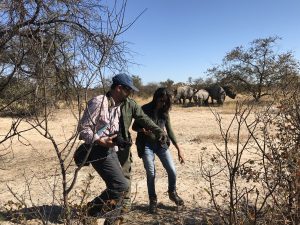
After that we saw rhinos in other traditional safaris but in our trip to Zimbabwe a few years later, we said to each other, let’s do it again – let’s track rhinos on foot. And by now we had done other walking safaris tracking gorillas & chimpanzees in dense jungles and lions & leopards in open grasslands and woodlands and that’s why we felt well prepared.
But this safari turned out to be, by far, our scariest. We were with a very nice young man named Sheppard (Sheppy for short) and he was taking us around Zimbabwe, from Bulawayo, in his car and we were enjoying all the stops which included ancient ruins, tribal villages, places with pre-historic rock art and more, till we were finally to be dropped at the train station for our onward journey to Victoria Falls.
Somewhere along the mini-trip within a trip, we were talking about rhinos and Sheppy said that he can do something about it. And surprise, we responded ‘let’s do it’. But little did I realise at that time that Sheppy wasn’t really a wildlife man. He was a city dweller but he did say he knew a ranger, who could take us into the bush for as little as 30 USD (around double today in rupee terms given the devaluation). Now in the world of walking safaris, 30 USD is not only cheap but it is so cheap that it is a red flag. It means that the ranger is just making a quick buck and because we gave the impression we didn’t have much, he thought this was the appropriate price to get the deal on an uneventful day. And so, I happily paid Sheppy who in turn was to pay the ranger – but first the ranger had to be tracked before we tracked the rhinos together.
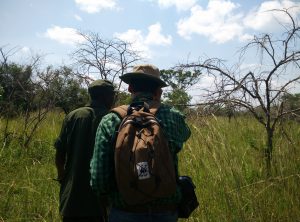
And just like that, we were out of the car and in the bush. My heart was already pounding and then Sheppy asked us to wait a bit till he found the ranger. Before I could tell him that we were going to follow him, he was gone. Suddenly we were alone and I asked Richa if we should head back to the car which was some distance away now. But we held ground for a while and listened to each and every sound and then, to our relief, Sheppy emerged back from the bush. He said he had found the ranger and the ranger was ready to take us to the rhinos. And so together we moved through the tall grass and thorny bushes to reach the ranger. He had a gun, so that was a really big relief and he seemed to know his work. First thing he did was to take some sand in the palm of his hand and then allowed it to sift through his fingers, slowly to the ground. This gave an understanding of where the wind was blowing. You see, rhinos have a great sense of smell and hearing, but very weak sight. So, to ensure they don’t smell us too early, we had to face against the direction of the wind, not towards it, which is what we suitably did.
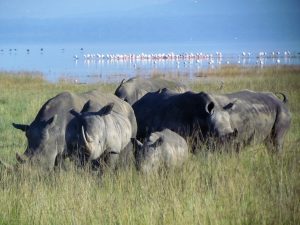
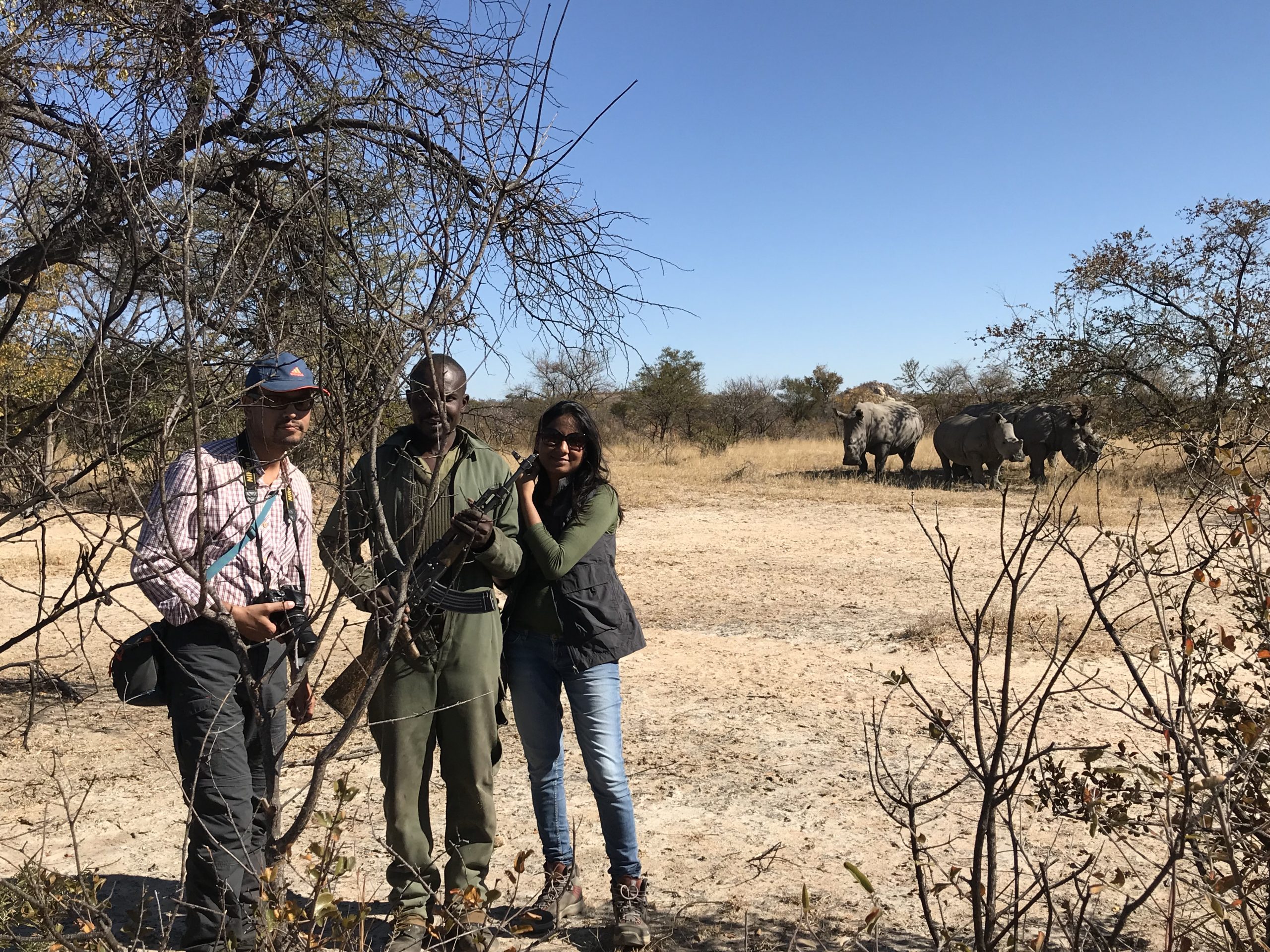
We also had to be very quiet and with that, we took one small step after another to reach as close as we could, which was around 20 metres, from a family of 5 or 6 with one calf. The rhino ears were ‘spinning’ in all directions to sense danger, given they were with a calf, and that is what I was fearing the most. Most animals are aggressive only when they are either hungry (rhinos are herbivores) or they feel threatened. This could have been the case for the latter. These were the longest 20 minutes and the shortest 20 metres of my life. For some reason, Richa was a lot more comfortable in this environment and wanted to stay longer. She even made me pose with the gun toting ranger, with the rhinos in the background and all I wanted to do was leave the place. Sheppy whispered a joke about me calling myself a big world traveller and being scared of the bush. We all had a silent laugh (remember we couldn’t make noise) and it is this little, unplanned side visit to see rhinos which become one of the highlights of the entire Zimbabwe visit. Frankly, today, it’s a stronger memory than admiring the majestic Victoria Falls even.
After that I have seen the rhinos a few more times in the wild but never like that day on foot, nor have I ever seen the heavily poached Black Rhino after the Lake Nakuru safari – way, way back in 2012. That memory is still so strong with the Black Rhino calf next to the mother and both peacefully munching their food, glad to be in the protection of a forest reserve. I sometimes do wonder what become of that mother and baby, given what is going on in the evil world of poaching and animal trafficking. But, in my naiveté, I believe the calf has grown and they are still peacefully munching on the abundant grass together.
Nitin Gairola, often considered the most travelled Indian, is from Uttarakhand and is on a quest to become the first person to travel to the entire natural world of every major desert, forest, grassland, tundra & ice biome on Earth, besides every major country. This multi-year project is called ‘Borderless Planet’ and Nitin has also set world travel records certified by India Book of Records, written for Lonely Planet, holds National Geographic conservation certifications, studies bio-geography & zoology and is a senior corporate executive in an MNC. He is a published writer & poet as well. Join him @ www.instagram.com/MostTravelledIndian/